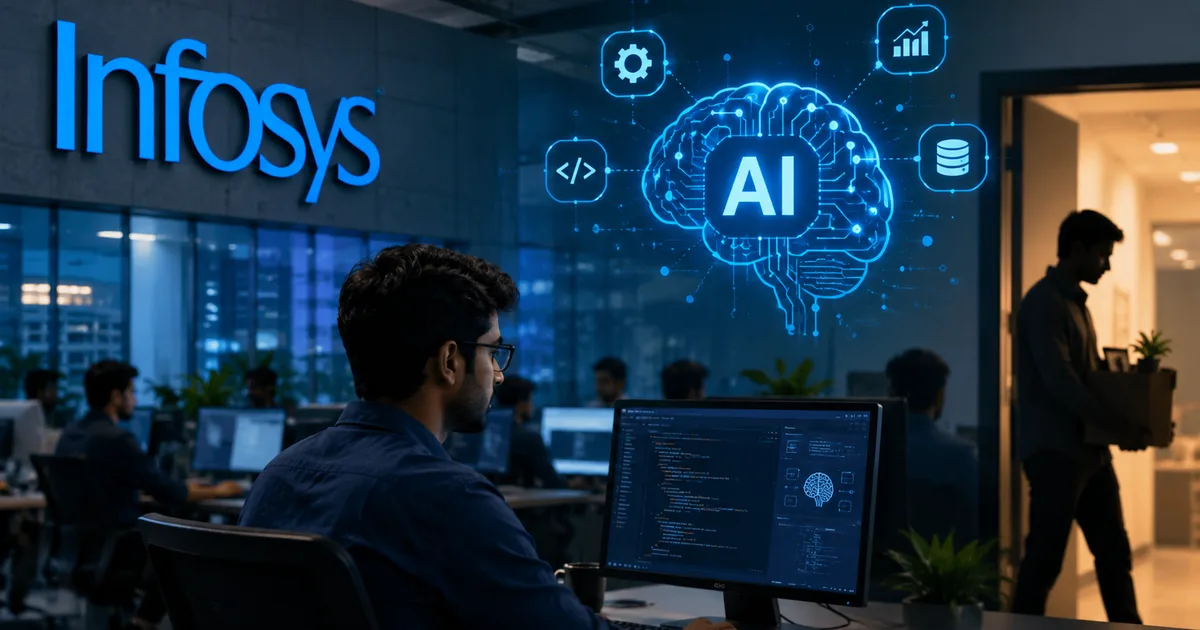
The Indian IT sector is going through a massive mutation right now. If you work in tech, you need to pay attention to what's happening on the ground in Bengaluru and Pune. We've spent years hearing executives talk about generative AI as some abstract future concept. But looking at Infosys CEO Salil Parekh's recent moves and the company's August 2026 data, the reality of generative AI's impact on Indian IT jobs and fresher hiring is finally crystal clear. It's no longer a pilot project. It's the new baseline.
Let's look at the actual numbers because they tell a story that PR statements usually hide. Honestly, the scale is a bit crazy. Infosys, along with TCS and Wipro, didn't just run a small test with AI tools. They aggressively expanded their Microsoft 365 Copilot rollout to over 3 lakh employees combined. Infosys alone pushed this tool to more than 100,000 of its people. And these employees aren't just letting the software gather dust. The company reports a monthly active usage rate of over 91 percent.
Think about the scale of that for a second. A hundred thousand people at one single company are actively generating prompts and relying on an AI assistant almost every single day. (It's a lot to process, actually.) You can read more about these industry-wide shifts in our Latest Tech News section. The short version is simple. The way Indian IT companies deliver code and service global clients has permanently changed in just six months.
The financial reality of AI adoption
A massive criticism of the AI boom over the last two years was that it generated endless hype but zero actual revenue. In my experience, skeptics love pointing this out. Infosys essentially proved that theory wrong in their Q1 FY27 results. Artificial intelligence services contributed a highly specific 8.2 percent to their total revenue. That's real money in a $1.5-trillion global tech services industry.
They managed this while keeping an operating margin of 21.1 percent, and their overall profit rose 12.2 percent year-over-year. They are making money from AI because their clients are actively demanding it. Every major bank in New York wants AI integrated into their legacy systems. And the massive retailers in London want the exact same thing. Indian IT companies are the ones securing the contracts to build those integrations.
Infosys is aggressively packaging these capabilities through their Topaz platform. Topaz is a suite of AI-first services and solutions that they embed into existing client workflows. It is far more than a simple software product. When Salil Parekh talks about the tech services industry, he's talking about the massive, multi-year contracts required to implement platforms like Topaz. Look, legacy Fortune 500 companies can't simply buy a basic subscription and call it a day. They need Infosys to completely rewire their internal data structures so the AI can actually read their proprietary information securely. That rewiring process requires thousands of highly skilled human engineers. (Which makes sense, actually.)
But there are other financial pressures forcing this rapid shift. Infosys took a massive Rs 1,289 crore hit recently due to new labour codes. When compliance and baseline employee costs jump that drastically, service companies have to protect their margins. They do that by automating the low-level tasks that used to require thousands of junior developers. It's basic corporate economics.
What this means for the average IT job
When a rival like Wipro publicly states their employees generate 7.5 million prompts a month and save 250,000 full-time equivalent workdays every quarter, IT workers understandably get incredibly nervous. That statistic sounds like a massive threat to job security. The numbers here are a bit fuzzy, but TCS is openly reporting 20 to 25 percent productivity gains in research and content-heavy tasks. They also see a two-fold improvement in generating business insights.
So, are these companies preparing to fire a quarter of their workforce? Honestly, no. I don't see mass layoffs of that scale happening because the overall volume of work is also growing. But the profile of who they want to hire and retain is shifting aggressively.
If you look at the Zoho CEO Sridhar Vembu 2026 Statement: AI's Impact on the Indian Tech Job Market Explained, you notice a consistent theme across the industry. The demand for raw, basic coding skills is dropping fast. But the demand for people who can manage AI agents and architect complex solutions is shooting up.
This shift is impacting mid-level management as well. It's a mess out there for some folks. Five years ago, a team lead spent a massive chunk of their week reviewing pull requests to catch basic syntax errors or logic flaws. Today, the AI tools catch the syntax errors before the code is even committed. The team lead's job has mutated from a code checker to a system architect. They now have to evaluate whether the AI-generated solution actually solves the business requirement efficiently. And they have to check whether it introduces subtle security vulnerabilities that a human might have caught. If a mid-level manager can't adapt to reviewing AI output at a massive scale, they will find their role redundant very quickly.
Nandan Nilekani made a statement recently that captures this dynamic. He said AI will amplify companies that adapt fast, instead of replacing them. That exact same logic applies to individual developers. The mid-level engineer who figures out how to use Copilot to clear their sprint backlog in half the time is the one getting the promotion. The developer refusing to adapt and insisting on writing every line manually is going to struggle to justify their billing rate.
The brutal truth for freshers in 2026
If you are graduating from an engineering college in 2026 or 2027, the traditional mass recruitment model is mutating right in front of you. If you ask me, it's terrifying for students. For a very long time, the playbook was highly predictable. Get your degree, learn some basic Java or Python, get hired by a mass recruiter, and spend your first six months on the bench getting trained on the company dime.
That bench is getting dramatically smaller.
Companies simply don't want to pay a fresher for six months to learn syntax that an AI can generate instantly without typos. Infosys expects incoming hires to hit the ground running with an understanding of how to work alongside these modern systems.
This trend extends far beyond Infosys. We saw very similar, cautious hiring trends when reviewing the HCLTech Q1 2026 Results: AI Growth & Fresher Hiring Outlook. Companies are absolutely still hiring. But they are hiring much more selectively.
They want freshers who understand prompt engineering. They want graduates who know what an AI agent is and how it interacts with an API. If your final year college project was just a basic CRUD application built from a YouTube tutorial, that won't impress a recruiter anymore. An AI can build that exact app in exactly three seconds. You have to demonstrate that you can solve complex business problems, rather than just mechanically typing out code.
A massive leadership transition
This intense AI focus is also driving decisions at the absolute highest levels of the company. Infosys just announced a massive leadership change. Ashiss Kumar Dash has been appointed as the CEO designate. He will officially take over the top job from Salil Parekh on April 1, 2027.
Parekh is largely credited with stabilizing the company over his nine-year run. Dash is coming in with a highly specific mandate. He is a three-decade veteran of the company, currently heading up the Services, Utilities, Resources, and Energy verticals. He isn't an outsider coming in to break things. But his focus is clear.
In his prepared statement about the appointment, Dash ignored traditional service delivery talking points. He said technology is entering a new era. AI is reshaping how businesses operate and create value. He explicitly stated his commitment to accelerating innovation and helping clients succeed in an increasingly AI-driven world. This goes far beyond a standard marketing script. It is the literal core business strategy for Infosys for the next ten years.
How you must adapt your career right now
For the average Indian IT professional, whether you have two years of experience or ten, this transition phase is incredibly stressful. Reading the headlines from the July 2026 Tech Layoffs: AI Automation's Impact on IT Jobs proved that absolutely no one is entirely safe from these structural shifts. (Annoying, I know.)
But you have options. There are concrete ways to protect your income and your career trajectory.
First, stop ignoring the internal AI tools your employer provides. If you have a Copilot license sitting unused on your machine, you're making a massive mistake. Open it. Use it daily. Figure out exactly how it breaks and where it actually saves you three hours of tedious work. You need to become the person on your team who knows how to fix the AI's inevitable mistakes.
Second, understand that the pure, mechanical delivery of code is rapidly becoming commoditized. The financial value of a developer is shifting. It's moving left towards understanding the actual business problem and designing the architecture. It's also moving right towards deploying and maintaining the solution in the cloud.
Survival skills you actually need
If you want to stay relevant in this market, you have to adjust your skill set today.
- Learn how to interact with large language models properly. Writing a highly effective prompt is an entirely different skill from typing a Google search query. Wipro employees are generating millions of prompts a month for a reason.
- Focus heavily on data privacy and enterprise security. When an AI agent processes sensitive client data, the security risks multiply exponentially. Knowing how to secure these automated pipelines makes you incredibly valuable.
- Develop deep, specific domain expertise. An AI model doesn't naturally know the highly specific, messy regulations of Indian retail banking or US healthcare compliance. If you understand the business domain better than the machine, you are safe.
- Check out our Tech Explainers for detailed breakdowns on how these specific enterprise systems actually talk to each other.
The bottom line
The Indian IT sector has survived massive disruptions before. It survived the 2008 global financial crisis and the painful transition to cloud computing. It'll absolutely survive generative AI.
Salil Parekh and incoming CEO Ashiss Dash clearly see this technology as a massive opportunity for revenue growth. They don't view it as a signal to pack up the industry and go home.
But the days of comfortable, quiet IT jobs where you write predictable boilerplate code for eight hours a day are ending fast. I'm not sure exactly why it happened so suddenly, but client expectations are drastically higher now. The software tools are incredibly powerful, and your managers expect you to use them to produce significantly more output in less time.
It's a tough, uncomfortable adjustment.
Honestly, it's going to catch a lot of complacent developers completely off guard. You just have to learn to manage the AI instead of trying to compete against it.