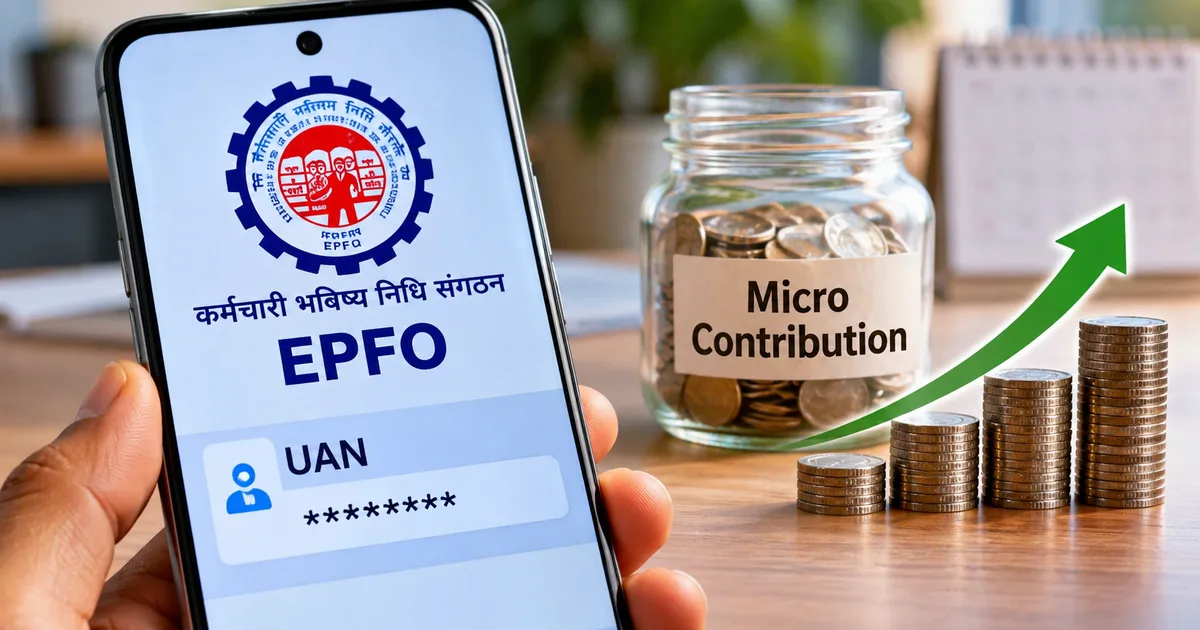
Picture this. You just finished a freelance design project over the weekend, and Rs 15,000 lands in your bank account. You feel oddly responsible today, so you think, why not drop Rs 5,000 straight into my Provident Fund account so I don't blow it on Swiggy orders and sneakers? Under India's current system, you just can't. Now that might finally change because of the EPFO UAN-linked micro-contributions proposal tabled at the retirement body's big November 2026 board meeting.
Right now, your Employees' Provident Fund (EPF) account is basically a locked steel gullak. Only your company's HR team has the key to drop coins in. Even though the money is yours and the account sits under your name, you have zero way to open PhonePe or net banking on a Sunday afternoon and top it up yourself (annoying, I know). Everything has to pass through your employer's monthly salary software.
Honestly, that's a mess. In a country where you pay Rs 12 for cutting chai using a QR code in three seconds flat, this whole setup has felt painfully outdated for years, if you ask me.
So when the Central Board of Trustees (CBT) of the Employees' Provident Fund Organisation met in New Delhi on 19 November 2026, one quiet line tucked inside their reform agenda grabbed attention fast. Alongside the big retirement withdrawal changes, EPFO proposed letting members and even third parties send voluntary deposits and tiny micro-contributions straight into a PF account using just a Universal Account Number (UAN). Employer payroll doesn't even have to be part of the loop.
What the EPFO 240th CBT meeting actually proposed
Union Labour and Employment Minister Dr. Mansukh Mandaviya chaired the 240th CBT meeting. Labour Secretary Dr. Chandra Bhushan Kumar was there too, along with Central Provident Fund Commissioner Ramesh Krishnamurthi. Most news channels ran straight with the retirement payout story, and I get why. The Systematic Withdrawal Plan (SWP) is a huge shift on its own.
Under the approved SWP framework, retiring members won't have to pull out their entire life savings in one giant lump sum. They can pick monthly or quarterly instalments instead, or go with half-yearly payouts, while the untouched balance keeps earning EPF interest. Around 6.32 lakh members above age 55 who have balances over Rs 5 lakh are expected to benefit first. The board also dropped the minimum balance requirement during withdrawals from 25% down to 10%. And they cut the waiting period for final settlement from 12 months to just two months.
'The proposal also seeks to introduce UAN-linked mechanisms for voluntary contributions and third-party micro-contributions, including customer tips, independently of traditional employer payroll systems.'
Read that line again. Independently of traditional employer payroll systems.
That single sentence is a huge shift in how EPFO thinks about Indian workers, I think. In its official 19 November 2026 press release, PIB noted that EPFO has already been widening coverage. It even pushed the wage ceiling for mandatory EPF coverage from Rs 15,000 to Rs 25,000 (you can read our breakdown of EPFO wage ceiling delay rules to see how that piece fits in). Moving from employer-only deposits to UAN-linked direct deposits is the logical next step.
Still, don't get ahead of yourself yet. Upstox and Livemint pointed out right after the meeting that only the proposal has board-level backing right now. The actual software isn't live. Neither are the payment limits or the formal government notification, and honestly, I'm not sure how long the paperwork will drag on.
How direct PF deposit via UAN works under the hood
To see why this proposal matters, look at how your PF money actually moves today. Every month, your company cuts 12% of your basic pay plus dearness allowance and adds its own matching share. Then HR uploads a giant digital spreadsheet called the Electronic Challan-cum-Return (ECR) to the EPFO portal. Your money doesn't go from you to EPFO. It goes from your employer's corporate bank account, gets tagged to the company's Establishment ID, and finally lands inside your Member ID.
Thing is, if you don't have an active employer filing an ECR for you, that whole pipe runs dry.
EPFO first brought in the 12-digit Universal Account Number (UAN) to stitch together multiple Member IDs whenever you switched jobs. Think of your Member IDs as separate folders from old jobs at TCS or Infosys, plus whatever Pune startup you joined next. Your UAN is the master filing cabinet holding them all together. Until now, though, that UAN couldn't act as a direct receiving address for incoming cash.
Look, under this proposed UAN-linked mechanism, EPFO wants to flip that plumbing around. Rather than shoving every rupee through a company payroll file, your UAN works more like a dedicated savings account number or a verified UPI handle tied to your Aadhaar and PAN. You, or an approved third-party platform, just initiate a payment tagged straight to that UAN. EPFO's backend then drops the money right into your provident fund ledger.
It sounds almost too simple to have taken this long (which is classic government tech, really). But in my experience, tearing apart legacy databases built decades ago around factories and salaried mills is brutal work. Separating a worker's identity from their employer's payroll code is a massive architectural rewrite.
Why gig workers and freelancers stand to gain the most
India's workforce in 2026 doesn't look anything like 1995. Millions of people drive for Uber and Rapido, drop off groceries for Blinkit and Zomato, fix ACs through Urban Company, or run solo consulting businesses off a laptop in Indore or Kochi. Formal payroll just doesn't exist for them.
And even among younger salaried workers, job hopping and career pivots are totally normal now. We saw that clearly when covering EPFO Gen Z workforce trends. Plenty of 26-year-olds work at an IT firm for two years and get a UAN. Then they quit to prep for UPSC or build a freelance career, and I've seen way too many watch their PF account sit frozen with zero new deposits.
With UAN-linked voluntary deposits, a person on a career break or working on their own can keep feeding their retirement fund whenever a good month rolls in. Got paid Rs 40,000 by a client in November? Drop Rs 3,000 into your UAN. Had a slow December? Put in zero. No HR approvals, and no fixed monthly cuts choking your cash flow.
The customer tip micro-contribution idea
Here's the part of the proposal that genuinely surprised me. Honestly, I think it's one of the smartest fintech-meets-policy ideas to come out of a government board in a while. The CBT specifically mentioned third-party micro-contributions, and yes, that includes customer tips.
Think about how a Rs 20 or Rs 30 tip works when you order biryani on a rainy evening in Mumbai. Today, that Rs 20 lands in the delivery partner's weekly payout and vanishes almost right away into petrol or tea. Nobody takes Rs 20 and walks into a bank to open a retirement deposit.
Now picture an optional toggle inside a gig worker's partner app. Every time a customer leaves a Rs 20 tip, or every time the worker finishes ten rides, the app automatically sends a tiny slice straight to the worker's UAN. Over a single day, Rs 40 feels invisible. Over 25 working days a month, that's Rs 1,000. Over 20 years of EPF compounding, those tiny invisible tips turn into a real safety net.
Of course, this has to stay 100% voluntary. A gig worker trying to pay Rs 8,000 in rent this week needs liquid cash first, not locked-up retirement money. If apps try to force automatic deductions without clear consent, workers will push back hard.
How voluntary PF contribution without employer payroll changes things for salaried staff
Wait, what if you already have a regular corporate job with a normal salary slip? You're probably wondering why you should care when the Voluntary Provident Fund (VPF) is already around.
If you've ever tried using VPF at an Indian company, you already know the headache. Most HR teams only open the VPF declaration window once a year in April, or maybe twice if they're feeling generous (which makes zero sense in 2026, if you ask me). Once you pick a percentage, say 8% extra on top of your mandatory 12%, your salary shrinks by that fixed cut every single month until the next window opens.
Real life doesn't work in neat monthly percentages. Maybe you can't spare an extra Rs 8,000 in July when school fees are due. Then March hits and you get a Rs 75,000 performance bonus. Suddenly you want to park Rs 30,000 in a safe, government-backed debt option. Direct UAN deposits solve that problem cleanly. Your mandatory 12% keeps running through payroll, and you top up extra money on your own schedule.
One quick heads-up before anyone gets carried away. Direct voluntary top-ups will almost surely flow into your EPF savings balance. They won't magically upgrade your monthly pension under the Employees' Pension Scheme (EPS-95). Pension math follows strict employer-contribution rules and legal caps, just like we saw in the EPFO higher pension verdict. Don't expect a self-funded Rs 5,000 deposit to bump up your EPS pension payout unless the final notification spells out a brand new pension track.
How CITES 2.01 and India's digital payment rails make this possible
Why didn't EPFO build this five years ago? Simple. Its old IT backbone just couldn't handle millions of tiny, irregular deposits.
For years, EPFO ran on decentralised regional servers. Your PF account lived inside a specific regional office database, like Bengaluru Whitefield or Mumbai Bandra. Moving money or merging accounts across offices meant slow batch files and manual sign-offs, which caused endless portal timeouts. (If you've ever tried logging into the Unified Portal on a Monday morning and stared at a spinning wheel for ten minutes, you know the pain.)
In its November 2026 release, PIB talked about rolling out CITES 2.01 (Centralised IT Enabled System 2.01). By ditching fragmented regional office servers for one central database anchored around the UAN, EPFO finally has the backend to process individual-level transactions at scale.
Now pair that central UAN ledger with India's existing digital rails like UPI and Aadhaar-seeded KYC. Add the Bharat Bill Payment System (BBPS) to the mix, and the pieces click. EPFO hasn't officially said which payment rails it's plugging into first, and the technical details here are still pretty fuzzy. I couldn't find a confirmed circular naming UPI AutoPay or BBPS yet. Still, in my view, anyone who builds payment software in India knows that routing Rs 20 or Rs 50 micro-contributions economically is basically impossible without zero-fee UPI rails. If a payment gateway takes Rs 2 on a Rs 20 tip, the math collapses on day one.
What is still missing before you can send a single rupee
Look, here's the deal: right now, you can't transfer money to your UAN. Don't waste twenty minutes hunting through the UMANG app or the EPFO Member Passbook portal for an 'Add Money' button. It isn't there yet.
Between a CBT board approval in principle and an actual working button on your phone, several concrete policy pieces still have to be finalised and published in the Gazette of India:
- Official minimum and maximum transaction limits for direct UAN deposits and third-party micro-contributions.
- Clear rules on how EPFO calculates monthly interest on mid-month ad-hoc deposits, since EPF interest traditionally tracks monthly running balances.
- Operational guidelines on whether people who have never held a formal corporate job can generate a fresh UAN purely for self-contributions.
- Platform onboarding rules for aggregators like food delivery, ride-hailing, and e-commerce apps that want to route customer tips or worker incentives.
- Clarity on withdrawal lock-ins for self-deposited money compared to traditional employer-routed PF funds.
Tax rules and interest caps remain unanswered
This is the big one for salaried professionals in the 30% tax bracket. Under current Indian Income Tax rules, interest earned on employee EPF contributions over Rs 2.5 lakh in a financial year gets taxed. That threshold rises to Rs 5 lakh a year only if no employer contribution is going into the fund.
So what happens if you earn a salary where your mandatory 12% already puts Rs 1.8 lakh into EPF, and then you manually deposit another Rs 1 lakh via your UAN? Almost certainly, the extra Rs 30,000 above Rs 2.5 lakh will trigger taxable interest. EPFO's CITES 2.01 backend will have to split your passbook into taxable and non-taxable buckets automatically. What about Section 80C deductions under the old tax regime? I'm not sure how they'll treat that yet. Until the Finance Ministry and Central Board of Direct Taxes weigh in, nobody can give you a 100% guarantee on tax perks for direct UAN top-ups.
Watch out for fake UAN top-up links right now
Whenever EPFO announces a big change, scammers move way faster than government IT departments. We already see sketchy KYC update texts and fake PF withdrawal links going around on WhatsApp every single week. That's why we track every new scam closely in our online financial scam alerts section.
Honestly, I expect scammers to start firing off SMS messages and WhatsApp forwards claiming you can 'activate UAN Direct Deposit' or 'claim extra PF interest' by tapping a short link and typing in your Aadhaar OTP. Ignore all of them. Until EPFO publishes an official circular on epfindia.gov.in and turns the feature on inside the verified UMANG app or Unified Portal, any website asking you to send money to a UAN via UPI is a scam. Plain and simple.
If you like keeping up with how India's payment and retirement systems actually work behind the scenes, browse our other digital finance tech explainers. For now, just keep your UAN Aadhaar-seeded and your bank KYC updated (it'll save you a headache later). Whenever EPFO flips the switch on direct micro-contributions, clean KYC is the first thing the system will check.