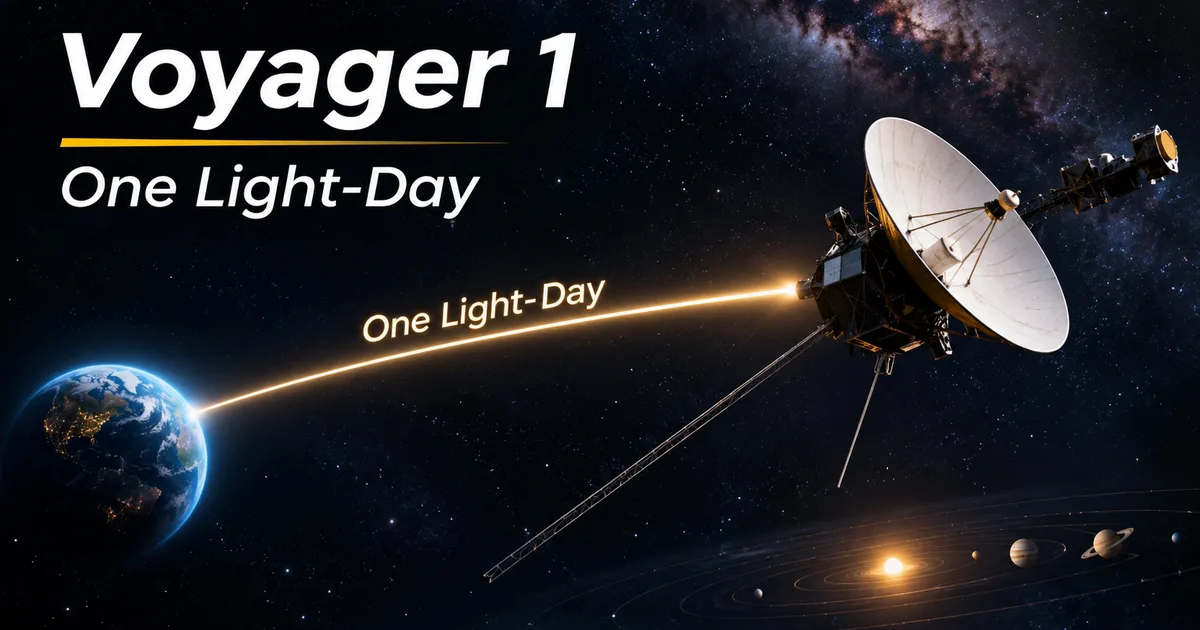
You know that mild panic when a UPI payment sits on the loading spinner for six seconds, or a WhatsApp voice note refuses to download on a crowded local train? We lose our patience in seconds. Now try wrapping your head around a message that takes a full 24 hours just to reach the receiver, and another 24 hours to bring back an 'okay'. That is the exact reality behind the one light-day milestone that NASA's Voyager 1 spacecraft crossed on November 18, 2026, at 3:46 p.m. IST.
Voyager 1 launched nearly 50 years ago, and it's now the first human-made object to get that far from home. The headlines sound wild. Honestly, though, the math behind it is pretty straightforward once you break it down. If you enjoy plain-English tech explainers, grab some evening chai and stick with this for a few minutes, because the numbers here put cosmic distance and modern engineering into real perspective.
What does one light-day from Earth actually mean?
First off, a light-day is a distance, not a unit of time. People trip over that constantly. Which makes sense, actually, because the word 'day' is sitting right there in the name.
In a vacuum, light moves at around 300,000 kilometres per second, or roughly 186,000 miles per second. Nothing in the universe moves faster. Think about the road trip between Mumbai and Delhi, which is about 1,400 kilometres. A beam of light could shoot from Mumbai to Delhi and bounce back more than 100 times in one second (pretty wild when you picture it).
Now let that beam run nonstop for 24 hours. Multiply 300,000 kilometres per second by 86,400 seconds in a day, and you get roughly 25.9 billion kilometres, or 16.1 billion miles. That huge stretch of empty space is one light-day. Voyager 1 crossed that invisible line at 5:16:07 a.m. EST (3:46:07 p.m. IST) on November 18, 2026, after spending 49 years and two months flying away from us.
Look at how long a beam of light takes to hit other stops in space:
- Light leaves Earth and hits the Moon, where ISRO landed Chandrayaan-3, in just 1.3 seconds.
- Sunlight takes a little over eight minutes to travel from the Sun to your rooftop in Chennai or Jaipur.
- A beam of sunlight needs roughly four hours and 10 minutes to reach Neptune, the farthest major planet in our solar system.
- From Neptune, that exact same beam still has to travel another 20 hours before it catches up with Voyager 1.
Even out there, Voyager 1 has barely stepped past our front gate. One light-year, the distance light covers in a full year, is about 9.46 trillion kilometres (5.88 trillion miles). Voyager 1 spent nearly 50 years covering just 1/365th of that distance. If you ask me, that's the detail that really messes with your head. Space is huge, and our fastest machines barely crawl.
How the 48-hour signal delay works in practice
Spacecraft don't run on fibre cables or 5G towers. They talk to Earth using radio waves, and radio waves move at the exact speed of light.
So when NASA engineers in California want to send a command to Voyager 1, they fire a radio signal through massive satellite dishes in the Deep Space Network. That signal travels through the dark for 24 full hours before Voyager 1's antenna picks it up. When the spacecraft replies, its faint radio signal spends another 24 hours flying back to Earth.
That adds up to a 48-hour round trip for a single 'did you get my last command?' check. Think about what that means for anyone in IT. When a website crashes or a server stalls, you restart it and check the logs five seconds later. NASA's Voyager team can't debug anything live. If they push a software patch on Tuesday afternoon, they sit around until Thursday afternoon just to find out whether the spacecraft took it (annoying, I know, especially when something's acting sketchy).
Contrast that with satellites orbiting closer to home. Take the ISRO-NASA NISAR satellite mission, which watches Earth's surface and ice sheets from low Earth orbit. Signals to and from NISAR travel in milliseconds. It's basically the same delay you get on a video call from Bengaluru to London. Voyager 1, I think, is stuck on a two-day postal cycle.
And that signal is shockingly weak by the time it reaches us. Voyager 1 is roughly the size of a Mini Cooper, and it runs on decades-old plutonium power cells that lose a bit more juice every year. Picking up its radio signal from 25.9 billion kilometres away takes some of the largest, most sensitive dish antennas on the planet. They all have to listen at once just to pull a tiny signal out of cosmic background noise.
Inside Voyager 1's 49-year journey into interstellar space
Here's the wild part. Voyager 1 wasn't supposed to last anywhere near this long. NASA launched it on September 5, 1977 (right when the original Star Wars movie was in theatres), with a primary mission of just four years. Its original job was simple enough: fly past Jupiter and Saturn to snap close-up photos and gather data on their moons and rings.
Once those planetary flybys finished, Voyager 1 didn't stop. Because there's practically no air resistance or friction in deep space, whatever speed a rocket and planetary gravity boosts give you stays with you. Today the spacecraft tears through the dark at roughly 37,800 to 38,000 miles per hour (around 61,000 km/h). That's faster than any bullet or fighter jet. Because of that faster path, it actually overtook its twin spacecraft Voyager 2, which had launched 16 days earlier.
Crossing the heliopause and the Pale Blue Dot
Before it left our planetary neighbourhood behind, Voyager 1 turned its cameras back toward Earth on Valentine's Day in 1990. Astronomer Carl Sagan had pushed NASA hard to take that photo. Engineers were nervous about it, though, because aiming sensitive cameras toward the inner solar system might've fried the optics.
That photo became famous as the Pale Blue Dot. Earth showed up as less than a single pixel, just a tiny speck sitting in a sunbeam. Look, if you ever get worked up over office politics or noisy social media fights, pulling up that 1990 photo puts things in perspective faster than any meditation app, in my experience.
Then in August 2012, Voyager 1 crossed the heliopause. That's the boundary where the Sun's protective bubble of solar wind and magnetic fields gives way to the cold gas and cosmic rays of interstellar space. No human machine had ever made it outside the Sun's bubble before.
'Traveling a light-day is a singular feat for a spacecraft, but Voyager is so much more than a distant traveler. The Voyager mission would be remarkable just for what it contributed to planetary science with the Grand Tour of the outer planets, but it went on to become central to NASA's fleet of heliophysics missions offering insights into the star that we all revolve around, the Sun.' - Joe Westlake, Director of NASA's Heliophysics Division
Mounted on the side of the spacecraft is a 12-inch, gold-plated copper disc called the Golden Record. Chaired by Carl Sagan's committee, it has spoken greetings in 55 human languages, music from Mozart to Chuck Berry, recordings of a baby crying and a whale singing, plus a cosmic map locating Earth with 14 pulsars. It's basically a message in a bottle tossed into an ocean we haven't even figured out how to map.
Current spacecraft status and the communication glitch
If you followed the latest tech news around November 18, you might've noticed a worrying twist right next to the celebration. Just days before hitting the one light-day mark, Voyager 1 ran into a technical glitch and stopped sending usable science and engineering data back to Earth.
Thing is, the situation is a bit of a mess right now, so let's separate what's confirmed from what's still murky. Engineers at NASA's Jet Propulsion Laboratory (JPL) did receive a basic radio signal from Voyager 1 early on November 19, almost exactly 24 hours after the spacecraft crossed the milestone. That signal confirms the spacecraft still has power and keeps its antenna pointed toward Earth on course. But it hasn't sent back readable science telemetry or health diagnostics since the glitch started. And the timeline for when full data will come back is still fuzzy, because NASA hasn't shared a firm public date yet.
Fixing a 1970s computer from 25.9 billion kilometres away is slow, stressful work. Back in 2023 and 2024, JPL engineers spent months troubleshooting garbled memory chips on Voyager 1 before getting its instruments back online. With a 48-hour wait between every test command and reply, diagnosing this latest fault is going to take plenty of patience. You can't just walk over and press a reset button.
As for where it goes next, Voyager 1 is drifting roughly toward a star named AC +79 3888 (also known as Gliese 445), which is more than 17 light-years away. I think it's wild that we can even track something out at that range. Its twin, Voyager 2, is still trailing behind and won't reach the one light-day milestone until November 2035.
Why 1977 engineering still hits differently today
Whenever stories like this pop up, I can't help comparing them to the gadgets on our desks. Half of us buy a Rs 25,000 or Rs 60,000 smartphone knowing the battery's going to sag after three years (usually right after the warranty ends), or that software updates will make it feel sluggish in four. We spend hours reading practical tech guides just trying to squeeze one extra year out of a laptop or a flaky Wi-Fi router.
Meanwhile, engineers in 1977 built a spacecraft with less memory than a cheap digital watch and strapped it to a plutonium battery. Then they sent it into radiation levels nobody had ever tested long-term. Nearly 50 years later, through freezing darkness and a 48-hour signal lag, Voyager 1 is still pinging home. Even if its science instruments stay quiet for a few weeks while JPL untangles this glitch, I'm not sure modern hardware will ever match that kind of stubbornness.