I've been looking at my phone a lot lately. The absolute mess that's the current state of WhatsApp forwards is wild. The fake Ayushman Bharat PMJAY 2026 Golden Card WhatsApp scams are everywhere right now. You've probably seen one. Your parents have definitely seen one too. They usually promise instant approval for the free health insurance card. And they want you to click a link to register immediately before some fake deadline expires.
Honestly, this is one of the more vicious scams circulating in India today. Out-of-pocket expenses for healthcare in India crush families every single day. A sudden hospital admission can easily wipe out years of savings (which makes sense, actually, given medical inflation). That's why the Pradhan Mantri Jan Arogya Yojana (PMJAY) is so popular. It has up to Rs 5 lakh per family per year for secondary and tertiary care hospitalization. It's a lifeline. But wherever there is a massive government program with high demand, scammers are right there to exploit the confusion.
People are struggling with medical bills. So when someone offers a government-backed solution, they jump at it. Scammers know this. They prey on desperation. They are using the real scheme as a hook to empty bank accounts via UPI and steal Aadhaar details. We cover a lot of scams here. But the ones targeting healthcare always make me angry. I think tricking someone into buying a fake pair of shoes is bad enough. Robbing a family trying to secure medical treatment is pure evil.
I am going to break down exactly what this scam is. I will also show you how it works and how you can protect your money.
What the Ayushman Bharat WhatsApp scam actually is
The setup is simple. It's also highly effective. You get a message on WhatsApp from an unknown number. Sometimes it even comes from a friend or relative who fell for the scam and forwarded it to their entire contact list. That happens because the fake website told them to "Share with 5 groups to activate your card."
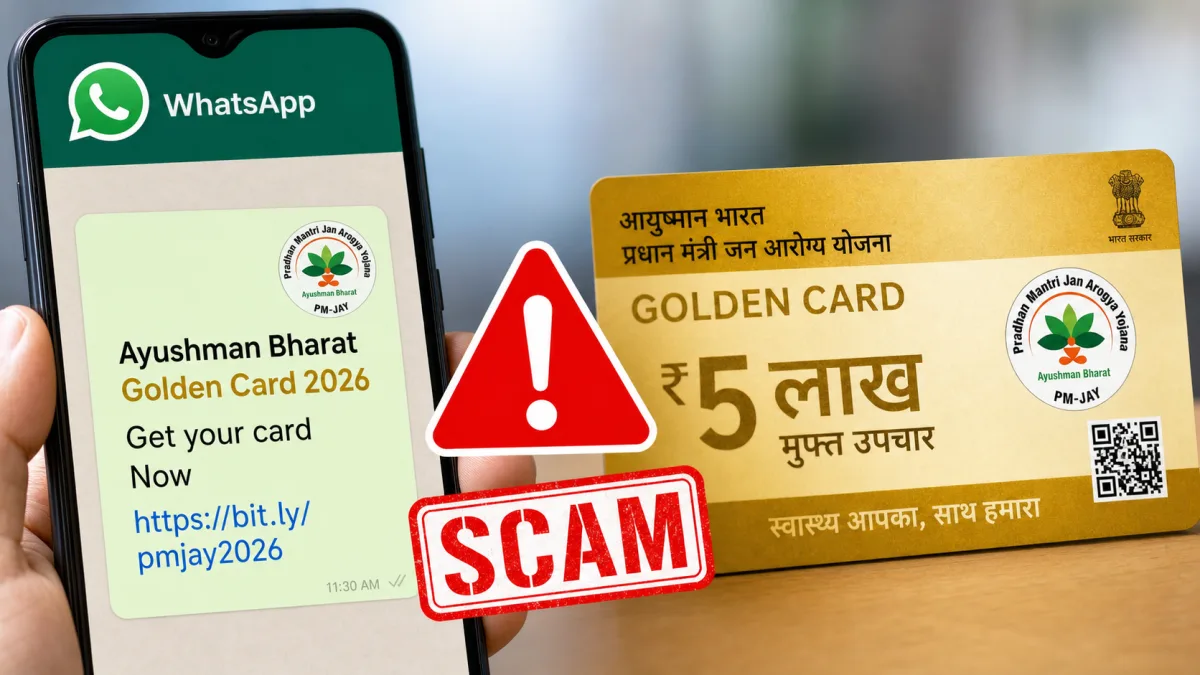
The message claims that the government is issuing new Golden Cards for 2026 under the Ayushman Bharat scheme. It usually has an image of Prime Minister Modi or the official National Health Authority logo. (I'm not sure exactly why they always add a picture of a shiny smart card too, but they do). The text insists that your name has been selected. It says you are eligible for Rs 5 lakh in free medical treatment. All you have to do is click a link to verify your details. Then you just pay a tiny registration fee or delivery charge for the physical card.
That link is a trap. The government doesn't charge you to register for Ayushman Bharat. There isn't a home delivery fee for a Golden Card. The entire program is meant to provide free healthcare to low-income families. So if someone asks for money to get you a free government benefit, it is a lie.
How this health card fraud works
Understanding the mechanics of this scam helps you spot it before you lose money.
Scammers have refined their process. They run this scam like a corporate business with call centers and graphic designers. The step-by-step breakdown of what happens when you interact with these messages shows their strategy.
Step 1: The urgent WhatsApp message
Scammers manufacture urgency. The message will say something like "Last date to apply is today!" or "Only 1000 cards left for your state." They want you to panic and click the link without thinking. They rely on the fact that people are afraid of missing out on government assistance. They also use regional languages now. A message circulating in Uttar Pradesh is in perfect Hindi. A message targeting rural Maharashtra is in Marathi. This localization makes the scam feel much more real.
Step 2: The fake government portal
When you click the link, you are taken to a website that looks exactly like the official PMJAY portal. The colors match perfectly. The government emblems are there. But look at the URL at the top of your browser. It is usually something sketchy like "ayushman-bharat-2026-apply.com" or "pmjay-golden-card-free.in".
Official Indian government websites always end in .gov.in or .nic.in. Close the tab immediately if you don't see that domain extension. Scammers buy these fake domains for a few hundred rupees. And then they use them to steal millions.
Step 3: The data harvest
The fake site asks for your personal information. They want your full name and your exact residential address. They also want your phone number and your Aadhaar number. Sometimes they ask for your PAN card details or voter ID too.
Once you type this in, you're handing scammers a complete profile of your identity. They can use this for fake KYC in other scams. They open bank accounts in your name to launder money. The Enforcement Directorate uncovered a scam where fake hospital files netted over Rs 64 lakh using bogus claims. Another report showed a huge fake card scam uncovered across UP and Punjab. Your stolen Aadhaar data feeds directly into these larger organized crimes. Scammers sell databases of real names and Aadhaar numbers to corrupt hospital administrators. Those administrators then file fake medical claims to the government. Basically, you become an unwitting participant in a massive scam network.
Step 4: The UPI payment trap
This is where they actually steal your money directly from your bank account. The website tells you that your registration is complete. They say your card is ready to print. Then they say you need to pay a small processing fee or a courier charge for home delivery. It's usually a tiny amount meant to avoid suspicion. Rs 50 or Rs 99.
They know you won't think twice about paying 50 rupees for a 5 lakh insurance cover. So you proceed to pay. The site redirects you to a UPI payment page. Or it asks you to open PhonePe or Paytm.
Here's the critical warning: the payment request you receive will often be for a much larger amount, or they'll set up an auto-pay mandate.
You think you're entering your UPI PIN for Rs 50. But the screen might actually say Rs 50,000 if you aren't reading carefully. The transaction might also set up a recurring mandate. This allows the scammer to pull money from your account every day until it's empty. Or you might just be sending Rs 50 directly to a scammer's mule account. They withdraw it quickly. Fifty rupees from a hundred thousand victims is half a crore.
Once you enter your UPI PIN, the money is gone.
Warning signs that the Ayushman link is fake
You don't need to be a cybersecurity expert to spot these scams. You just need to look for a few specific red flags. Stop what you're doing if you see any of these.
- The message comes from a random 10-digit mobile number, not an official verified WhatsApp business account with a green tick.
- The link asks you to download an APK file directly to your phone. Never install apps directly from WhatsApp links. Read our guides on Android security if you're confused about this. These APKs often contain malware that reads your OTPs in the background.
- The website URL doesn't end in .gov.in. I can't say this enough. Look at the address bar.
- They ask for any amount of money. The real Ayushman Bharat registration is entirely free. Common Service Centres might charge a tiny nominal fee of Rs 30 for printing a plastic card, but the online registration itself never requires a UPI payment to a random website.
- The text has spelling mistakes, weird formatting, or uses excessive capitalization. Scammers often use poor translation tools or rush their work.
The government will never ask you for your UPI PIN to provide a social benefit. If a website asks for your UPI PIN, you're paying them. They aren't helping you.
Your UPI PIN is only for sending money from your account. You never need to enter it to receive a card. You don't need it for a subsidy or a refund either.
How to protect yourself from PMJAY frauds
We have to be proactive. Scammers are getting smarter, and they adapt quickly. When the government launches a new scheme, scammers have a fake website up within hours. It happens when they update an existing scheme too.
First, go straight to the source. Type the official address into your browser yourself if you want to check your eligibility for Ayushman Bharat: beneficiary.nha.gov.in. Don't click links sent in WhatsApp groups. You can also visit your nearest government hospital to check your status in person. Or you can go to an empaneled private hospital.
Second, use the official Ayushman app from the Google Play Store or Apple App Store. Make sure the developer is listed as the National Health Authority. Don't download apps from third-party websites.
Third, protect your Aadhaar data fiercely. You can lock your Aadhaar biometrics using the official UIDAI website or the mAadhaar app. This stops criminals from misusing your identity for biometric authentication even if they manage to steal your Aadhaar number. If you ask me, you should use DigiLocker to provide verified documents if you just need to share your identity. Do not send photos of your cards over WhatsApp. We have a list of tools that can help you secure your digital footprint.
Fourth, consider what happens if you already entered your details but didn't pay. If you gave them your Aadhaar number and phone number, you are now at high risk for targeted phishing calls. Scammers will call you pretending to be from the health ministry. They will claim there is an issue with your application and ask for an OTP. Never share an OTP on a phone call. Not with the bank. Not with the government. Not with the police. Not with anyone.
Fifth, talk to your family. Send this article to your parents' WhatsApp group. Older people are specifically targeted by these healthcare scams. They are more likely to need medical assistance. They are also less likely to verify website URLs. Have a conversation over dinner about not clicking links.
Where to report this Ayushman scam immediately
If you realize you've made a mistake and entered your UPI PIN on one of these fake sites, you need to act fast. Don't wait for the bank to call you. Don't feel embarrassed. It happens to thousands of smart people every day. The criminals do this for a living.
Call the national cyber crime helpline at 1930 immediately. This is the official government number for reporting financial scams. The faster you call, the higher the chance they can freeze the scammer's bank account before they withdraw your money. The first hour after the scam is when you have the best chance of stopping the transaction.
After calling, you must file a formal complaint online. Go to cybercrime.gov.in and register the exact details of the scam. Provide screenshots of the WhatsApp message and the fake website if you still have it open. Also provide the UPI transaction ID from your banking app.
You should also report the scam message directly within WhatsApp (annoying, I know, but it takes two seconds). Long-press the message, tap the three dots in the top right corner, and select Report. This flags the account to WhatsApp's security team. It helps ban the scammer's number. And it prevents them from targeting others.
The Indian Computer Emergency Response Team (CERT-In) regularly tracks these widespread phishing campaigns. They issue advisories on their portal (https://www.cert-in.org.in/). Following their updates can keep you informed on the latest tactics scammers use to bypass security measures. The numbers here are a bit fuzzy, but thousands fall for this daily. For a broader look at current threats, you can check our explainers on how cybercrime networks operate.
Look, we just have to look out for each other. The internet in India is growing fast. But digital literacy is lagging behind. We're all adopting digital payments and online government services. That's fantastic, but it leaves us vulnerable. Scammers exploit that gap in understanding. By knowing exactly how these fake Ayushman Bharat PMJAY 2026 Golden Card WhatsApp scams operate, you can stop them from stealing your hard-earned money. Stay skeptical and verify everything independently. Never pay a fee for a free government scheme.