Flipkart's Big Billion Days are almost here, and you know what that means. Right on schedule, the scammers are out in full force, flooding Indian smartphones with traps.
Honestly, I see this exact pattern every single year. A major online sale gets announced. The hype builds up, and suddenly everyone's phone is bombarded with messages about winning free iPhones or massive cash prizes. But this year's "Fake Flipkart Luck Badal Sakta Hai Campaign WhatsApp Prize Scam 2026" is particularly nasty. They're using the exact official slogan from Flipkart's genuine advertising campaign, Luck Badal Sakta Hai, Yahan Kuch Bhi Ho Sakta Hai. And people are losing real, hard-earned money.
Here's the deal. Flipkart opens its Big Billion Days general sale on October 9, 2026. The scammers know this perfectly well. They're banking on you being excited and maybe letting your guard down just a bit. In my experience, these setups look completely legitimate until the very last second. So, let's break down exactly what this scam is and how you can keep your bank balance safe.
What Exactly Is the Flipkart "Luck Badal Sakta Hai" Scam?
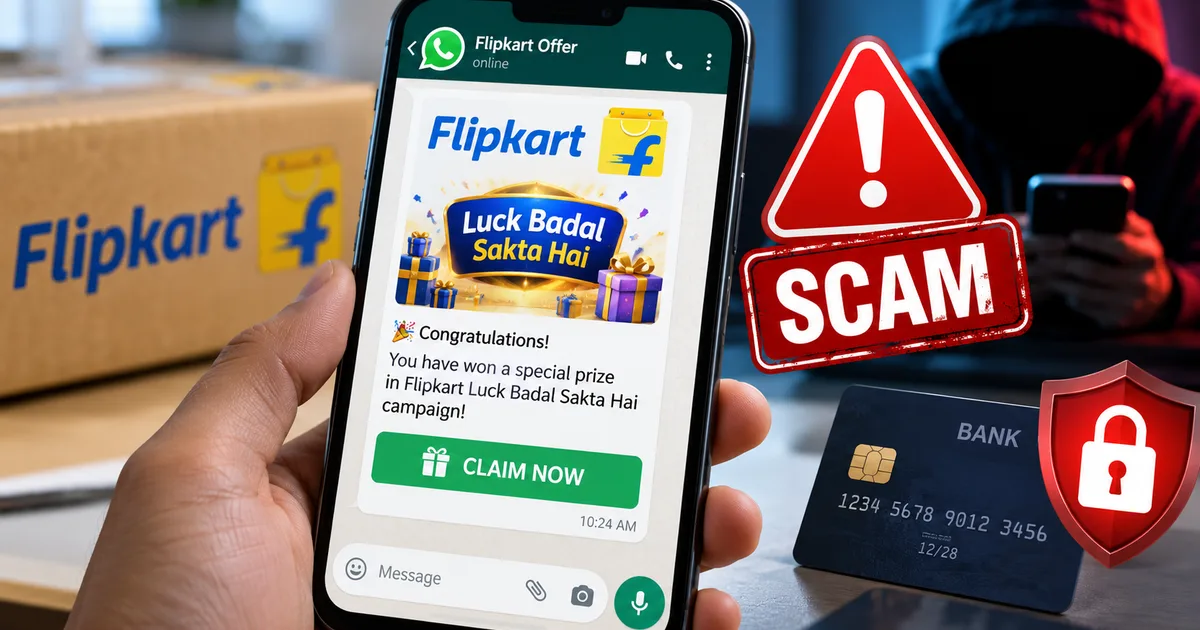
This scam almost always starts on WhatsApp. You'll get a message out of the blue from an unknown number. Often, it's an international number or a compromised business account claiming you've won a massive prize in an exclusive lucky draw tied to the Big Billion Days sale. To make it look convincing, they'll use the official Flipkart logo and maybe even slap on pictures of the celebrities Flipkart hired for the real ads like Rohit Sharma or Jackie Shroff.
Look, the message usually says you've won something absolutely ridiculous like an iPhone 16 Pro or a ₹50,000 cash prize. But there's always a catch (which makes sense, actually). To claim this amazing prize, you need to click a specific link and pay a small "processing fee" or "delivery charge."
Spoiler alert. There's no prize. There's only a scammer sitting in a room somewhere, waiting for you to hand over your UPI PIN. It's a complete fabrication designed to exploit trust in a well-known brand.
How the Scam Works: A Step-by-Step Breakdown
I want you to see exactly how these criminals operate step by step, so you can spot the trap before you step in it. It's a calculated psychological game.
- The Initial Bait: You receive a WhatsApp message. It looks surprisingly professional. It has the Flipkart logo and that Luck Badal Sakta Hai slogan. It enthusiastically congratulates you on being a lucky winner.
- Creating Fake Urgency: The message almost always has a tight time limit. "Claim your prize within 2 hours or it goes to the next winner in line." This is a classic social engineering trick. It's designed to make you panic and stop thinking critically.
- The Malicious Link: You click the link, and it takes you to a website that looks nearly identical to Flipkart. The colors are right, and the fonts match. But if you look closely at the URL at the top of your browser, it won't be flipkart.com. It'll be a deceptive domain like flipkart-lucky-draw-2026.in or some random string of characters.
- The Information Grab: The fake site will ask for your personal details to "verify" your identity and "ship" the prize, like your full name and phone number. Then, the trap closes. It asks for a small payment, maybe ₹199 or ₹499 for "delivery" or "registration."
- The Final Financial Blow: When you try to pay that small fee, they don't just take the ₹199. The payment gateway is fake. They might trick you into entering your UPI PIN on a screen that is actually requesting a much larger transfer. Or they might silently capture your credit card details and the OTP you receive. Before you even realize what happened, your bank account is emptied.
It's incredibly similar to what we've seen with the Fake KBC Season 18 Lottery Winner WhatsApp Scam 2026. The script changes to fit the current trend. But the ultimate goal is always the same: stealing your money.
Warning Signs You Should Never Ignore
So, how do you know if a message is real or a complete fake? Honestly, it's pretty simple if you know what specific red flags to look for.
- It arrives on WhatsApp from a random 10-digit number. Flipkart doesn't notify lucky draw winners via WhatsApp from a random mobile number. Official communications come through the app itself or SMS with a verified sender ID (like AD-FLPKRT).
- They ask for money upfront. If you actually won a legitimate prize, you wouldn't have to pay a single rupee to get it. Period. Any request for a "processing fee" or "customs clearance" is a 100% confirmed scam.
- The website link is sketchy. Always, always check the URL before typing anything. If it's not exactly flipkart.com or happening entirely within the official Flipkart app, close the tab immediately.
- Typos and bad grammar. While scammers are getting much better with tools like ChatGPT, many of these messages still have weird phrasing or spelling mistakes that a huge company would never make.
- They ask for your UPI PIN to receive money. I can't stress this enough: You NEVER enter your UPI PIN to receive money. You only enter it to send money from your account. If anyone asks for your PIN so they can "transfer your prize money," they are actively robbing you.
We see these deceptive tactics across all kinds of digital fraud in India. If you ask me, checking out our dedicated Scam Alerts & Safety hub is totally worth your time to see how these criminals operate.
The Technology Behind the Scams is Getting Scarier
Here's something that really worries me, and it should worry you too. Scammers aren't just using simple fake websites anymore. The malware they deploy is a mess.
Researchers recently found a new mobile spyware platform called ZeroDayRAT being actively sold on Telegram. This thing is nasty. It supports Android versions 5 through 16 and is designed for total surveillance.
If you accidentally download a fake app, say, a "Flipkart VIP Prize Claim" app that the WhatsApp message told you to install, this spyware infects your phone. Once it's there, the scammers can see everything. They can read your SMS messages (which means they can intercept your bank OTPs) and even log your keystrokes. They can literally watch you type your banking passwords. I'm not sure exactly why it's so easy for them to bypass security these days, but it is.
"The platform goes beyond typical data collection into real-time surveillance and direct financial theft," said Daniel Kelley, a security researcher at iVerify.
They can even enumerate every account registered on your device, from Google and WhatsApp to PhonePe and Paytm. It has a specific bank stealer module to target online mobile wallets. It's terrifying stuff. And this is exactly why you must never download apps from random links sent to you on WhatsApp or Telegram. Only use the official Google Play Store or Apple App Store.
How to Protect Yourself and Your Bank Account
Okay, let's talk about defense. How do you make sure you don't fall for this, especially when the scams look so convincing?
- Don't click the link. It sounds basic, but it's the best defense. If you get a sketchy message offering a free prize, just delete it. Block and report the number on WhatsApp immediately.
- Verify independently. If a tiny part of you thinks you might have actually won something, don't use the link in the message. Open the official Flipkart app on your phone and check your notifications or wallet there. If there's no official message inside the app, the WhatsApp text is a lie.
- Never share OTPs or passwords. No legitimate company or bank will ever ask for your OTP or banking password over a call or text. Anyone who asks is a scammer.
- Educate your family. You might be tech-savvy enough to spot a fake URL, but your parents or grandparents might not be. Talk to them. Show them exactly what these scams look like. They are often the most vulnerable targets.
- Use strong passwords and enable 2FA. Turn on two-factor authentication for your email and your banking apps. It's an extra layer of security that can save you even if someone manages to steal your password.
You need to be just as careful with other services claiming to offer government benefits. For instance, we've seen nearly identical tactics used in the Fake EPFO Employees Enrolment Campaign 2026 WhatsApp Scam. The wrapper changes, but the poison is the same.
What to Do If You Have Been Scammed
Look, mistakes happen. Scammers are highly manipulative and they create fake urgency. Sometimes smart people get caught off guard (annoying, I know). If you realize you've fallen for the scam and lost money, you need to act incredibly fast.
- Call 1930 immediately. This is the National Cyber Crime Reporting Portal helpline in India. The faster you call, the higher the chance they can contact the banks and freeze the fraudulent transaction. Don't wait to see if it resolves itself.
- File a formal report online. Go to the official government cybercrime portal at cybercrime.gov.in and file a detailed complaint. Give them all the information you have: the phone numbers that contacted you and the fake URLs.
- Contact your bank instantly. Call your bank's customer care helpline right after calling 1930. Tell them your account has been compromised through a phishing scam. Ask them to block your debit card or temporarily freeze your account to prevent any further unauthorized withdrawals.
- Change all your passwords. From a secure device, change the passwords for your primary email and your banking apps. If you reuse passwords across different sites, change them everywhere.
Agencies like CERT-In (the Indian Computer Emergency Response Team) and local cyber cells are constantly working to take down these fake websites. But new ones pop up every single day. It's an endless game of whack-a-mole. You are your own first line of defense.
The Bottom Line
Flipkart's Big Billion Days are genuinely a great time to buy that smartphone you've been wanting. The discounts are real, and the official deals are worth checking out. But the random WhatsApp messages telling you you've magically won a car or a free iPhone are fake.
Don't let the excitement of a massive online sale blind you to the obvious red flags. Be deeply skeptical of unprompted messages. And always remember the golden rule of the internet. If it sounds too good to be true, it's definitely a scam.