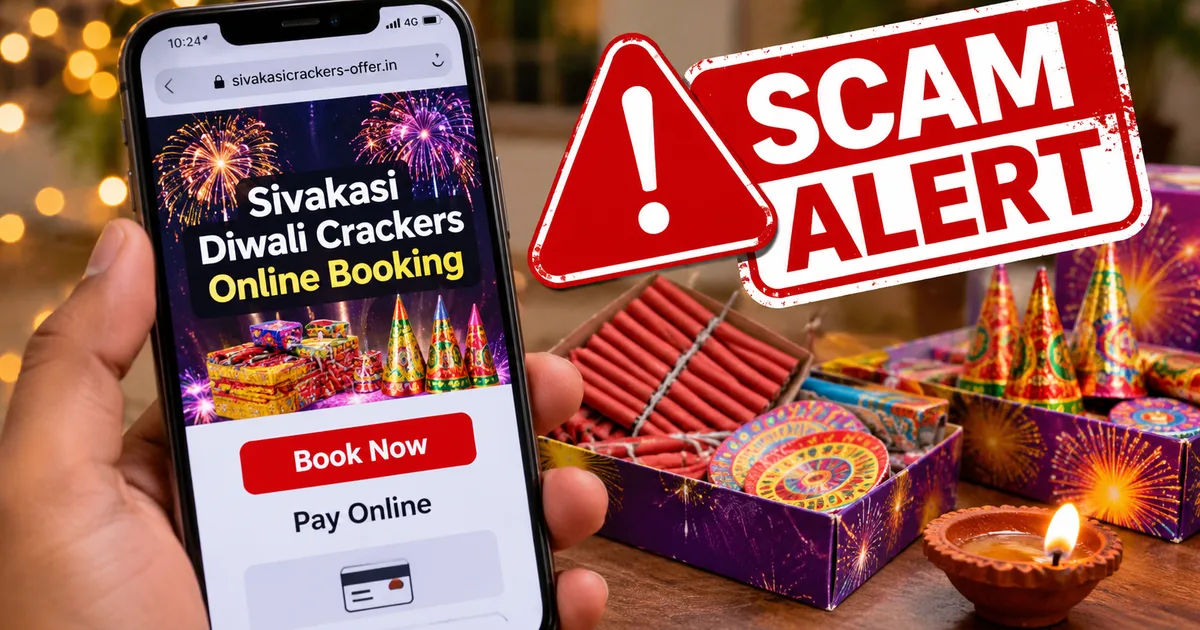
Every October and November, thousands of families across Bengaluru, Hyderabad, Delhi, and Mumbai look for affordable fireworks to celebrate the festive season. Local markups are brutally steep. They often touch double or even triple wholesale rates. So when an ad pops up on your Instagram feed or a family WhatsApp group promising direct factory prices from Virudhunagar district, clicking on it feels like an obvious win. Think you can order cartons of sparklers and aerial shells to your door at an 80% discount? You can't. You're walking straight into the fake Sivakasi Diwali crackers online booking scam.
I looked through dozens of these storefronts over the past week. Honestly, the polish on these fake setups is terrifying. They steal genuine factory license numbers and slap legitimate Sivakasi pin codes on their contact pages. They upload clean product catalogs too. Everything is built to make you feel like you're dealing directly with an honest heritage business. You aren't. You're dealing with scammers who take your money through a quick UPI transfer and disappear before you can even track anything. (I know, it sounds tempting when local retail markups touch 300%, but it's a trap).
The legal reality of buying crackers on the internet
Here's something that catches almost everyone off guard: buying firecrackers online for doorstep delivery is not legal in India.
Back in 2018, the Supreme Court of India passed a strict order that banned the online sale of firecrackers through e-commerce platforms. The logic was simple enough. Firecrackers are hazardous explosive materials under the Explosives Act. You can't ship gunpowder and aerial shells through regular courier vans or delivery bikes alongside shirts and laptops. The Petroleum and Explosives Safety Organisation (PESO) has very rigid rules about this. They require strict temperature controls and licensed explosive-transport vans, with physical verification at every transfer point.
The Supreme Court of India prohibited e-commerce platforms from selling or delivering firecrackers online, making any service that offers direct doorstep courier delivery illegal across the country.
Thing is, genuine Sivakasi manufacturers know this law inside out. Legitimate factories like Standard Fireworks or Sri Kaliswari don't have shopping carts on their websites where you punch in your address and pay ₹3,000 for home delivery. None of them do. Some genuine dealers post price estimates online, sure, but in my experience, you always have to collect the stock physically from licensed godowns or arrange dedicated commercial transport. If a website claims it'll send a box of flower pots and rockets straight to your apartment via Blue Dart or Delhivery, that site is lying to you.
How the Sivakasi crackers scam works step by step
The fraudsters behind this racket don't rely on clumsy emails anymore. They run organized, seasonal scams that lean heavily on slick social media ads.
Step 1: Sponsored ads on social media and WhatsApp groups
Weeks before Dhanteras, scam networks run targeted campaigns across Facebook and Instagram. They use catchy slogans like "Direct from Sivakasi Factory" or "Flat 75% Off Diwali Mega Combo". Most of these ads send you to a URL that mimics well-known brand names, usually tacking on words like "bazaar" or "store" to the address. Similar patterns appear in fake Amazon Great Indian Festival WhatsApp scams, where festive demand creates instant trust.
Step 2: The slick digital catalog
Click the link, and you land on a surprisingly sharp storefront. You see crisp photos of branded crackers and neatly organized combo packs. The pricing alone should ring alarm bells. A combo pack that costs ₹8,000 in your local city market is listed for just ₹2,199. To sweeten the deal, they throw in free home delivery across India on all orders above ₹1,500. It looks convincing on a phone (which makes sense, actually, because that's where most people browse).
Step 3: The WhatsApp consultation and QR code push
When you try to check out, the website usually claims the automated card gateway is down for maintenance. Typical excuse. Instead, a chat window opens up, or you get redirected to a WhatsApp number with a business profile displaying a Sivakasi address. The person on the chat speaks politely and confirms your pincode right away. Next, they send a professional PDF invoice with GST numbers. Then comes the trap: they send you an individual PhonePe or Google Pay QR code and ask for a 100% advance transfer.
Step 4: Ghosting or fake transport clearance extortion
Once your UPI transaction clears, one of two things happens. In the simpler version of the fraud, they immediately block your number and remove the chat history. In the nastier variation, they contact you the next morning posing as a logistics manager from a transport agency. They tell you that your parcel is held up at an inter-state checkpoint or PESO inspection post. Then they demand an extra ₹1,800 as an insurance deposit. If you pay that, they demand another ₹2,500 for state tax clearance. They keep bleeding your account dry until you finally realize no parcel ever existed in the first place.
Warning signs of fake Diwali cracker websites
Spotting these fake operations takes only a minute once you know what to check. Scammers work on high volume and quick turnover, so they leave clear technical footprints behind.
Look out for these red flags:
- Prices that sit 70% to 80% below the retail market rate for popular Sivakasi brands.
- Unrealistic promises of free doorstep courier delivery for hazardous fireworks.
- Payment requests made to personal UPI IDs or savings accounts rather than registered current accounts matching the company name.
- Absence of a working landline number or verifiable physical address registered with the Virudhunagar district administration.
- Domain names registered just a few weeks or months before Diwali, which you can verify using free Whois lookup services.
- Pressure tactics urging you to transfer money within thirty minutes to lock in a festival discount slot.
Notice how almost none of these websites offer Cash on Delivery (COD). Not one. Scammers invent all kinds of excuses for this. They usually claim logistics partners don't permit cash handling for explosive materials. While COD is indeed risky for merchants, their complete refusal of recognized payment gateways is your biggest clue.
Real police cases show how deep the racket goes
This isn't some rare or isolated threat. State police departments across India register hundreds of cracker scam cases every single November.
According to advisories from the Tamil Nadu Cyber Crime Wing, scammers exploit the festive rush by setting up dozens of clone websites. These sites copy established Virudhunagar manufacturing units almost completely. In several recent investigations, officers discovered that the bank accounts receiving the funds weren't in Sivakasi at all. They were mule accounts operated from northern and eastern states, opened with forged Aadhaar cards.
Namakkal district police and crime branch units in Odisha report identical patterns. Victims place orders worth ₹3,000 to ₹15,000 for their family celebrations, only to get fake consignment notes with dead tracking numbers. I'm not sure exactly why banks take so long to freeze these accounts, but the result is always the same. By the time Diwali arrives, the websites vanish, and the mobile numbers are disconnected.
How to protect your money from online firecracker fraud
You don't have to give up celebrating with your family. But you definitely need to change how you buy.
First, stop looking for door-to-door courier delivery for fireworks. It simply doesn't exist legally. If you want genuine Sivakasi products at fair rates, I think your best bet is pooling orders with neighbors or your apartment society. Deal directly with licensed local distributors who hold valid police and PESO permits. Many authorized dealers in major cities receive legal wholesale shipments by road. They sell them from designated temporary grounds under municipal supervision.
Second, check website registration dates before trusting any online vendor. If a store claims it's been operating since 1995, but its domain was purchased in September 2026, close the tab immediately. Fraudsters build disposable websites every festive season and abandon them once complaints roll in. The following year, they register fresh domains. We've seen this exact throwaway domain model across our recent scam alerts and consumer warnings.
Third, never send money to individual UPI accounts for commercial purchases. When you scan a QR code on Google Pay or Paytm, inspect the recipient name carefully. If the site claims to be Sivakasi Fireworks Corporation but the UPI receiver is an individual name like Ramesh Kumar, stop. Cancel the transaction right then. You can check our detailed step-by-step tech safety guides to learn how UPI merchant verification works.
Lastly, stay suspicious of WhatsApp links that promise festival discounts. (annoying, I know, when group chats get flooded with them). Just like the recent surge in fake central government Diwali bonus messages, fraudsters exploit the festive mood to spread malicious booking links through forwarded messages.
Where to report online cracker fraud in India
If you realize you've already sent money to a fraudulent cracker website, don't waste time arguing with the scammer on WhatsApp. They won't refund your money. You need to act within minutes.
Follow these immediate steps:
- Call the national cybercrime helpline at 1930 immediately. If you report the fraudulent UPI transaction within the initial two hours, often called the golden hour, the authorities can request the recipient bank to freeze the beneficiary account before the criminal withdraws the cash.
- File a formal complaint on the official National Cyber Crime Reporting Portal at cybercrime.gov.in. Upload clear screenshots of your chat history, the website link, the UPI transaction reference ID (UTR number), and the payment receipt.
- Contact your bank or payment app support team (PhonePe, Google Pay, or Paytm) and report the transaction as fraud so they can flag the merchant VPA in their internal anti-fraud database.
- Forward suspicious links and phishing portals to CERT-In (the Indian Computer Emergency Response Team) through their incident reporting portal at cert-in.org.in to help take the malicious infrastructure offline.
Reporting fraud quickly through 1930 is your only realistic chance of freezing illicit funds before cyber criminals move them across mule accounts.
Don't let the embarrassment of losing ₹2,000 or ₹5,000 stop you from reporting. Most cyber syndicates rely on the fact that individual victims shrug off small losses. The numbers here are a bit fuzzy, but when hundreds of people report the same UPI VPA or phone number, state cyber units like the Tamil Nadu Cyber Crime Wing can build a solid case and freeze the mule accounts before pulling down the rogue domains.