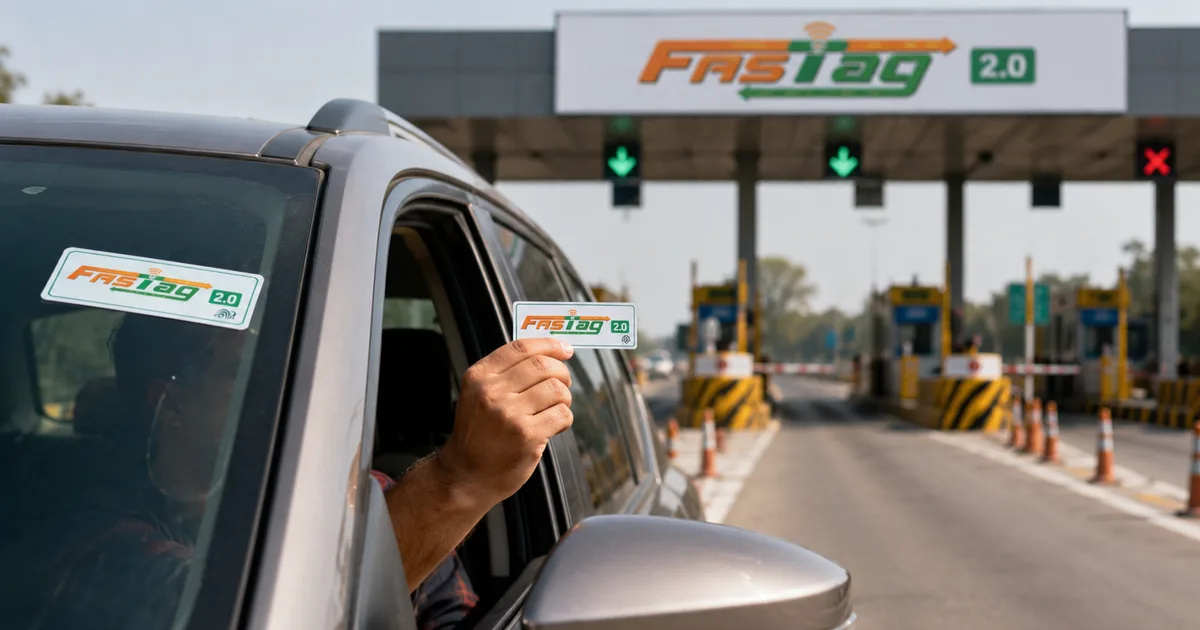
If you drive on Indian highways, FASTag 2.0 is about to change how you experience toll booths, and if the government keeps to its timeline, whether you stop at them at all. NPCI has been building out a new generation of FASTag capabilities through 2025 and into 2026, and the picture is now clear: AI-powered parking payments, free-flow tolling without barriers, and a significant upgrade to the RFID infrastructure that runs the whole system.
Here's what's actually happening, what it means for your daily commute, and what you need to do with your existing FASTag.
What FASTag 2.0 actually is
There's no single "FASTag 2.0" product you can buy at a bank counter right now. Think of it less as a new sticker and more as a system upgrade. NPCI and NHAI are rolling out new capabilities on top of the existing FASTag infrastructure. The physical tag on your windscreen may still work fine. What's changing is what that tag can do and how the highway infrastructure reads it.
The main upgrades in 2026 are:
- Free-flow tolling, where your vehicle is read at highway speed with no stopping required
- AI-powered parking payments at airports, malls, and commercial parking lots
- Stricter KYC enforcement and blacklisting rules to cut down on toll evasion
Over 8 crore FASTags are active in India right now. That's a massive base to upgrade. NPCI's approach has been to keep the new system backward-compatible where possible, pushing the new features through highway-side infrastructure rather than asking everyone to swap their windscreen stickers.
Gadkari's barrier-free travel announcement: what's actually happening on the ground
Union Minister Nitin Gadkari stated India would have barrier-free travel on national highways within a year. No toll plazas. No queues. No stopping.
Honestly, versions of this promise have been floated before. But this time there's real hardware going up. Feig Electronic, a German company that manufactures RFID readers, has been deploying equipment specifically designed for India's FASTpay free-flow tolling program. Their readers can pick up FASTag signals from vehicles moving at normal highway speed, no barrier or slowdown needed.
The technology is called multi-lane free flow (MLFF). Gantry structures go over the highway, and as your vehicle passes underneath, your FASTag is read and the toll is deducted automatically. No stopping. No lane selection. No getting stuck behind a truck whose tag reader fails at 2 AM.
Will this cover every toll plaza in India within a year? Probably not. Major expressways are moving faster than older single-carriageway national highways. The direction is clear, though, and the first few fully free-flow corridors, including stretches on NH-48, are expected to be live by late 2026.
The AI parking feature most people haven't noticed yet
This is, if you ask me, the most interesting part of the FASTag 2.0 rollout. NPCI has built an AI-powered parking payment system that uses your existing FASTag as the payment mechanism. You drive into a parking lot, a camera reads your number plate, your FASTag account is matched to your vehicle registration, and the parking fee is deducted automatically when you leave. No ticket. No QR code. No fumbling for exact change at the exit barrier.
Think airports, malls, corporate parks, metro station parking. If you've ever sat in the Bengaluru Airport parking exit queue for 20 minutes while one person disputes the hourly rate, you understand exactly why this matters.
The system uses ANPR (Automatic Number Plate Recognition) on entry and exit, linked to your FASTag wallet in the backend. It's part of NPCI's push to expand FASTag beyond highway tolling, where most of the transaction volume sits today, into everyday urban use cases. And honestly, that's the right direction.
Rollout is happening in phases. A few airports and large commercial properties are already in pilot (the exact confirmed list isn't public yet, but it's coming). Reports from early 2026 point to Hyderabad and Pune among the first cities where this will be visible at scale.
New FASTag rules in 2026 that affect every vehicle owner
NHAI has tightened compliance rules considerably. Here's what has changed:
- The one FASTag per vehicle rule is now strictly enforced. Multiple FASTags linked to the same vehicle registration? All but one will be blacklisted automatically.
- FASTags unused for 12 months or more may be deactivated by the issuing bank.
- KYC must be complete. A FASTag with incomplete KYC gets blacklisted, and you'll be charged double the normal toll rate.
- Banks are now required to send low-balance alerts when your FASTag wallet drops below Rs. 100.
The double-rate penalty is the one that trips people up most. If your FASTag is blacklisted for any reason, the toll system still registers your vehicle but charges you 2x. And the receipt doesn't always explain why. So do a status check right now if you haven't in a while. Seriously, takes two minutes.
How to check and update your FASTag in 2026
Check your status first
The My FASTag app from NPCI, available on both Android and iOS, is the easiest way to do this. Log in with your registered mobile number and you'll see your wallet balance, KYC status, vehicle details, and transaction history. A "blacklisted" or "inactive" status means you have a problem to fix before your next highway trip.
You can also check via the NHAI FASTag portal at fastag.ihmcl.com, or through your bank's own app if your FASTag was issued by them. One flag worth noting: if your FASTag was issued by Paytm Payments Bank before RBI's restrictions on them came into effect, check the status carefully and consider shifting to another NHAI-listed issuer.
Sort out your KYC if it's still pending
Go to your bank's FASTag portal or the My FASTag app. You'll need your vehicle RC (Registration Certificate) details and either Aadhaar or PAN. Aadhaar-based eKYC is the fastest option, usually done in under five minutes. If your FASTag was issued before 2022 and you've never done KYC, do it this week. Enforcement in 2026 is noticeably stricter than even a year ago.
Do you actually need a new physical FASTag?
For the free-flow tolling changes, almost certainly not. The MLFF gantries are designed to read the same RFID chips already on your windscreen. The upgrade is happening on the highway side, not yours.
You might need a replacement if your tag is physically damaged, more than five years old (RFID chips can degrade), or was issued by a bank that no longer offers FASTag services. Replacement is between Rs. 100 and Rs. 500 depending on the issuing bank and can be done entirely online for most banks. Check the complete FASTag setup guide in our guides section if you need a step-by-step walkthrough.
For the AI parking feature specifically, there's nothing extra to do. The system works off your number plate. Just make sure the vehicle registration number linked to your FASTag account is actually correct. You'd be surprised how many people have a typo in there from when they got the tag done quickly at a highway booth years ago. Worth verifying in the My FASTag app right now.
Topping up your FASTag wallet
Any major UPI app works: PhonePe, Google Pay, Paytm, BHIM. Look under "Recharge" or "Travel." Net banking and cards work too. Minimum top-up is usually Rs. 100. Keep at least Rs. 500 in there if you're a regular highway user, especially as free-flow corridors go live and manual balance checks at booths become less frequent.
What this actually means for Indian drivers day to day
The shift to free-flow tolling is a bigger quality-of-life improvement than it looks on paper. If you drive Delhi-Jaipur or Mumbai-Pune regularly, you know the toll booth experience. The queue. The exact-change problem even with FASTag. The one vehicle in the wrong lane that holds everyone up. Getting rid of all that, even on a handful of key expressways, will feel significant once it's live.
For city commuters, the parking integration is the more immediately useful change. It won't appear at every mall overnight. Parking operators need to install the ANPR cameras and that takes time and money. But NPCI's system is certified and ready. The constraint now is on the venue side, not the payment infrastructure.
NPCI's AI-powered FASTag parking system uses Automatic Number Plate Recognition (ANPR) to match vehicles to their FASTag accounts, deducting parking fees automatically on exit. No ticket or QR code needed.
One practical thing: as tolling gets invisible and automatic, it also gets easier to lose track of what you're spending. Check your FASTag transaction history once a month. The My FASTag app has a full log, and most UPI and banking apps show it too if your FASTag is linked to your account.
The broader picture is real progress. Over 20 billion UPI transactions were processed in a single month in early 2025. More than 8 crore FASTags are active across the country. MLFF gantries are going up on actual highways, not just in ministry presentations. This digital payments infrastructure is being built out faster than most people expected a few years ago.
Whether Gadkari's exact "within a year" timeline holds is genuinely uncertain. I'm not sure exactly why government infrastructure schedules in India have such a complicated relationship with calendar accuracy, but they do. The technology is real, the hardware is being deployed, and the free-flow future is closer than it's ever been. Check your FASTag status today. That part, at least, you can control.