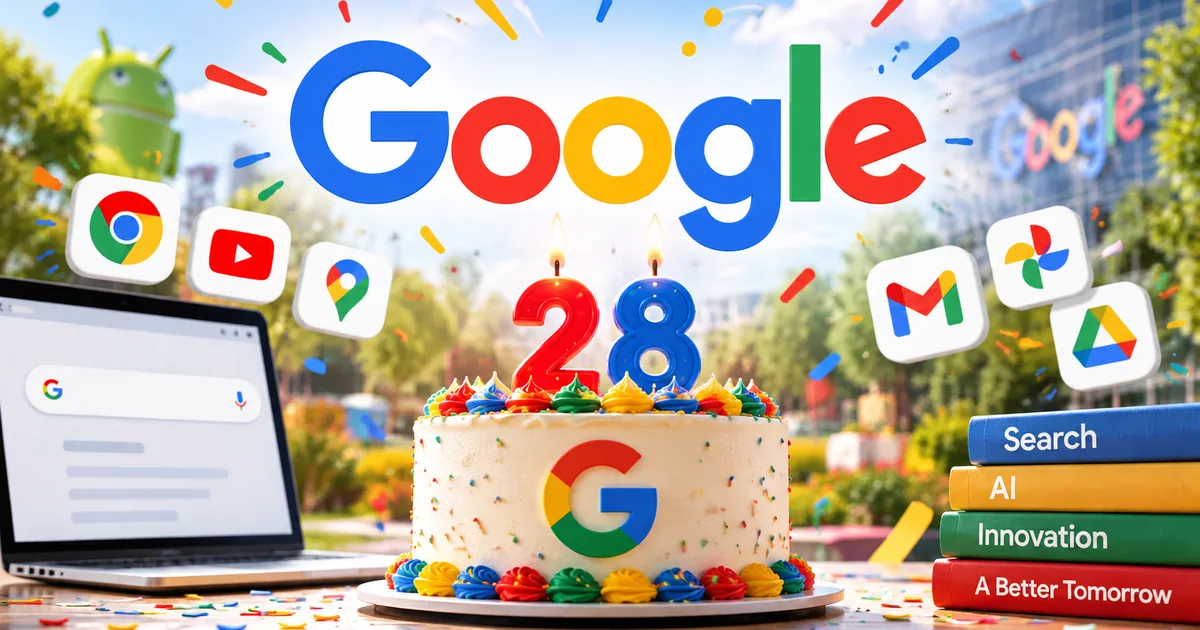
You probably opened your browser today and noticed something pleasantly old-school. The familiar multi-colored logo looks a bit blockier, a bit more like the internet of the dial-up era. And that's because today marks the Google 28th Birthday 2026 celebrations. They've swapped out their modern branding for a retro-themed Google Doodle that takes us straight back to 1998.
Twenty-eight years. Think about that for a second. If Google was a person in India, it'd be dealing with parental pressure to get married and buy a flat in Bengaluru. But instead, it's the Latest Tech News giant that basically controls how we find information and argue with strangers online.
Honestly, it's hard to remember how we functioned before this search engine existed. Did we just ask people for directions? Look things up in heavy encyclopedias that took up entire bookshelves? Today, whether you're trying to figure out how to link your Aadhaar to your PAN card or searching for the nearest UPI-accepting chai tapri, you start with a quick search.
I want to break down why the dates are completely confusing and what you can find if you click on today's special doodle.
The confusion over the actual birthday date
Here's a weird piece of trivia. Google doesn't actually know its own birthday. Or rather, it chooses to ignore its actual birth certificate.
Look, if you check the corporate filings, Larry Page and Sergey Brin officially incorporated Google Inc. on September 4, 1998. They were just two PhD students at Stanford University at the time. They had this massive idea for organizing the world's information. And they managed to get a $100,000 cheque from Sun Microsystems co-founder Andy Bechtolsheim.
In today's money, that's roughly ₹83 lakh. That initial funding was written out to "Google Inc." before the company even legally existed. They had to scramble to get the paperwork done just to cash the cheque (which makes sense, actually).
So why are we celebrating on September 27?
The company shifted the date around a few times in the early 2000s. I'm not sure exactly why they couldn't pick one. Sometimes they celebrated on September 7 or September 8. But since 2006, they've consistently stuck with September 27. According to Google's own history blogs, this date was chosen to commemorate a historic record-breaking page indexing milestone they hit back in the day. Now, it's just tradition.
"The choice of September 27 as Google's birthday has varied over the years. The company initially celebrated its birthday on different dates in September but 27th became the consistent date from 2006."
To really understand how much has changed, look at a few fast facts from 1998 compared to today:
- They started with around 25 million indexed pages. Today, the number is in the hundreds of billions.
- The original hardware was housed in a garage. Now they operate massive data centers across the globe, including server farms right here in India.
- They only handled around 10,000 queries a day. Now they process over 100,000 queries every single second.
Exploring the retro Google Doodle and AI trivia
They always do something fun for their birthday. This year, the homepage tribute brings back the 1998-era logo. It's a chunky and slightly amateurish design. It feels completely out of place on today's ultra-minimalist web, if you ask me.
But the real fun starts when you interact with it.
If you click the logo, you don't just get search results for the company's history. You get pushed into a special "AI Mode." This mode features a trivia quiz about the company's lore and past birthday traditions.
I tried it earlier today. The questions range from ridiculously easy to surprisingly obscure. It tests your knowledge on everything from the first server racks to the origins of the name itself. Those early racks were famously built using Lego bricks.
Basically, the quiz is a clever way to show off their artificial intelligence capabilities. You get dynamic responses, and it adapts to your answers. It's lighthearted. But it's also a flex of their current technical muscle.
From BackRub to Googol to Google
Larry Page and Sergey Brin originally called their search engine project "BackRub." Yes, really. They chose the name because the system checked backlinks to estimate the importance of a site.
Can you imagine saying "let me BackRub that" instead of "let me Google that"? The mind boggles. The HR complaints would be a mess.
Thankfully, they realized they needed a better name. They aimed for something that reflected the massive scale of information they wanted to organize. So they landed on "googol." That's the mathematical term for the number 1 followed by 100 zeros.
Legend has it that someone misspelled it as "Google" during a domain name search, and the typo stuck. It's a good thing it did. It rolls off the tongue much better in my experience.
The very first doodle was an out-of-office message
Today's birthday doodle is highly polished. But the very first doodle was literally an out-of-office auto-reply.
In August 1998, before the company was even officially incorporated, Page and Brin were heading to the Burning Man festival in the Nevada desert. They wanted a way to let their users know that if the servers crashed, nobody was around to fix them.
So, they placed a simple stick figure drawing of the Burning Man logo behind the second "o" in Google. That was it. A visual out-of-office note. It was practical and slightly goofy. And it birthed a tradition that has given us thousands of interactive games and historical tributes over the years.
Google's massive footprint in India
Thing is, it's impossible to talk about this 28th anniversary without looking at how deeply entrenched the company is in India. We're one of their biggest and most important markets.
Look at Android. It completely dominates the Indian smartphone market. Walk down any street in Mumbai or a Tier-3 town in Bihar, and almost every phone you see is running Google's operating system. They basically built the infrastructure that brought the Indian masses online.
Then there's Google Pay. When UPI exploded in India, Google was right there. They adapted to the Indian financial ecosystem perfectly. Millions of Indians use GPay multiple times a day.
We've also seen them push aggressively into the hardware space here. They're finally taking the Indian market seriously with their Pixel lineup. They manufacture devices locally to bypass steep import duties (annoying, I know).
The impact goes beyond consumer products. The company has a massive corporate presence here, employing thousands of engineers and executives. The tech job market is heavily influenced by their moves. For instance, the recent HCLTech Google Vendor Consolidation shows how decisions made in Mountain View ripple through the Indian IT sector. It affects thousands of jobs and vendor contracts.
We also have Sundar Pichai at the helm. Having an Indian-born CEO leading one of the most powerful companies in the world remains a huge point of cultural pride. Even if his decisions are purely business-driven.
Navigating Indian regulations and government policies
It hasn't been entirely smooth sailing for the tech giant in India. Operating at such a massive scale means you eventually butt heads with regulators. The Indian government has become increasingly strict about data localization and market monopolies.
The Competition Commission of India has heavily fined Google multiple times over its Android billing policies. Indian startups and app developers have rebelled against the mandatory 30 percent commission fees. That forced the company to revise its payment structures for the Indian market.
With the new DPDP Act coming into play, their data collection practices are under tighter scrutiny than ever before. Every new product launch now has to pass through a much stricter regulatory filter. It's a delicate balancing act, I think. They need the Indian market to fuel their global growth, but they have to play by New Delhi's rules to stay here.
The shift to AI and what comes next
So, what does a 28-year-old tech company do for its next act? The answer is obvious. Artificial Intelligence.
Search is changing. We don't just want a list of blue links anymore. We want answers. We want the system to understand context. This is where AI tools are completely reshaping the landscape. If you spend any time browsing AI Tools & Software, you know the pace of development is sketchy.
Google is pushing its Gemini models hard. They're integrating AI into Docs and the core search experience itself. But this transition is messy. We've all seen the AI Overviews give wildly incorrect answers. They're trying to build the airplane while flying it.
They're facing massive competition now. OpenAI and ChatGPT completely disrupted their monopoly on answering questions. For the first time in two decades, Google looks vulnerable. They're no longer the underdog startup in a garage. They're the massive incumbent fighting off nimble competitors.
This massive push into AI has serious implications for the workforce, especially in a service-heavy economy like ours. Business leaders are sounding the alarm. You can read the Zoho CEO Sridhar Vembu 2026 Statement for a sobering look at how AI coding tools might disrupt entry-level Indian IT jobs.
It's a strange time. Google spent 28 years training us to search the web in a specific way. Now, they're trying to untrain us and teach us to converse with an AI instead.
Final thoughts on the 28-year milestone
Twenty-eight years in tech is an eternity. Companies that were giants in 1998, like Yahoo and Netscape, are either dead or clinging to life as corporate zombies. Google survived the dot-com crash and the shift to mobile.
Now they face the AI revolution. Will they still be the dominant force when they turn 30? Or 40? I don't know.
But for today, at least, we get to enjoy a retro logo and a fun trivia quiz. Take a few minutes, click the Doodle, and test your knowledge. It's a nice reminder of an earlier and slightly less complicated internet.
And if you fail the trivia quiz, well, you can always just search for the answers.