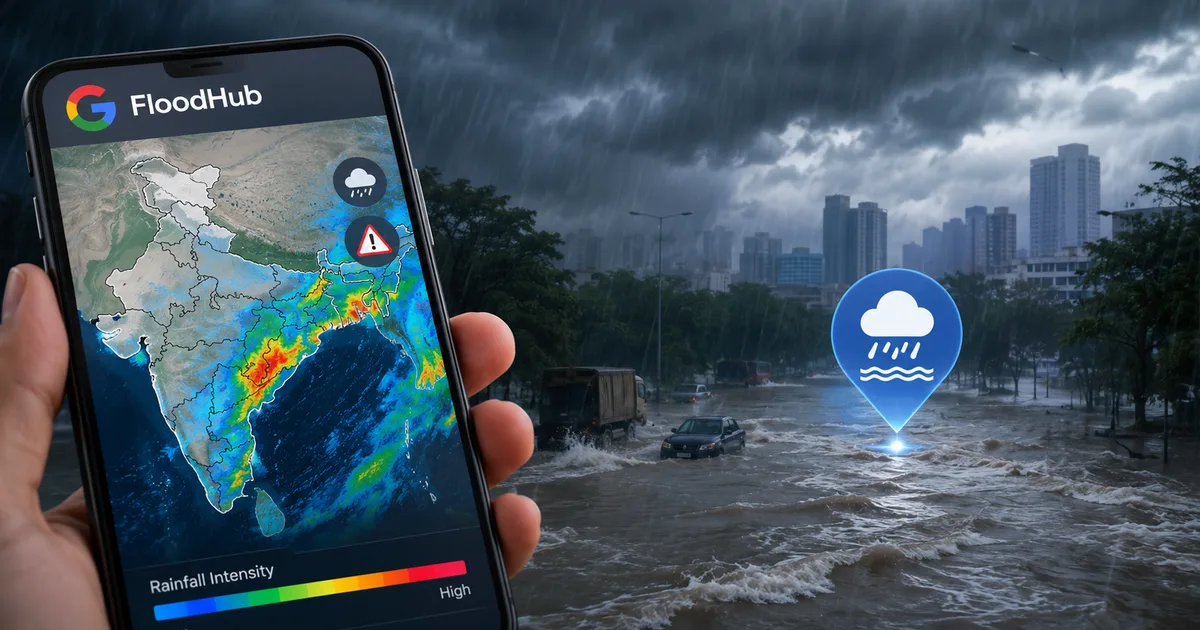
Look, the monsoon season in India is getting wildly unpredictable. One day you're complaining about the heat, and the next day your neighborhood street has turned into a rushing river. I've seen cars floating away in Bengaluru and Mumbai. It's a genuine nightmare. So when I started testing the new Google FloodHub AI 2026 update, I wanted to see if it actually works for us on the ground or if it's just more tech company noise.
Honestly, this is one of the more useful features they've added to their AI lineup.
They aren't just throwing data at a wall. They're using actual machine learning to predict where water is going to go before it gets there. And for anyone living in a flood-prone area (which is basically half of India right now), this is a big deal.
What exactly is the Google FloodHub AI 2026 update?
Basically, FloodHub is a platform Google built to predict riverine and flash floods. They take public data and weather models and feed it all into their AI. The system then spits out a map. This map shows exactly where floods are likely to happen up to seven days in advance. The 2026 update is a massive expansion. They announced recently that their AI now covers 2 billion people across 80 countries. A huge chunk of those people are right here in India.
They rolled out some major announcements at Google I/O Connect India 2026 recently. They're bringing in-country AI processing and fully air-gapped deployments for Indian enterprises. This means they're getting serious about localizing their tech. They're even partnering with local meteorological departments to make the predictions sharper. I tried looking up my own city last week, and the level of detail is honestly surprising. You can see specific villages and neighborhoods mapped out with color-coded warning levels.
How to use FloodHub to track rainfall and alerts
You don't need a fancy app or a subscription. It's completely free. Here's the deal on how to set it up and actually use it.
- Open your phone browser or desktop and search for "Google FloodHub".
- Click on the official link. It will open up a map interface that looks a lot like Google Maps.
- Zoom in on your state or city. You will see colored pins.
- Click on a pin near your area. It shows the current water level and the forecasted level for the next few days.
If things look bad, the pin turns red. That's your cue to move your car to higher ground or start packing a bag.
You can also turn on location-based notifications on your Android phone. When a flood is imminent, Google pushes a notification directly to your lock screen. In my experience, keeping this on is smart if you live near a river or in a low-lying urban area.
Comparing FloodHub with traditional IMD alerts
We all know the Indian Meteorological Department (IMD). They do a tough job. But their alerts can sometimes be a bit broad. "Heavy rainfall expected in coastal Karnataka" is helpful, but it doesn't tell you if your specific street is going to go under water. Here's a quick breakdown of how FloodHub compares.
| Feature | Google FloodHub AI | Traditional IMD Alerts |
|---|---|---|
| Precision | Hyper-local, often down to specific village boundaries. | Usually district or state level. |
| Lead time | Up to 7 days in advance. | Typically 24 to 48 hours. |
| Format | Visual maps and direct phone notifications. | Text bulletins, SMS, and news reports. |
| Data source | AI models combined with satellite and terrain data. | Radar, weather stations, and manual forecasting. |
The AI system doesn't replace the IMD. It actually relies on some of their data. But it processes that information much faster. And it presents it in a way that is immediately actionable for regular people.
Why this matters for small businesses and freelancers
Think about a small shop owner in Assam or Bihar. A sudden flood can wipe out lakhs of rupees in inventory overnight. We're talking about severe financial ruin.
Having even a two-day head start means you can move goods to the first floor or secure your shop. Even for freelancers and remote workers, floods mean power cuts and internet outages. If I know a flood is hitting my area on Thursday, I can warn my clients and finish up projects early. I might even buy a backup UPS or power bank. A standard 10,000mAh power bank costs around INR 1,000. And knowing when to keep it fully charged is a simple thing that saves you a lot of headache (annoying, I know).
You can read more about how AI is changing business on our guides page, but this is a very practical, immediate benefit.
The technology behind the predictions
The tech relies on two main models. First is the Hydrologic Model. This predicts how much water will flow into a river based on rainfall and weather forecasts. Second is the Inundation Model. This takes the water flow data and simulates exactly where the water will spill over the banks.
Google has been training these models for years. They're using massive amounts of historical data to teach the AI how water behaves in different terrains. And because it's AI, it gets slightly better with every flood event. It learns from its mistakes.
Google stated that their Crisis Resilience AI now covers 2 billion people, aiming for a world where no one is surprised by a natural disaster.
This is a big claim.
I'm usually skeptical of massive tech promises. I'm not sure exactly why they think they can cover everyone, but seeing the system work during the recent pre-monsoon showers in Kerala made me a believer. The accuracy was spot on for a few heavily affected districts.
The limitations you need to know about
I'm not going to pretend this is a magic bullet. The system has flaws. It's mostly focused on riverine floods right now. That means rivers overflowing their banks. It struggles with flash floods in highly concrete urban areas where drainage systems simply fail. If your city floods because the municipal corporation didn't clean the storm drains, Google can't predict that very well.
Also, it needs an internet connection to check the maps.
During a severe storm, telecom networks often go down. If you don't get the warning before the towers fail, the tool is useless. The government needs to figure out how to broadcast these AI alerts over traditional radio or offline SMS networks.
We see similar issues with other tech rollouts. You can check our explainers on government portals to see how infrastructure limits often hold back good software.
India-specific context and privacy
With all this data processing, some people worry about privacy. Google says the flood alerts use anonymized location data to send push notifications. They don't track your exact identity for this specific service. The numbers here are a bit fuzzy, but given the recent push for local data processing in India, with Google launching sovereign AI stacks, the data is likely staying within Indian borders.
If you're worried about tech scams, like those fake SMS messages promising government relief funds, just remember that Google FloodHub will never ask for your Aadhaar number or UPI pin. It's just a map. If you get a message saying you need to pay a fee to access premium flood alerts, that's a scam. Report it immediately to the national cybercrime portal at cybercrime.gov.in or call the 1930 helpline. We track a lot of scams on our scams page.
Getting ready for the season
So, should you start using it? Yes.
It takes thirty seconds to look up your town. It's free, and it has information you simply can't get from a regular weather app. I check it every few days now during the rainy season. It gives me a bit of peace of mind.
We're going to see a lot more of this AI integration in everyday tools. It isn't all just chatbots writing emails. Sometimes, it's complex math figuring out if your house is going to be safe next Tuesday. And honestly, I'll take that over another AI text generator any day.