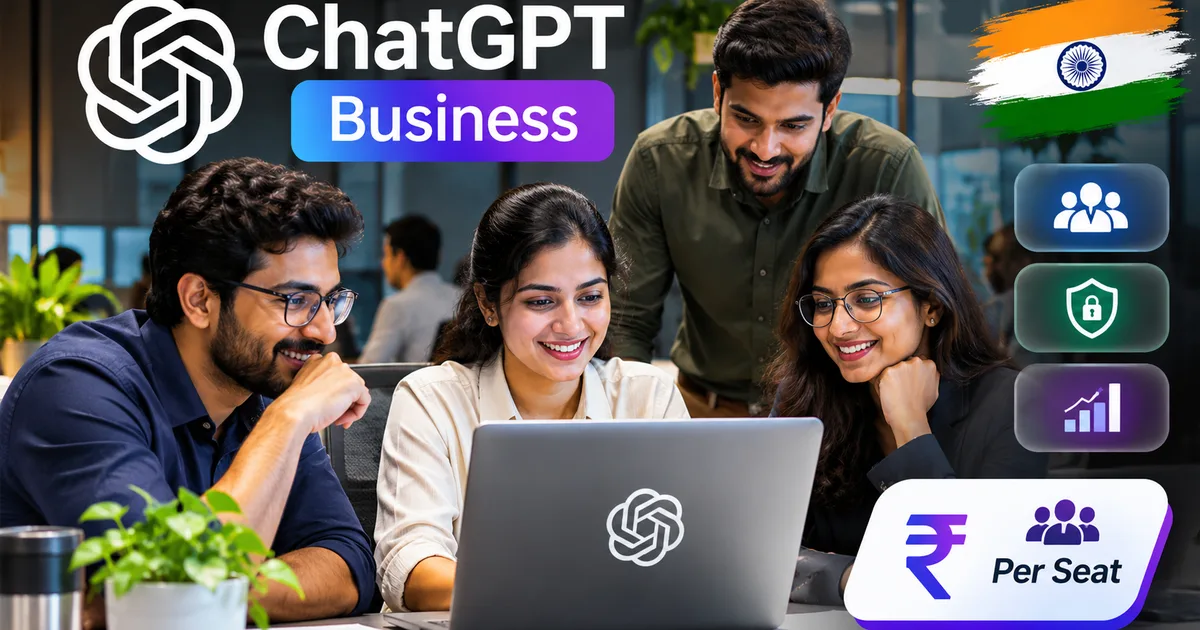
OpenAI has rolled out a major shake-up to its corporate offerings by introducing a $125 monthly Premium tier for ChatGPT Business, aimed at heavy power users who need five times the capacity of standard seats. For Indian businesses, this launch lands at a peculiar moment. OpenAI recently began displaying sponsored advertisements to over 100 million free and entry-level users across India, making the clean, ad-free environment of a paid workplace plan far more attractive. If you run a startup in Bengaluru, an agency in Mumbai, or a chartered accountancy firm in Delhi, you're probably wondering whether paying for dedicated seats makes financial sense.
I spent time running the numbers on seat costs, tax bills, and usage caps to see where the value actually sits. Look, enterprise software pricing in India is always tricky. When you convert dollar subscriptions to Indian rupees and add local taxes, software bills swell fast. But with privacy regulations tightening across the country, running a business on shared personal logins isn't a viable shortcut anymore.
What OpenAI ChatGPT Business actually gives your team
Let's be straight about how many Indian offices currently handle artificial intelligence. Five colleagues share one personal login on a communal browser, or everyone uses their individual free accounts and pastes company drafts into open chats. It's messy. It's unsafe.
ChatGPT Business replaces that chaos with a centralized admin dashboard. As the administrator, you invite team members using their corporate email addresses, assign workspace roles, and control who can view shared projects. You can build shared custom GPTs trained on internal documentation, such as customer support playbooks or company travel policies. Workspace members also get access to collaborative editing spaces, which you can explore in detail through our OpenAI Canvas workspace guide, allowing writers and developers to refine output together in real time.
Administrative control makes offboarding painless (which, for the record, I think is one of the biggest reasons to upgrade). When a contractor or junior executive moves on, you don't need to change shared credentials across six different team chats. You simply remove their license from the console, and their access to corporate conversations terminates on the spot.
ChatGPT Business team seat pricing in Indian rupees
Pricing for ChatGPT Business requires straightforward math once you account for currency conversion and Indian tax obligations. OpenAI prices standard seats at $25 per user each month when billed on an annual agreement, or $30 per user each month on a rolling monthly cycle. You must buy at least two seats to start a business workspace.
At an exchange rate of roughly ₹87 per US dollar, the annual commitment comes to approximately ₹2,175 per seat every month. If you choose monthly billing for maximum flexibility, that figure rises to around ₹2,610 per seat each month.
Then comes the 18% Integrated Goods and Services Tax (IGST) applicable to Online Information Database Access and Retrieval (OIDAR) services under Indian tax law. Unless you supply an active Indian GSTIN during checkout to settle taxes under reverse charge, OpenAI adds that 18% directly onto your card charge. That lifts your real monthly cost on the annual commitment to roughly ₹2,566 per user.
Here's what the standard seat math looks like across different office sizes on annual billing before taxes:
- Two seats minimum: $50 per month, which equals roughly ₹4,350 monthly or ₹52,200 annually.
- Five seats for a growing agency: $125 per month, coming to about ₹10,875 monthly or ₹1,30,500 annually.
- Ten seats for an engineering squad: $250 per month, totaling roughly ₹21,750 monthly or ₹2,61,000 annually.
- Twenty seats for a scaling startup: $500 per month, reaching approximately ₹43,500 monthly or ₹5,22,000 annually.
Those numbers represent real budget lines for an Indian firm, yet they remain significantly cheaper than contracting an additional junior resource.
Standard seats versus the $125 premium tier
The biggest update to the platform is the introduction of Premium seats priced at $125 per user each month. In Indian currency, that equals roughly ₹10,875 before tax, or about ₹12,830 per month once local GST applies (I know, sounds steep, but wait until you see the difference in limits).
Why would any sensible Indian founder pay five times the standard rate for an individual seat?
The answer comes down to operational limits. Standard seats share general capacity caps during peak business hours. When your developers run extensive debugging sessions through advanced reasoning models, they hit hourly messaging fences quickly. The Premium seat provides five times the operational capacity and unrestricted priority access to OpenAI's most capable reasoning models.
Honestly, buying Premium seats for your entire staff is a poor use of capital. Your social media manager or customer support rep doesn't need a ₹12,800 monthly seat to polish emails. But allocating two Premium seats to your lead software architects while keeping eight other teammates on Standard seats makes complete financial sense. OpenAI allows this mixed-seat structure within the same billing dashboard, preventing your total software spend from getting out of hand.
Data privacy and India's DPDP Act
If you keep up with daily Indian tech news, you know that data compliance is no longer optional. India's Digital Personal Data Protection (DPDP) Act sets substantial financial penalties for unauthorized handling or leakage of personal digital records. When employees paste client PAN details, medical histories, or proprietary sales sheets into public AI tools, that information can be incorporated into model training pools.
ChatGPT Business establishes a formal contractual barrier against that risk.
OpenAI contractually guarantees that customer data submitted to ChatGPT Business is not used to train its AI models, giving teams a clean shield under Indian data privacy regulations.
Your team conversations, uploaded spreadsheets, and custom GPT instructions stay isolated within your organizational boundary. CERT-In cybersecurity directives also advise tight administrative supervision over enterprise digital tools. Having full administrative control over employee accounts ensures that proprietary company knowledge doesn't walk out the door.
The payment headache: RBI e-mandates and GST
Paying for international software subscriptions from India can be frustrating. The Reserve Bank of India enforces strict Additional Factor of Authentication (AFA) and e-mandate rules for recurring card debits. Because foreign software vendors bill through international gateways that don't always trigger an Indian one-time password (OTP), personal credit cards and debit cards issued by banks like SBI or HDFC frequently decline recurring renewals.
Here's how Indian businesses handle recurring billing without unexpected workspace disruptions:
- Set up an Indian corporate credit card that supports international transactions and recurring merchant authorizations.
- Use business expense management cards from platforms like RazorpayX or Zaggle that handle cross-border SaaS subscriptions smoothly.
- Enter your company PAN and 15-digit GSTIN in the billing preferences section before completing checkout.
- Download the monthly tax invoice to claim Input Tax Credit against your company's GST liabilities.
Adding your GSTIN to the billing profile saves your company 18% in cash flow every billing cycle. That simple step recovers thousands of rupees across a calendar year.
ChatGPT Business India guide: making the call
Deciding whether to adopt ChatGPT Business comes down to your team structure and data exposure. Solo freelancers and independent consultants should remain on individual plans. You don't need a team management console, and paying for the mandatory two-seat minimum would mean spending ₹2,500 every month on a blank seat you don't need.
Small teams of three to fifteen professionals handling sensitive client deliverables will find immediate value in Standard seats. The plan stops chaotic account-sharing, protects client data from public training pools, and delivers reliable generation capabilities. If you have full-time coders or data analysts who constantly hit usage ceilings, upgrade just those specific seats to the Premium tier.
For an alternative view of team pricing and governance models, read our analysis of the Anthropic Claude Enterprise workspace to compare safety safeguards and administrative controls. You can also browse our curated AI tools directory to evaluate other workplace assistants. OpenAI's mixed-seat model makes ChatGPT Business practical for Indian teams, provided you configure billing properly and assign premium licenses only where daily workloads truly justify the cost.