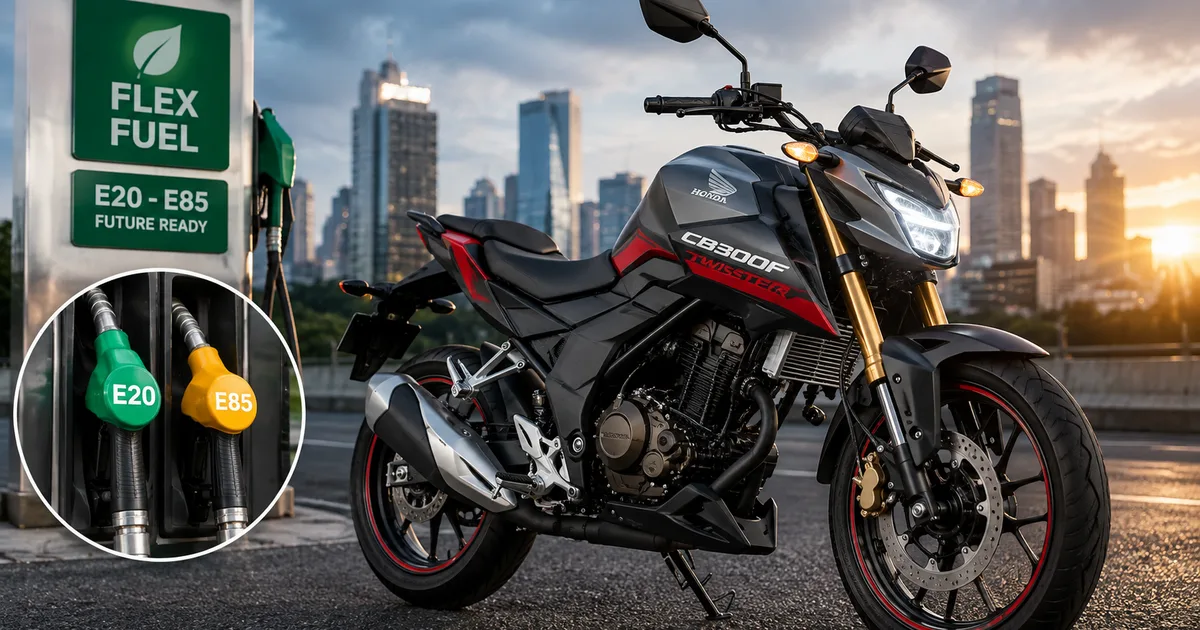
You pull into a petrol pump in Delhi or Bangalore right now, and the attendant asks if you want normal or speed. In a few years, that conversation might sound very different. You'll probably be thinking about the Honda CB300F Twister 2027 Flex Fuel India launch because ethanol blending is changing how we buy bikes. Honda just revealed this flex-fuel version in Brazil. It gives us a clear look at what is coming to Indian roads. I've been tracking these flex-fuel updates for a while. The shift is real. It isn't some distant concept anymore.
This new Twister can run on plain petrol or ethanol blends. That means you get choices. Honestly, it's about time we saw this technology trickle down to the 300cc segment. Here's what this means for your daily commute. And your wallet.
What is flex fuel technology anyway?
A lot of people hear "flex fuel" and assume their bike is going to run on some weird chemical mix that ruins the engine. That's definitely not true. Look, a flex-fuel engine is just a standard internal combustion engine with upgraded parts. It can burn petrol. It can burn ethanol. Or it can burn a mixture of both right in the same tank.
You don't need a separate tank for the ethanol (which makes sense, actually). The bike's computer figures out the ratio and adjusts the fuel injection automatically. Honda calls their specific system FlexOne. It uses sensors to measure what you just pumped into the tank. Then it changes the spark timing and fuel delivery on the fly.
Why does this matter for India? The Indian government has been pushing hard for E20 fuel. E20 means 20 percent ethanol and 80 percent petrol. Ethanol is made from crops like sugarcane. We have plenty of that in states like Maharashtra and UP. Importing crude oil costs the country billions of rupees. Growing our own fuel saves money. It's basic economics.
But ethanol is corrosive. If you put high-ethanol fuel in a normal bike, it eats the rubber seals and plastic fuel lines. A flex-fuel bike like the new CB300F has reinforced fuel lines. It also has a tougher fuel pump. The engine valves are hardened to handle higher temperatures too.
Looking at the 2027 Honda CB300F Twister specs
The Brazilian launch gave us the exact spec sheet. It's mostly good news. The engine is a 293cc single-cylinder unit with an oil cooler. When running on pure petrol, it makes around 24.5 horsepower. But here's the interesting part. When you run it on ethanol, it actually makes a tiny bit more power. Ethanol has a higher octane rating. So the engine can run more advanced ignition timing without knocking.
I don't think you'll feel a massive difference on your commute to the office. But knowing the bike runs cleaner and slightly stronger on local fuel is nice.
Honda also threw in some solid hardware upgrades. The front end now has Showa upside-down (USD) forks. The older models felt a bit soft when you pushed them in corners. These USD forks should make the front end feel much more planted.
Here are the main features you get on the new model:
- Showa USD front forks for better cornering stability
- Honda Selectable Torque Control for managing rear wheel slip
- Full LED lighting all around the bike
- A digital instrument cluster with ethanol blend indicators
- Dual-channel ABS as standard equipment
How the traction control actually works
Traction control on a 300cc bike might sound like overkill to some of you. The CB300F isn't a superbike. It won't accidentally flip you backwards if you sneeze on the throttle. But Indian roads are a mess sometimes. You might hit a patch of gravel, or some spilled diesel. Even a wet white line during the monsoons can be sketchy.
The traction control system monitors the speed of both wheels. If the back wheel starts spinning faster than the front wheel, the computer cuts engine power for a fraction of a second. It stops the slide before you even realise it happened. In my experience, I've ridden bikes with basic traction control in the rain, and it saves you from stupid mistakes.
Expected Honda CB300F flex fuel price in India
Pricing is tricky right now. The current standard petrol CB300F saw some massive price cuts recently. Some dealers were selling the base model for around Rs. 1.55 lakh ex-showroom. But that was for clearing old stock.
A new 2027 model with Showa USD forks, traction control, and flex-fuel capability will definitely cost more. The reinforced engine parts for ethanol compliance aren't cheap.
I expect the launch price to sit somewhere between Rs. 1.90 lakh and Rs. 2.10 lakh ex-showroom. This puts it right in the middle of a very crowded market. It will compete directly with the Suzuki Gixxer 250 and the KTM Duke 250.
Running costs are the real selling point. If ethanol becomes cheaper than petrol at the pumps, the per-kilometre cost of this bike will drop significantly. The claimed mileage for the current model is around 33 kmpl. You might see a slight drop in fuel efficiency when running on high ethanol blends. That's because ethanol contains less energy per litre than petrol. But if the fuel costs less per litre, your monthly fuel bill might still go down.
You can check out our explainers section to read more about how ethanol affects engine efficiency.
The bigger picture for Indian motorcycles
Honda isn't the only company doing this. The entire two-wheeler industry is scrambling to meet the new government mandates. Royal Enfield was recently spotted testing a flex-fuel version of the Classic 350. They are aiming for E85 compliance. That means the bike can run on 85 percent ethanol. Hero MotoCorp is also working on flex-fuel versions of the Splendor+ and HF Deluxe.
This transition reminds me of the jump from BS4 to BS6 emission norms. It caused a lot of panic. Prices went up. People complained. But after a year, everyone got used to it. The bikes got smoother and more reliable thanks to fuel injection.
The move to flex fuel will probably follow the same pattern. The initial bikes might be slightly more expensive. People will argue on WhatsApp groups about engine reliability. Just watch out for misinformation. Like those fake messages claiming the government will ban all old petrol bikes. You can read our scams page to see how quickly these fake rumors spread online.
What should you do right now?
If you're planning to buy a 300cc bike in the next few months, should you wait for the 2027 CB300F Twister?
It depends on your priorities. If you keep your bikes for 8 to 10 years, waiting for a flex-fuel model makes a lot of sense. The fuel stations of the future will prioritise E20 and higher blends. Having a bike that is built specifically for those fuels gives you peace of mind.
But if you change bikes every three years, you don't need to wait. Current BS6 phase 2 bikes can handle E20 fuel without falling apart immediately. The government mandates say all new vehicles must be material-compatible with E20. They might not be fully optimised for it like the FlexOne Honda. But they'll work.
"The introduction of flex-fuel motorcycles is a necessary step for energy independence, but the real test will be the availability of high-blend ethanol at local fuel stations across India."
If you ask me, Honda is playing this smart. The CB300F was always a sensible, slightly boring choice in the 300cc segment. Adding USD forks and traction control gives it some excitement. Adding the flex-fuel engine gives it a sensible selling point.
The Indian launch timeline is a bit fuzzy. Honda usually takes about six to eight months to bring their Brazilian models to India. We'll likely see this bike at an auto show or a dedicated launch event late next year.
We'll keep tracking the local testing. Until then, make sure your Aadhaar is linked to your vehicle registration. Keep your papers in DigiLocker. And ride safe. If you want to understand more about vehicle registrations and government apps, we have a few detailed guides you can read.
Ethanol supply chain and fuel stations in India
Finding ethanol-blended fuel is the next big hurdle. Right now, most major petrol pumps in tier 1 cities like Mumbai, Delhi, and Bangalore have started dispensing E20 fuel. The oil marketing companies like Indian Oil and Bharat Petroleum are upgrading their infrastructure. But if you ride out to a rural area in Rajasthan or Bihar, you're likely getting regular E10 or unblended petrol.
This is exactly why the Honda CB300F Twister 2027 Flex Fuel India launch is important. A pure ethanol vehicle would leave you stranded on a highway. A flex-fuel vehicle doesn't care. If you find an E85 pump, you fill it up. If you only find standard petrol, you fill that up. The bike handles the math.
When you pay for fuel these days, it's almost always via UPI. I scan the PhonePe or GPay QR code at the pump without even thinking about it (annoying, I know). The government has integrated the entire fuel supply chain digitally. You can even check fuel prices on various apps before you leave the house. Having a bike that taps into the locally produced ethanol economy just fits perfectly into this modern, digital India. We're reducing our reliance on imported oil. We pay instantly from our bank accounts. We ride bikes that adjust their own spark timing. It is a massive technological leap from the carbureted Splendors we rode ten years ago.
Comparing the CB300F to the competition
You have to look at the rivals to understand where the CB300F sits. Consider the Suzuki Gixxer 250. The Gixxer has an amazing oil-cooled engine. It is incredibly smooth on the highway. But the design is getting a bit old. It also lacks traction control.
Then there is the Bajaj Dominar 250. The Dominar is a heavy machine. It feels great on a straight highway. But it's a workout in heavy traffic. The Honda CB300F is much lighter. It tips into corners easily and doesn't cook your legs in bumper-to-bumper traffic.
And we can't ignore the new Royal Enfield models. Royal Enfield is testing the Classic 350 Flex Fuel right now. But a Classic 350 and a CB300F are completely different tools. The Classic is about relaxed cruising. The CB300F is an aggressive streetfighter meant for quick overtakes. They appeal to completely different riders.
If Honda prices the CB300F correctly, around Rs. 1.95 lakh, it becomes a very logical purchase. You get Japanese reliability. You get cheap running costs with ethanol. And you get modern safety features.
The maintenance reality of flex fuel engines
I see a lot of mechanics worrying about flex-fuel engines. They think these engines will require specialized tools or expensive computer diagnostics for every minor service. That's mostly a myth.
The basic mechanical parts of the CB300F remain exactly the same. You still change the engine oil every few thousand kilometres. You still clean and lube the chain. You still check the brake pads.
The only difference is the fuel delivery system. The FlexOne ECU and the upgraded fuel injectors are sealed units. If they fail, you replace them. You don't fix them with a screwdriver. But Honda parts are generally very reliable. And since the government is mandating these changes, every local mechanic will have to learn how to deal with them eventually. It's just like the transition to fuel injection a few years ago. People panicked. Then they learned. And now nobody wants to go back to carburetors.
The oil cooler on the CB300F is a nice touch. It keeps the engine temperatures stable during long rides. Ethanol burns a bit differently than petrol. So managing engine heat is important for longevity. Honda knows what they're doing here.
Wrapping up the specs
The global launch gives us a solid summary of what to expect. The engine is a 293cc air/oil-cooled single. It has a six-speed gearbox with a slip and assist clutch. The fuel tank holds roughly 14 litres. The braking is handled by disc brakes at both ends with Nissin calipers. The seat height is usually around 789mm. This is very comfortable for the average Indian rider.
The design has been sharpened up. The tank extensions look more aggressive, and the tail section is slimmer. It looks like a proper modern streetfighter now.
Is it enough to beat the KTM Duke 250? Probably not in terms of raw speed. The KTM makes more power and has a more aggressive chassis. But the Honda will likely be cheaper to buy. It's cheaper to run. It's easier to live with in heavy city traffic. And with the flex-fuel tech, it is definitely more future-proof. You can check out our news section for more updates as the official India launch date gets closer.