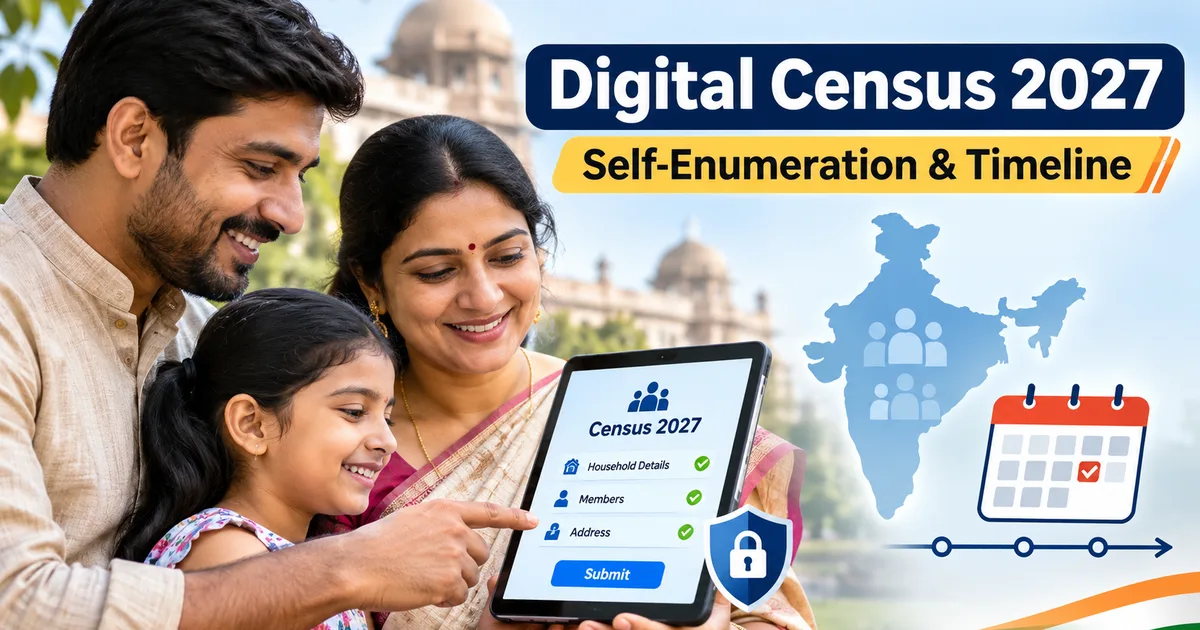
If you live in Uttar Pradesh, Punjab, Goa, or Uttarakhand, your housing society WhatsApp group has probably been buzzing all week. Someone forwards a government link telling everyone to submit a form before November 30, and three neighbours immediately ask if they have to install another app on their phones. Welcome to India Digital Census 2027. For the first time since the country began counting its population in the 1870s, this massive headcount is moving off bulky paper registers and onto web browsers and handheld tablets. Think of it like completing online bank e-KYC before an agent visits your home to verify your details, except here you answer 40 household questions online so an enumerator doesn't stand at your gate for half an hour.
And honestly, the upgrade was long overdue. India's last completed Census happened way back in 2011. Pandemic disruptions pushed the 2021 cycle out by years. So state governments and city planners are still working off population numbers that are more than 15 years old.
Knowing how the portal works, why deadlines change by state, what's new since 2011, and when the enumerator shows up saves a lot of confusion when someone finally rings your doorbell.
How the self-enumeration portal and app system works
First, stop looking on the Google Play Store or the Apple App Store for a citizen Census app. There isn't one. Installing random APK files forwarded on WhatsApp is an easy way to hand scammers access to your banking apps (and those sketchy WhatsApp forwards spread fast). For regular residents, the whole thing runs on one official government site: se.census.gov.in.
Wait, so where does the app part come in? That software is only for the enumerators, not the public. Official field workers visiting homes carry handheld devices loaded with custom census software to log and check entries on the spot, while you just use a normal phone or laptop browser.
The online form is pretty simple. I haven't seen every validation screen for the states opening in January yet, and the exact rollout details for later phases are still a bit fuzzy, but based on the Registrar General of India's instructions right now, here's how it goes:
- Open se.census.gov.in in your browser and select one of the 16 Indian languages supported by the portal.
- Log in with your mobile number, ideally the same number your household registered during the Phase 1 houselisting round, along with basic household details.
- Answer 40 notified questions covering household particulars and individual details for every resident living under that roof.
- Review the spellings and birth years carefully, then submit the form to generate a unique Self-Enumeration ID (SE ID).
- Save that SE ID and share it with the census enumerator during their door-to-door visit.
That last step trips plenty of people up, if you ask me. Submitting the online form doesn't mean nobody visits your house. You still get an in-person visit during the field window. Thing is, instead of keeping your whole family waiting in the living room while an official types everyone's education and job details on a tablet, you just hand over your SE ID so they can check and close your entry in minutes.
'The self-enumeration process is a secure, convenient and user-friendly web-based facility available in 16 Indian languages.'
Look, registering on se.census.gov.in costs Rs 0. Nobody from the Ministry of Home Affairs is going to call asking for your Aadhaar OTP or UPI PIN. They won't ask for a verification fee either. If you get sketchy links or WhatsApp APK files claiming to be Census updates, check our online scam alerts before you tap anything.
Phase 1 vs Phase 2 and the India Digital Census 2027 timeline
India never counts 1.4 billion people in a single weekend. It always splits into two stages, which is why different dates keep popping up in news headlines.
Phase 1 is the Houselisting and Housing Census (HLO). Basically, it's like drawing the map before you count the passengers. Enumerators log buildings, house structures, drinking water sources, toilet access, and basic household assets. According to government statements from November 2026, Phase 1 is already finished across 35 States and Union Territories, except Manipur.
Phase 2 is Population Enumeration, the actual headcount of residents. Since several states have Assembly polls due early next year, the Registrar General of India split Phase 2 into staggered windows:
- Goa, Punjab, Uttar Pradesh, and non-snow-bound areas of Uttarakhand have online self-enumeration open from November 16 to November 30, 2026, followed by house-to-house visits from December 1, 2026 to January 4, 2027, and a revisional round from January 5 to January 9, 2027.
- Remaining participating States and Union Territories, including Delhi, Meghalaya, Maharashtra, Karnataka, and Tamil Nadu, get their online self-enumeration window from January 10 to January 24, 2027, followed by door-to-door counting from January 25 to February 28, 2027, and a revisional round from March 1 to March 5, 2027.
- Ladakh and snow-bound non-synchronous areas of Jammu and Kashmir, Himachal Pradesh, and Uttarakhand completed population enumeration earlier to avoid winter snow cutoffs.
- Manipur remains on hold until further orders following High Court directions.
Those five extra days at the end, called the revisional round, are just a cleanup pass. Enumerators come back or update entries for any births or deaths that happened right up to the official timestamp.
You'll also hear officials talk about a reference date like 00:00 hours on January 5, 2027 for the four poll-bound states, or 00:00 hours on March 1, 2027 for the rest of the country. Think of it like taking a freeze-frame photo of a packed Mumbai local train at midnight (good luck getting everyone to stand still, right?). Even though field visits stretch across five weeks, the official count freezes the national snapshot at that exact midnight timestamp under India's official clock, alongside mandatory Indian Standard Time rules. I think this midnight cutoff makes sense on paper, though it always sounds a bit weird until you picture the train photo.
What changed in India Digital Census 2027 compared to 2011
If you remember the 2011 Census, you probably remember a tired schoolteacher carrying thick paper bundles wrapped in cloth, writing with a ballpoint pen, and hoping it wouldn't start pouring. Millions of physical sheets then had to be bundled, trucked to scanning hubs, and digitized over years.
Moving field entry onto tablets changes speed and cuts down silly errors. When an enumerator enters details into the software, built-in checks flag impossible birth years or mismatched household totals right away. And once the tablet connects to mobile data, entries sync straight to central servers instead of sitting in district godowns for months.
Real-time syncing sounds tidy on paper until you step into a valley in Meghalaya or a remote block in Chhattisgarh with patchy 4G. Honestly, I couldn't find clear official specs on how long the enumerator software stores data offline between syncs, so that technical detail is a bit fuzzy. Expanding rural satellite internet coverage should eventually help patch dead zones. Still, keeping tablets charged and online in rural districts is going to be a real test for state teams, if you ask me.
Putting the web portal in 16 Indian languages is a genuinely smart move. Parents can read questions comfortably in Hindi, Tamil, Marathi, Bengali, or Malayalam without guessing English terms. Meanwhile, a son or daughter living in a Bengaluru PG can log in after office hours and submit accurate household details.
Families also keep asking about relatives living abroad or working in another city. The October 30, 2026 notification issued under Section 3 of the Census Act, 1948 and Rules 6A and 6D of the Census Rules, 1990 sets out how local residents, internal migrants, overseas students, and NRIs are classified under usual residence rules. Mostly, the Census counts people living at their usual place of residence during the enumeration window, not every Indian passport holder living overseas permanently. So if someone in your family is studying abroad or working in another state, read the residency instructions inside se.census.gov.in carefully before submitting so they don't get counted twice or skipped.
Disability data, caste questions, and privacy concerns
Faster software fixes paperwork bottlenecks. It doesn't fix gaps in the questions themselves.
That issue drew sharp scrutiny in late November 2026 around how India counts disability. In the 2011 Census, India recorded 26.8 million persons with disabilities, which is 2.21% of the population. Independent surveys asking broader questions about how people handle daily activities came back with noticeably higher numbers. After an official visit to India from November 16 to 25, 2026, UN Special Rapporteur Heba Hagrass urged authorities to adopt a census method that captures the everyday barriers people face at school or at work, rather than sticking to narrow labels. Whether the 40-question digital form captures that well won't be clear until the full tables come out.
Political debate around caste enumeration and future Lok Sabha seat freezes is also running alongside the rollout. But from a pure tech perspective, cybersecurity is the bigger immediate test, I think. Researchers at the Observer Research Foundation (ORF) have warned about the security stakes of digitizing personal records for over 1.4 billion people. Under the Census Act, 1948, your individual household answers are legally confidential and can't be inspected in court or used for income tax and policing (which is a relief, honestly). Even so, locking down central databases against breaches is a massive backend engineering job. For more breakdowns on how large public digital platforms handle privacy and infrastructure, browse our tech explainers section.
Practical tips before you fill out your online form
If your state's online window is open right now or starts on January 10, don't wait until the last night. Traffic spikes always slow down OTP delivery.
- Keep the mobile phone registered during Phase 1 houselisting beside you so OTP login goes smoothly.
- Write down exact birth years, schooling status, and work particulars for everyone living in the house before opening se.census.gov.in.
- Save a PDF copy or clear screenshot of your SE ID immediately after submitting, and share it with elderly parents at home if they will meet the enumerator.
- Don't panic if you miss the 15-day self-enumeration window, because an enumerator will still visit your residence during the door-to-door phase to record your details.
Honestly, if you already order groceries or pay electricity bills using UPI, doing this online is well worth the 15 minutes, in my experience. You knock it out over a cup of chai and make sure nobody misspells your family's names at the gate.