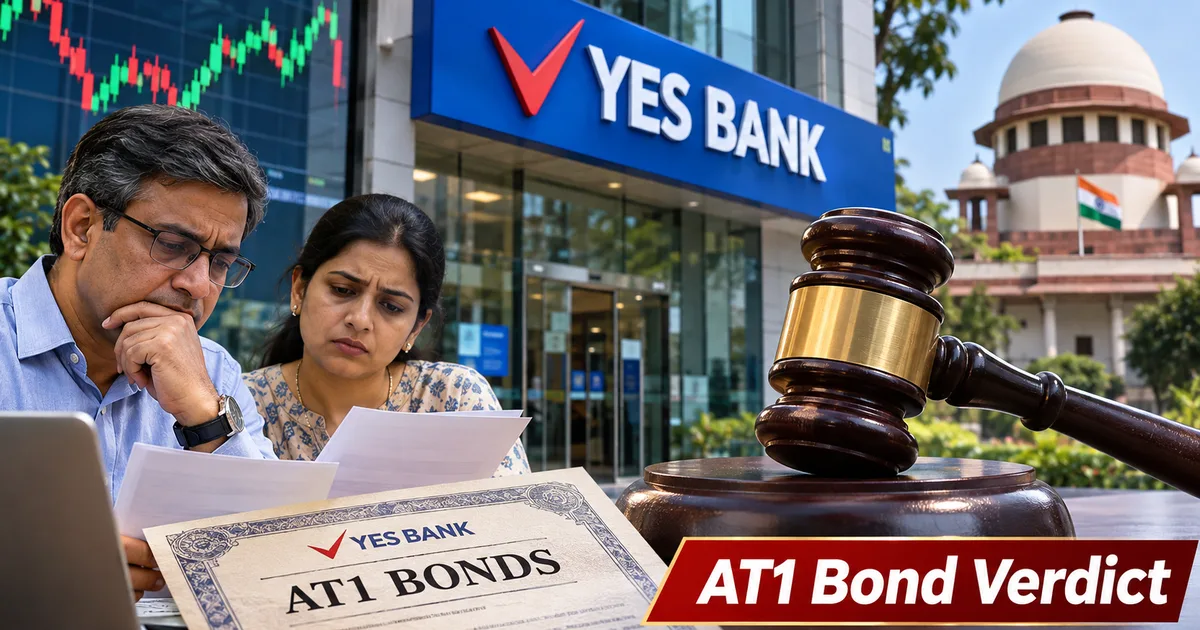
Picture this. It's mid-October 2026, you open your Groww or Zerodha app over morning chai, and Yes Bank is bleeding red, down 14.5% in a single trading session. Your family WhatsApp group lights up right away with frantic messages asking if the bank is collapsing all over again. Nope. What actually rattled the market was the Supreme Court's Yes Bank AT1 bond verdict on October 15, 2026, and that ruling revived a six-year-old Rs 8,415 crore bill nobody quite knows how to pay.
Now think about a retired uncle in Pune who put Rs 10 lakh into those same bonds back in 2017 because his relationship manager promised him a juicy interest rate. His entire principal vanished overnight in March 2020. For him, this verdict looked like justice finally knocking on the door. Except things are never that simple (annoying, I know). By mid-November 2026, both the Reserve Bank of India (RBI) and Yes Bank had rushed back to the Supreme Court for a review, and the Central government filed one too.
So what on earth is an AT1 bond? Why did the court overturn a 2020 bank rescue decision, and where does that leave everyday Indian investors like us? If you ask me, the whole saga is a mess.
What are AT1 bonds, really?
Banking jargon is great at making normal people tune out in ten seconds flat. Stick with me for a minute, though, because Additional Tier-1 (AT1) bonds are actually easy to understand once you drop the fancy labels.
Think of a bank like a big neighbourhood co-operative that borrows money from different people to run. Regular savings accounts and fixed deposits are at the front of the repayment line. When trouble hits, those depositors get protected first. Equity shareholders sit at the very back since they own the bank, so their share price takes the beating before anyone else loses money.
AT1 bonds sit in an awkward spot right between regular debt and equity shares. They are perpetual bonds, which means they have no fixed maturity date. You don't automatically get your principal back after five or ten years like you would with a normal corporate bond or a bank FD. Instead, the bank pays a higher interest rate, often 9% to 10% back when regular FDs barely crossed 6.5% or 7%, and the bank has an option to buy the bond back later if it wants.
There's always a catch with rates that good. Buried inside the offer document is a strict loss-absorption clause. Under global Basel III banking norms, AT1 bonds are built to act as a shock absorber. If a bank's capital drops below a danger mark and hits what regulators call the point of non-viability, those bonds can be converted into shares or written down to zero.
Poof. Gone.
Honestly, this is where things turned into a real mess in India. Mutual funds and insurance companies usually know the risks, or at least they're supposed to. In the late 2010s, though, plenty of wealthy individuals and middle-class retirees were pitched AT1 bonds as 'super FDs' with extra interest. I'm not sure why the pitch got so sketchy. High commissions probably helped. Either way, most buyers had no clue their money could legally vanish before equity shareholders lost everything.
Why the Supreme Court quashed the Rs 8,415 crore write-off
To see why the judges ruled this way in October 2026, you have to rewind to March 2020. Yes Bank was on the edge of collapse under a mountain of bad loans. The Central government put the bank under a moratorium and capped cash withdrawals, so millions of UPI and debit card users suddenly panicked. Meanwhile, the RBI replaced Yes Bank's board with an administrator and brought in State Bank of India (SBI) along with other lenders to pump in rescue capital.
Before that crisis hit, Yes Bank had raised Rs 8,415 crore across two AT1 bond issues: Rs 3,000 crore in December 2016 and Rs 5,415 crore in October 2017.
Look, the next part honestly sounds like a classic government paperwork goof-up. The early draft of the rescue plan had a clear clause to write down those AT1 bonds. But when the Central government notified the final Yes Bank Reconstruction Scheme on March 13, 2020, that write-down clause had been dropped from the text (don't ask me how something that big gets left out at the last minute). Even so, the RBI-appointed administrator went ahead and wiped out all Rs 8,415 crore worth of AT1 bonds the very next day, on March 14, 2020.
Bondholders weren't about to swallow an Rs 8,415 crore loss quietly. Through their trustee, Axis Trustee Services Ltd, they took the fight to the Bombay High Court. In January 2023, the High Court sided with them because the final notified scheme didn't give the administrator legal power to do the write-off. Yes Bank and the RBI appealed to the Supreme Court, and the Centre filed an appeal too.
Fast forward nearly four years. On October 15, 2026, the Supreme Court tossed out those appeals and upheld the Bombay High Court's order. The judges didn't say AT1 bonds can never be written down. They just said the administrator skipped the legal process written into the final scheme.
'The order was more on technical grounds largely related to the process followed by the administrator and not on the concept of AT1 Bonds which are based on a globally accepted principle.' - Ambareesh Baliga, independent market analyst, speaking to The Hindu
If you ask me, that detail is what makes this case so wild. A paperwork slip made over one chaotic weekend in March 2020 turned into an Rs 8,415 crore legal headache six years later.
Who pays the bill: 60 lakh retail shareholders vs bondholders
Money doesn't come out of thin air. If Yes Bank has to put Rs 8,415 crore of wiped-out bonds back onto its books, someone has to pay for it. The stock market figured out who that someone is within minutes of the verdict.
Yes Bank's shares fell 14.5% on judgment day, its worst single-day drop since July 2020. Within a week, the stock was down 24% and sitting at its lowest level since 2005.
Thing is, big funds aren't the only ones holding this stock. Around 60 lakh retail shareholders own Yes Bank shares today. Many are small Indian investors who bought in over the past few years hoping for a steady turnaround. They're in the same boat as SBI and the other banks that rescued Yes Bank in 2020. As independent market analyst Ambareesh Baliga pointed out, those 60 lakh small investors already took a beating during the earlier crisis, and now they're staring at another hit.
Just look at the numbers Yes Bank itself put out. Putting the bond principal back on the books would shave around 250 basis points (2.5 percentage points) off its Common Equity Tier-1 (CET1) capital ratio, based on its June 2026 numbers. Our HDFC Bank Q2 results breakdown explains why capital buffers matter so much. For Yes Bank, brokerage estimates say the post-tax hit would wipe out over a full year's profit. That probably means a fresh fundraising round, which would dilute current shareholders even more.
'The underlying logic was that existing capital instruments should bear losses in accordance with their terms before new capital is introduced. Otherwise, the burden of repairing the bank risks being shifted to new investors or public resources.' - Shriram Subramanian, Founder and Managing Director of InGovern Research Services
I think both sides actually have a fair case here, which is why the whole situation is so ugly. Bondholders followed the exact text of the final scheme and won in two separate courts. At the same time, 60 lakh retail shareholders and the rescue banks had zero say in what the administrator signed on March 14, yet they might end up footing the bill (pretty unfair, if you ask me). Much like the EPFO higher pension verdict, a big legal win for one group of Indian savers can easily create a financial mess for whoever has to pay out.
Why RBI, Yes Bank, and the Centre filed review petitions
If you thought the October 15 judgment settled the matter, not even close. November 2026 turned into a full-blown legal sprint at the Supreme Court.
- Earlier in November 2026, Axis Trustee Services filed a contempt petition on behalf of bondholders, alleging that Yes Bank hadn't provided any clear roadmap to restore the bonds or carry out the court's order.
- On November 13, 2026, both the RBI and Yes Bank filed separate review petitions asking the Supreme Court to reconsider its October 15 judgment.
- On November 17, 2026, the Central government (Union of India) became the third party to file a review petition against Axis Trustee Services Ltd.
Why is the RBI fighting this so hard? Because for the central bank, this is about much more than Yes Bank. In its petition, the RBI said the judgment clashes with its Basel III Master Circular. It warned that the ruling 'defeats the mandatory loss-absorption requirement of AT-1 Bonds and renders the relevant provisions of the Basel III Master Circular otiose.' The regulator also pushed back hard against being painted as a 'mere bystander' in the 2020 rescue, so it asked for an open-court hearing and a stay on the order.
From a banking system angle, I think the RBI has a real point here. Imagine another Indian private bank hits a wall five years from now. Regulators need fast tools to absorb losses so normal depositors don't lose their savings and taxpayers don't have to foot the bill. If AT1 bonds can't be written down reliably during a rescue, SBI and other big investors might hesitate next time. Even worse, banks across India could pay higher borrowing costs to raise AT1 capital because the numbers around how a court treats these triggers are suddenly a bit fuzzy.
Still, regulators have to follow their own rules. Asking investors to swallow an Rs 8,415 crore wipeout when the final notified government scheme left out the write-down clause was always going to end in court.
What the ruling means for your money right now
Whenever a bank lands on the front page, rumours move faster than facts. Let's break down what this actually means for your money.
If you hold Yes Bank AT1 bonds
Don't start spending that payout just yet. Even though the Supreme Court ruled in your favour, reactivating the bonds and restoring your principal is completely on hold while the review petitions and contempt case play out. Any unpaid historical interest coupons are stuck in the same queue too. Review petitions at the Supreme Court are tough to win, sure, so the odds aren't automatically against you. Still, nobody knows when this wraps up. Follow official updates from Axis Trustee Services, and ignore anyone on social media promising to 'expedite' your claim for a fee.
If you own Yes Bank equity shares
You're stuck waiting and watching for now. That 24% drop right after the verdict already showed how nervous the market is about an Rs 8,415 crore hit and another fundraising round. If the Supreme Court tosses out the review petitions, Yes Bank's capital ratio takes a real dent. If the judges agree to hear the review and stay the order, you might see a relief rally. Either way, if you ask me, those 'guaranteed multibagger' reels on Instagram are best ignored (social media stock tips during a legal fight are rarely a good idea). This is a risky turnaround bet, so don't treat it like a safe blue-chip stock.
If you have a Yes Bank savings account or FD
Relax. Your everyday savings account, salary credit, UPI transfers, and regular fixed deposits aren't getting frozen over this verdict. Yes Bank in late 2026 has way stronger capital buffers than it did in March 2020. Even in a worst-case scenario, deposits up to Rs 5 lakh per depositor per bank are insured by DICGC (Deposit Insurance and Credit Guarantee Corporation). Watch your bank's numbers if you like, sure, just don't rush to an ATM over a WhatsApp forward.
If someone pitches you high-yield bank bonds
Honestly, this is the biggest lesson here for Indian savers. Next time a bank relationship manager or investment app pitches you a bank bond paying 9.5% when regular FDs sit around 7%, stop and ask one blunt question: is this an AT1 perpetual bond? If the answer is yes, treat it like equity risk instead of FD safety. Read the offer document and check the write-down rules. And never put emergency or retirement money into something built to absorb a bank's losses.
We unpack fine-print traps like this in our plain-English tech explainers, and you can track how the Supreme Court handles the RBI and Centre review petitions in our latest India tech news section. Until the court puts those review pleas on its calendar, the Rs 8,415 crore question is still wide open.