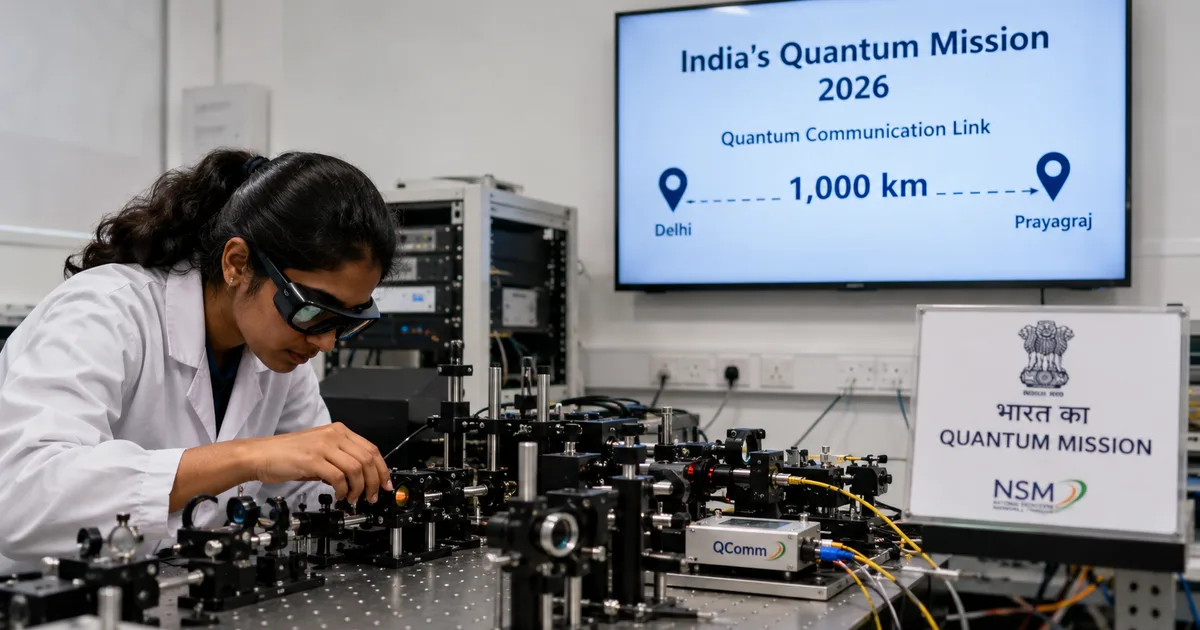
India's National Quantum Mission just hit a milestone that would have seemed like science fiction even three years ago: a 1,000 km secure quantum communication network, built with indigenous technology, achieved in under three years of the mission's launch. If you're wondering what that has to do with your bank account, your Aadhaar data, your UPI transactions, or your DigiLocker documents. Quite a lot, actually. The mission, officially called the National Mission on Quantum Technologies and Applications (NM-QTA), is India's most serious deep-tech bet since the space program.
What is India's National Quantum Mission?
The National Quantum Mission (NQM) was approved by the Cabinet in April 2023 with a budget of ₹6,003.65 crore spread over eight years. The goal was to put India in the same league as the US, China, and the EU when it comes to quantum computers, quantum communication networks, and quantum sensors. Basically the whole stack.
Union Minister Jitendra Singh, who heads the Ministry of Science and Technology, reviewed the mission's progress in early 2026 and publicly praised the 1,000 km secure quantum communication breakthrough as an "indigenous" achievement. Meaning India didn't just buy the equipment from abroad. It built and tested the core technology itself.
That last part matters. A lot.
China has deployed QKD satellites. The US has poured billions into quantum research through DARPA and the National Quantum Initiative. Europe has the Quantum Flagship program running since 2018. India is now in that group, with working, indigenously developed technology. That's a real change from where things stood five years ago, and I think it's worth saying clearly rather than burying in a press release.
The 1,000 km quantum network: what it actually does
Quantum communication works on a principle called quantum key distribution, or QKD. Without going too deep into physics, the basic idea is this: encryption keys are encoded in quantum particles. If anyone tries to intercept them, the quantum state changes and the intrusion is instantly detectable. You can't secretly eavesdrop. The moment someone intercepts the particles, the state collapses and the intrusion is immediately visible. It's a physics constraint, not a software one.
Traditional encryption, the kind protecting your HDFC netbanking or your government DigiLocker, can theoretically be cracked by a sufficiently powerful quantum computer. QKD is designed to stay secure even in that future. Which is exactly why building this infrastructure now, before the threat fully arrives, is the smart call.
Achieving a 1,000 km network means India can run QKD-protected communications between cities. Think Delhi to Mumbai, roughly. This is a real operational network. Not a lab tabletop demonstration.
India's National Quantum Mission achieved a 1,000 km secure quantum communication network using indigenous technology in under three years, with a 2,000 km target for the second half of 2027, four years ahead of its original eight-year schedule.
According to The Hindu BusinessLine, NQM is now targeting 2,000 km by the second half of 2027, four years ahead of the original plan. At 2,000 km, you're covering Delhi-to-Chennai distances. Enough to build quantum-safe links between major government data centers, banking hubs, defense installations, and stock exchanges across the country.
The spending gap worth tracking
Here's where I want to be honest about some uncomfortable numbers.
An RTI application revealed that of the ₹6,003.65 crore budget approved in April 2023, only ₹17.02 crore had actually been disbursed to institutions including IISc Bengaluru. That's less than 0.3% of the total sanctioned budget, more than two years into the mission.
To be fair, large government missions do have slow starts. Procurement timelines are painful, equipment needs import clearances, and institutional agreements take forever to finalize. And the 1,000 km milestone genuinely shows serious work happening on the ground. So the money isn't the whole story.
But sustained multi-year investment is what separates countries that lead in quantum from countries that just issue press releases about it. China's quantum program doesn't run in fits and starts. Neither does America's. India has the technical talent, that much is clear. Whether the money flows consistently is the real question, and one worth watching as NQM approaches its mid-program review.
Why quantum computing is a cybersecurity threat to Indian users
The cybersecurity risk from quantum computing is real, even if it isn't here yet.
As quantum computers grow more powerful, existing encryption standards like RSA and ECC will become breakable. RSA-2048 protects most of your online financial transactions today. ECC protects your mobile banking apps and the TLS connections to government portals like the Income Tax e-filing site. A sufficiently powerful quantum computer could crack RSA-2048 in hours rather than the billions of years a classical computer would need. This theoretical tipping point is called "Q-Day" in security research.
And there's a threat that's already active right now. Security researchers call it "harvest now, decrypt later." Some state-level actors are collecting encrypted internet traffic today, storing it, and planning to decrypt it once quantum computers become powerful enough. Your tax filings and banking communications could be sitting on foreign servers right now, waiting for that moment. Building quantum-safe infrastructure before Q-Day arrives is necessary planning, not paranoia.
This is also, by the way, why the 1,000 km quantum network announcement is more than a science headline. India is building the plumbing for secure government communications before the threat materialises rather than scrambling after. (I know, sounds like something bureaucracies rarely manage to do. Which is partly why it's worth acknowledging when they get it right.)
What CERT-In and RBI are watching
CERT-In has been tracking post-quantum cryptography migration as part of national cybersecurity readiness. The US NIST finalized its first post-quantum cryptographic standards in 2024, including algorithms like CRYSTALS-Kyber and CRYSTALS-Dilithium, designed to stay secure even against quantum attacks. Indian banking and government IT systems will need to migrate to these or equivalent standards over the next several years.
RBI hasn't issued specific quantum-readiness guidelines yet, and honestly I'm not sure exactly when that changes, but given the DPDP Act 2023's requirements around data security and what "reasonable security" means for data fiduciaries, guidance is likely in the pipeline. If you work in financial services, follow India tech policy news closely. This will sneak up on compliance teams that aren't paying attention.
Industry and academia are getting involved
Government labs aren't carrying this alone. Deloitte India and IIT Bombay recently launched a joint Quantum Technology Centre to accelerate adoption and build a domestic talent pipeline. The global talent gap in quantum computing is severe, and India needs trained engineers at scale. A handful of government researchers in isolated labs won't cut it.
IBM has also been active in India's quantum ecosystem. Indian researchers and developers already have cloud access to IBM Quantum systems, so a student at NIT Trichy or a startup founder in Pune can run quantum algorithms on real hardware today. No ₹500 crore lab required. (I think this is actually one of the more genuinely useful things happening in Indian deep-tech right now. Lowering the barrier to experimentation matters enormously for building a real talent base.) That access is what eventually makes NQM's industrial goals achievable.
On the international side, India and the US have been discussing expanded quantum cooperation under the iCET (Initiative on Critical and Emerging Technology) framework. This could give Indian institutions access to US quantum research programs and equipment that's currently export-controlled. Our deep-tech explainers have more on how iCET works and what it means for Indian startups building in this space.
What this means for you right now
For most Indian internet users in May 2026, quantum computing is still a background story. Your UPI flow won't change tomorrow. But depending on where you sit, there are things worth doing now.
- If you work in banking, fintech, or government IT: post-quantum cryptography migration is going to become a compliance requirement within a few years. Understanding NIST PQC standards before it becomes urgent is worth your time.
- If you're a student or early-career engineer in CS or physics: NQM has fellowship programs and research positions. Quantum computing is one of the few areas where India is investing early and seriously, worth considering as a career direction.
- If you run a small business storing customer data: ask your cybersecurity vendor about their post-quantum roadmap. Their answer will tell you a lot about how seriously they're thinking about long-term data protection.
- For everyone tracking India's digital policy: watch whether NQM's actual fund disbursement catches up with its milestone announcements. The technology is real. The execution needs to match.
The 1,000 km milestone is genuinely impressive. The researchers and engineers who achieved it with indigenous components deserve real credit. But a mission this large, with implications for national security and India's standing in global deep-tech, needs consistent funding and transparent timelines. Periodic press briefings from a minister's office don't substitute for that.
See our cybersecurity guides for what you can do today to protect your personal and financial data while this larger infrastructure takes shape.