If you live in a village or small town more than 10 km from the nearest ATM, you already know how exhausting cash withdrawal can be. Sometimes it's a half-day trip. Sometimes the machine is broken. Sometimes you're elderly and the journey simply isn't worth it. India Post Payments Bank's Aadhaar ATM doorstep banking service was built for exactly this situation, and in 2026, it covers more ground than most people realise.
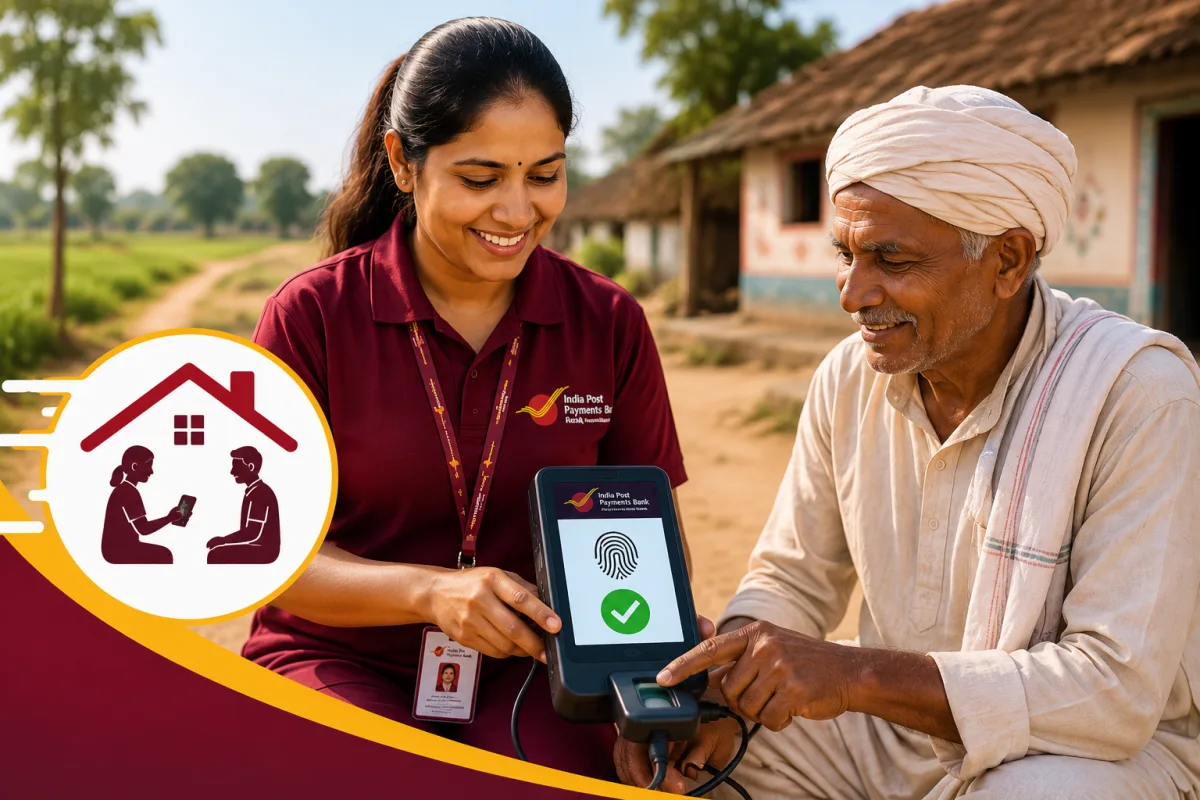
The idea is simple. A postman from your local post office comes to your home with a small biometric device. You give your Aadhaar number, press your thumb on the fingerprint reader, and cash is yours. No ATM card. No PIN. No branch visit. And it works with any bank account linked to your Aadhaar, not just your IPPB account.
What is the IPPB Aadhaar ATM service?
IPPB (India Post Payments Bank) was set up by the central government in 2018 with one specific goal: reach the parts of India that commercial banks can't. It runs through over 1.5 lakh post offices, including remote locations where there's no SBI branch, no ATM, sometimes not even reliable mobile data.
The Aadhaar ATM service uses the Aadhaar Enabled Payment System (AePS), built and managed by NPCI. Your Aadhaar number and fingerprint replace your debit card and PIN. The postman carries a micro-ATM device, a handheld machine roughly the size of a chunky smartphone, that connects to the banking system via mobile internet.
AePS has been around since 2016. What IPPB added is the doorstep delivery layer. You don't go to the post office. The service comes to you. That distinction matters enormously for elderly users and for women in remote households. Honestly, for anyone whose nearest bank branch is a bus ride away, this is just a better setup.
IPPB operates through over 3 lakh Gramin Dak Sevaks (GDS), the local postmen who already know your neighbourhood and your household, sometimes by name for decades. They're not strangers. That trust factor, I think, is actually part of why this works where formal banking correspondent networks have struggled.
How the doorstep cash withdrawal actually works
Here's the step-by-step for a first-time user:
- Contact your nearest post office or local postman (GDS) to schedule a doorstep visit. You can also call IPPB customer care at 155299 (toll-free) or use the IPPB mobile app if you have one.
- The postman arrives with a biometric micro-ATM device.
- Tell them the name of the bank where your Aadhaar-linked account is held. You don't need the account number.
- Press your thumb on the fingerprint reader. Authentication goes through UIDAI's servers in real time.
- Choose your transaction — cash withdrawal, balance check, or mini statement.
- For a withdrawal, the postman counts out the cash and hands it to you. You get a receipt, either printed or via SMS.
The whole process takes about 5 minutes once the postman is at your door. If your fingerprint isn't recognised, which happens fairly often with elderly users or people doing rough manual work, some devices offer iris scan as a fallback (annoying, I know, but genuinely useful). Not every GDS device has that capability yet, though.
Services available via this doorstep channel
Cash withdrawal is the most common use, but it's far from the only one. Through a single postman visit you can also do:
- Cash deposit into your IPPB account
- Balance enquiry on any Aadhaar-linked bank account
- Mini statement showing your last 5-10 transactions
- Aadhaar-to-Aadhaar fund transfer — send money using just the recipient's Aadhaar number, no bank account number required
- Bill payments — electricity, water, DTH, mobile recharge via the postman's app
- Insurance premium collection — IPPB has tie-ups with multiple general and life insurers
The insurance piece is worth noting. IPPB ran a campaign called 'General Insurance Super Dhurandhar' and the North Gujarat Region under Postmaster General Krishna Kumar Yadav got national recognition in 2025-26 for enrolling the most customers in insurance products. It shows IPPB is actively pushing financial products through this doorstep channel, not just cash. Whether you want to buy insurance at your door is your call, but the option is there.
What it costs in 2026 — and what changed
IPPB recently revised its AePS service charges. The fee structure isn't always communicated clearly at the doorstep, so it's worth knowing before the postman shows up.
For IPPB account holders:
- First 3 AePS transactions per month are free
- From the 4th transaction onwards, ₹20 per transaction applies
- Doorstep visit service component: typically ₹15-₹20 depending on your location and transaction type
For non-IPPB accounts (any Aadhaar-linked bank):
- The postman's device works interoperably with SBI, PNB, Bank of Baroda, Canara Bank, and most major public sector banks
- Your own bank may apply AePS charges on their end — most PSU banks allow 3-5 free AePS withdrawals per month before they start charging
Bottom line: for someone withdrawing their monthly pension or a PM-KISAN installment once a month, this is effectively free. The charges only become relevant if you're transacting multiple times a week.
2026 regulatory updates that affect AePS users directly
RBI's new KYC rules for AePS agents
In 2026, RBI issued tighter KYC requirements for all Banking Correspondent agents operating AePS terminals, including IPPB's GDS postmen. Every AePS agent must now complete fresh KYC verification and carry a registered, verifiable agent ID. The regulation came after documented fraud cases where fake agents misused AePS devices to drain money from rural beneficiaries.
What this means for you: the postman who comes to your door should have a valid IPPB agent ID card. Ask to see it before any transaction begins. If they can't produce one, don't proceed. This is a simple check that can save you real money.
See our complete guide to safe AePS transactions for a fuller picture of what a legitimate visit looks like versus a suspicious one.
Daily transaction limits tightened
AePS cash withdrawals are capped daily by the bank linked to your Aadhaar. Most accounts allow up to ₹10,000 per day. Fully KYC-verified accounts at select banks permit up to ₹50,000 (which makes sense, actually, given the fraud risk). These limits exist to reduce losses in biometric fraud cases, which do happen. If you need more than ₹10,000 in a day, you'll need a branch visit or a different payment channel.
NPCI reported that AePS processed over 400 crore transactions in 2024-25, driven substantially by rural and semi-urban usage as welfare payments — MNREGA wages, pension disbursals, PM-KISAN installments — continue to route through Aadhaar-linked bank accounts across India.
Who actually benefits most from doorstep banking
Several groups in particular:
- Senior citizens and pensioners receiving central or state government pension, EPF payouts, or PM pension — the ATM trip is often physically the hardest part
- MNREGA workers whose wages are deposited into Aadhaar-linked accounts — withdrawal shouldn't require half a day of travel
- PM-KISAN farmers getting the ₹2,000 quarterly installment directly into Aadhaar-linked accounts
- Women in rural households who may lack easy transport access or aren't comfortable at bank branches alone
- Residents of villages with no ATM or bank branch — there are still thousands of such villages in Jharkhand, Chhattisgarh, Odisha, Rajasthan, and northeastern states
Kerala expanded doorstep cash delivery from April 8, 2026, letting users request postman visits without prior appointments. Several other states are watching that rollout closely before scaling similar models.
How to request a doorstep visit
You have a few options depending on what's accessible to you:
- Walk into any post office and ask the postmaster about IPPB doorstep banking. They can schedule a GDS visit.
- Call 155299 — IPPB's toll-free customer care line, available during normal banking hours.
- Use the IPPB mobile app if you already have an account — look for the 'Request Doorstep Service' option.
- In some districts, WhatsApp-based booking is being piloted. Ask your local postmaster if that's live in your area.
You don't need an IPPB account for Aadhaar ATM cash withdrawal. It works for any Aadhaar-linked account at any bank. But opening a free IPPB savings account does unlock deposits and bill payments through the same postman visit, plus access to IPPB's insurance options.
Honest limitations you should know about
This service solves a real problem. But it has gaps.
Fingerprint rejection is probably the biggest practical issue. If your fingerprints have worn down from age or years of manual labour, which is very common among older farmers and construction workers, the device may fail repeatedly. Iris scan is supposed to be the fallback, but it's not on every GDS device yet. If this is a recurring problem, visit your post office in person and ask them to register your iris biometric as the primary authentication method.
Connectivity is the second constraint. The micro-ATM needs a live mobile data connection to authenticate with UIDAI. In areas with weak 4G coverage, transactions can fail partway through. I'm not sure exactly how often this happens district by district, but it's stressful when it does, even though your money doesn't get deducted on a failed auth. Check our explainer on offline payment options that don't need live internet.
Cash float matters too. The postman carries a fixed amount of cash per round. If you need ₹8,000 and they have ₹5,000 on hand, you'll get a partial withdrawal. Calling ahead and telling them the amount you need helps avoid this entirely.
One rule: always get a receipt. Every AePS transaction generates either a printed slip or an SMS confirmation. If the postman can't produce either, something is wrong. Report suspicious behaviour at your post office, on cybercrime.gov.in, or by calling the National Cyber Crime Helpline at 1930. Read our section on AePS fraud tactics to understand what a fraudulent doorstep visit looks like before one happens to you.
The bigger picture here is genuinely interesting, if you ask me. IPPB's doorstep network is one of the few examples of century-old infrastructure getting repurposed for modern digital banking. Jio Payments Bank and Ezeepay are expanding to 12,000+ rural locations via their own BC agent networks. UPI usage has grown 118% in semi-urban and rural stores. But UPI needs a smartphone and internet access. Doorstep AePS needs neither. For the portion of rural India that still lacks both, the postman with a fingerprint device is the most practical banking option available right now. Follow our IPPB policy coverage for charge updates and service expansions as they happen through 2026.