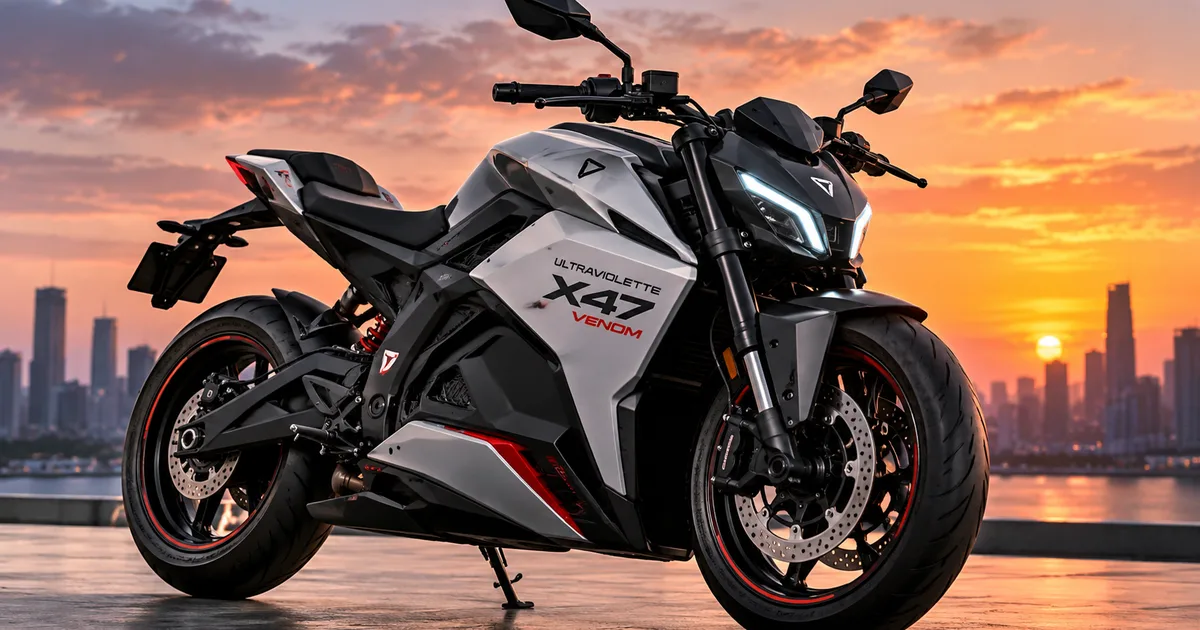
Picture this: you're stuck at the Silk Board junction in Bengaluru during peak evening traffic. Horrible, right? Your left wrist aches from constantly slipping the clutch on a 350cc petrol motorcycle while engine heat cooks your shins. You find yourself wondering why performance two-wheelers still feel like an exhausting workout in daily traffic. That's where the Ultraviolette X47 Venom 2026 enters the conversation. Bengaluru-based Ultraviolette Automotive has officially launched this electric motorcycle in India at an introductory starting price of Rs 2.65 lakh. It's aimed straight at riders who want sports-bike thrills without regular visits to petrol pumps.
Look, electric two-wheelers in India have been stuck in a predictable box for years. You see plenty of sensible family scooters dropping children at school or carrying grocery bags from the local market. What if you want real speed? If you want an aggressive stance and true highway capability, your options haven't been great. If you ask me, the earlier F77 proved that fast electric bikes can work in India, yet it carried a hefty price tag and a heavy chassis that felt like a handful in crowded traffic. The new X47 Venom tries to tackle those exact pain points with a lighter frame and revised battery hardware. Better yet, its introductory sticker price directly takes on popular 400cc single-cylinder petrol machines.
Ultraviolette X47 Venom price in India and variant breakdown
Here's the deal: Ultraviolette set the introductory price of the X47 Venom at Rs 2.65 lakh (ex-showroom). That number matters. A lot. It puts the bike in direct competition with petrol rivals like the KTM 390 Duke and the Triumph Speed 400, along with the Royal Enfield Himalayan 450.
When you factor in actual on-road expenses, electric vehicles still get clear breaks across several Indian states (which makes sense, given how aggressively governments want people off petrol):
- Ex-showroom introductory price starts at Rs 2.65 lakh for early bookings across Indian metro dealerships.
- Road tax waivers and reduced registration fees apply in several states like Delhi and Tamil Nadu through local EV policies.
- Mandatory five-year third-party insurance combined with comprehensive cover adds approximately Rs 18,000 to Rs 22,000 depending on your insurer.
- Total on-road pricing in cities such as Bengaluru and Mumbai lands near Rs 2.85 lakh to Rs 2.95 lakh before optional accessory packs.
Compare that to a petrol 400cc sports bike. In places like Karnataka or Maharashtra, hefty road tax pushes the final on-road price well above Rs 3.5 lakh. I think that price gap alone is going to turn quite a few heads. You can check our tech explainers hub to see how road tax calculations and green vehicle policies vary across different regional transport offices.
Ultraviolette handles bookings online through their digital portal, taking token amounts through UPI or net banking. Deliveries will roll out in batches, starting with top metro hubs before heading into tier-two cities.
How the new VX-100 platform changes electric motorcycle design
The biggest engineering change here sits tucked right under the sharp tank shrouds. Ultraviolette built the X47 Venom on its fresh VX-100 platform, running a 100-volt electrical architecture.
If electrical talk makes your eyes glaze over, picture water pressure in a garden hose. It's the easiest way to understand it. When you try pushing huge amounts of water through a pipe at low pressure, you need a thick, heavy pipe. Crank up the pressure, though, and you can shove the exact same energy through a much narrower line. On an electric bike, higher voltage means the motor draws less current for the same power. That lets engineers use thinner copper wiring and keep operating heat down, avoiding unnecessary bulk on the chassis.
Thing is, excess weight has always been the enemy of fast electric bikes. Batteries are basically heavy bricks of lithium and nickel. In my experience, even ten extra kilos can make a motorcycle feel clumsy when you're filtering through packed lanes. With the VX-100 setup, Ultraviolette managed to shave off valuable kilos while keeping thermals steady during hard highway pulls.
According to test ride data reported by Autocar India, the new architecture sheds noticeable bulk around the mid-frame, making low-speed U-turns in tight street lanes far less intimidating than on previous generation machines.
And keeping heat under control is everything in our riding conditions. When ambient temperatures cross 43 degrees Celsius during a brutal North Indian summer, battery management software often throttles motor output to save the internal cells. The VX-100 platform uses redesigned cooling channels around the motor and battery pack to stop that annoying power drop from kicking in.
Ultraviolette X47 Venom range and battery specs tested on Indian roads
Specs on paper look exciting. But anyone who rides daily in India knows claimed test-track numbers rarely match real life.
Battery capacity and everyday efficiency
The top-spec version of the bike packs a large 11 kWh battery pack. That setup yields a claimed Indian Driving Cycle (IDC) range of 343 km on a full charge. It's a massive headline figure.
Laboratory IDC tests run under strict dyno conditions at steady speeds without headwinds or sudden hard braking. So what will you actually see on your daily commute? Honestly, the numbers here are a bit fuzzy until more customer bikes hit the road, but real-world testing gives us a solid baseline.
Here's a realistic estimate based on actual road conditions:
- Dense city commuting with frequent traffic lights and moderate regen will return roughly 240 km to 260 km on a single charge.
- Mixed riding through suburban ring roads at 60 km/h to 75 km/h will comfortably deliver around 210 km to 230 km.
- Aggressive highway riding with constant cruising between 100 km/h and 120 km/h will likely bring real range down to 175 km to 195 km.
Even at that lower highway figure, you can ride from central Delhi to Neemrana or from Bengaluru to Mysuru on a single charge without hunting for a plug midway. If you ask me, that alone kills off the range anxiety that keeps riders glued to petrol pumps. If you're comparing two-wheeler battery setups, you can read our breakdown of the Simple Wave electric scooter to understand how smaller battery packs behave under daily urban loads.
The motor makes plenty of torque to push the bike from zero to 60 km/h in under three seconds. It tops out at a claimed 155 km/h. Highway overtaking feels quick and stress-free.
Fast charging speeds and socket compatibility
A giant battery is useless if it takes all day to juice up. The X47 Venom supports 12 kW DC fast charging alongside standard AC charging options.
Hook it up to a compatible fast charger, and the battery goes from 20 percent to 80 percent in around 45 minutes. That fits neatly into a quick highway breakfast stop at a roadside dhaba. For overnight home charging, you get a portable charger that plugs right into a standard 15-ampere three-pin wall socket (the heavy plug you use for an AC or geyser). A full recharge from zero takes about six to seven hours. You just plug it in before bed, and you're ready to roll the next morning.
Highway charging infrastructure across India is spreading fast right now. Riders can tap into public networks alongside fast-charging stations set up for four-wheelers, including points rolled out for the Tata Curvv EV fast-charging network across major national expressways.
Safety technology, radar alerts, and smart display features
Motorcycle safety on Indian roads needs far more than good brakes. Stray cattle and sudden lane changes by auto-rickshaws make daily city riding totally unpredictable. It's a mess out there.
Ultraviolette put a built-in rear collision radar module right under the tail section. That radar constantly scans your blind spots for approaching traffic. If a vehicle closes in too fast from behind, the bike warns you with visual lights on the mirrors and gentle haptic pulses through the handlebar grips. It doesn't steer or brake for you. Which, if you ask me, is a sensible engineering decision, because unexpected automated inputs on two wheels can easily throw you off balance. Instead, it gives you just enough warning to switch lanes or check your mirrors.
The cockpit has a 7-inch colour touchscreen running Ultraviolette's custom operating system. The screen stays plenty readable under harsh afternoon sun and comes with:
- On-board turn-by-turn navigation powered by Indian map data, eliminating the need to mount fragile smartphones on handlebar brackets.
- Integrated digital document storage allowing you to keep verified vehicle registration and insurance records accessible without physical paperwork.
- Automated fall and crash detection that transmits your emergency location coordinates to pre-selected contacts via an onboard cellular SIM.
- Multiple levels of regenerative braking adjustable on the fly via handlebar switchgear to match traffic flow.
You also get dual-channel anti-lock braking with switchable rear ABS modes. It provides confident stopping power whether you're dealing with dusty tarmac or wet monsoon roads.
Comparing the X47 Venom with petrol rivals and electric alternatives
To see where this bike fits, you have to look at daily running costs alongside the riding dynamics.
A typical 400cc single-cylinder petrol bike gives you around 25 to 28 km per litre in city traffic. With petrol sitting around ₹103 per litre in Bengaluru, every single kilometre costs you about ₹3.80 to ₹4.10 just in fuel. Over a 1,000-kilometre monthly commute, you're shelling out over ₹4,000 every month on petrol alone. And that's before adding routine oil changes or chain maintenance.
By comparison, charging this 11 kWh battery pack at domestic electricity rates of around ₹8 per unit costs under ₹90 for a full charge. Even with a conservative real-world range of 220 km per charge, your running cost works out to roughly 40 paise per kilometre. Over that same 1,000-kilometre month, your electricity expense is barely ₹400. That's an easy monthly saving of over ₹3,500 on daily travel.
Most riders wanting simple city transport will probably look toward upcoming electric commuters like Ather Konarc. But the X47 Venom is for people who refuse to trade highway speed for fuel savings. You can follow other new launches through our latest electric vehicle news coverage.
Who should actually spend Rs 2.65 lakh on the X47 Venom?
Let's be real about who this machine is actually for.
If you only travel four kilometres a day to pick up groceries or drop children off at school, buying this bike makes no financial sense. A basic electric scooter handles those short trips at a third of the price. Similarly, if your idea of motorcycling means heading deep into remote Himalayan passes where power sockets are sketchy at best, a petrol adventure tourer is still your best bet.
In my opinion, the X47 Venom hits the sweet spot for daily corporate commuters and weekend highway riders who clock 30 to 80 km every day. You get sports-bike punch with commuter-level running costs. And the whole platform is built specifically to survive harsh Indian heat and broken monsoon roads without falling apart.