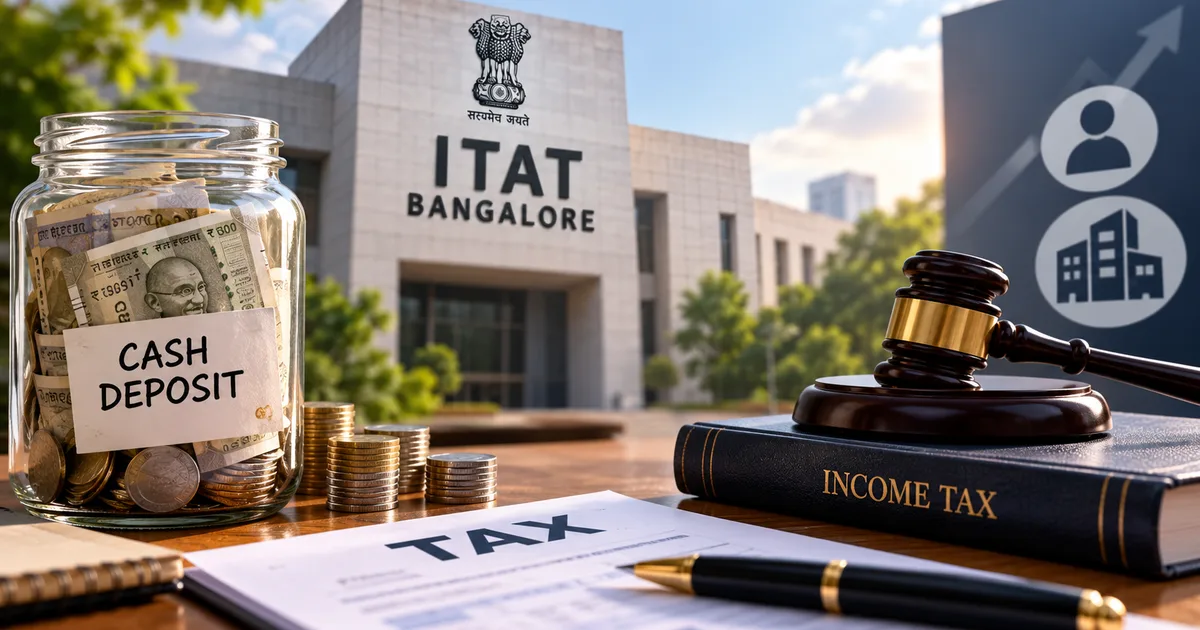
Have you ever tried applying for a foreign visa, only to be told you can't leave the country because you owe the income tax department an absurd amount of money? That's the exact nightmare a man from Indiranagar in Bengaluru woke up to recently. He had a massive unexplained cash deposit in his account, and he'd simply ignored the tax notices. This brings us to the recent ITAT Bangalore Cash Deposit Ruling 2026, which is making everyone double-check their bank statements. Honestly, if you still think you can deposit lakhs of rupees in cash and the taxman will simply look the other way, you're setting yourself up for a disaster.
So there are two very different rulings here. One person lost everything. Another person won against the tax department. And honestly, the difference between them is exactly what every Indian taxpayer needs to understand right now.
The Rs 41.69 lakh disaster: why ignoring notices ruins you
Our first story is about a Bengaluru resident named Reddy. His annual income was comfortably below the Rs 5 lakh threshold. Or so he claimed. He said rent was his only real source of income. His wife and father covered all his daily expenses. Because his income was low, he figured he didn't need to file his income tax returns (ITR). He also decided not to bother checking his emails or the income tax e-filing portal at all.
But then he decided to travel abroad. The embassy asked for his ITR as part of the visa application. When he finally logged into the system, he got a massive shock. The income tax department had flagged Rs 41.69 lakh in cash deposits in his bank account. They marked the whole amount as completely unexplained.
The assessing officer didn't stop there. They treated the entire Rs 41.69 lakh as unexplained money under Section 69A of the Income-tax Act. They also added another Rs 3.69 lakh as unexplained credit. Oh, and Rs 1.5 lakh as business income. Then they slapped on interest and started penalty proceedings. It was a complete mess.
"The assessment was completed ex parte because Reddy failed to respond to notices issued by the Income Tax Department. He also didn't contest the Assessing Officer's orders before the Commissioner of Income-tax (Appeals) within the prescribed time," explained Chartered Accountant Suresh Surana.
Reddy panicked. He appealed, but he did it nearly four years late. Specifically, there was a delay of around 1,480 days. The Income Tax Appellate Tribunal (ITAT) Bangalore looked at this and simply said no. They flat out refused to condone the delay.
This is the biggest takeaway from this specific case. You can't ignore official communication. The "I forgot to check my email" excuse just doesn't work in 2026. The tax department sends SMS alerts and emails. They also update your e-filing dashboard. If you get a notice, you have to reply. If you miss the deadline, things get very expensive very fast. And if you're wondering about the ITAT Penalty Relief for Unfiled ITR 2026, let me tell you that relief usually requires a valid, proven reason for the delay. Not just negligence.
The Rs 25 lakh victory: why keeping records saves you
But consider a completely different scenario that happened around the same time. Mrs Nagarathna from Vijayanagar works with BESCOM. She deposited Rs 25 lakh in cash at a Corporation Bank branch back in June 2016. Naturally, the income tax assessing officer in Koramangala got a bit sketchy about it. The officer noticed that she had sold a property just a few weeks before the deposit. The immediate assumption was that she sold the property for cash and dumped it into her account.
The officer treated the Rs 25 lakh as unexplained money under Section 69. But Mrs Nagarathna didn't ignore the notices. She responded. She clarified exactly where the money came from.
She explained that the cash was accumulated from earlier withdrawals. She and her husband had made these withdrawals over the past two years. They'd withdrawn Rs 13.17 lakh and Rs 11.95 lakh from their disclosed bank accounts because they were planning to buy a house. When that cash wasn't needed immediately, she redeposited it.
The assessing officer didn't buy it. But Mrs Nagarathna appealed, and this time, the ITAT Bangalore gave a ruling in her favor. The tribunal stated that if the source of a cash deposit can be traced back to identifiable withdrawals from disclosed bank accounts, the explanation can't be rejected just because there's a time gap. A gap between withdrawal and deposit is fine.
This ruling is a huge relief for normal people. Sometimes you withdraw cash for an emergency or a medical issue. If you end up not using it and deposit it back months later, the tax department can't just assume it's black money. But you have to prove it. I think this is the most important part. You need the bank statements showing the exact withdrawals. Without that proof, you're completely out of luck.
Understanding section 69 and section 69A
You hear these sections thrown around a lot when the tax department gets involved. Basically, these are the sections the government uses to tax money they think you're hiding.
Section 69 deals with unexplained investments. If you buy a house or gold, and you can't explain where the money came from, the taxman uses Section 69.
Section 69A deals with unexplained money or jewelry. This is the section usually applied to mysterious cash deposits. And if they catch you under these sections, the tax rate is brutal. You don't just pay your normal slab rate. The tax is levied at a flat 60 percent. Add the 25 percent surcharge and the 4 percent health and education cess, and the effective tax rate jumps to over 78 percent. If you deposit 10 lakhs of unexplained cash, the government takes nearly 8 lakhs of it.
How the tax department actually tracks your cash
A lot of people in India still think they can game the system. They try depositing cash in small chunks or using different bank accounts. That doesn't work anymore. The system is entirely automated. It's fully linked to your PAN and Aadhaar.
Banks and financial institutions have to file a Statement of Financial Transactions (SFT). If you deposit more than Rs 10 lakh in cash into your savings accounts across the entire financial year, the bank automatically reports it to the income tax department. It goes straight into your Annual Information Statement (AIS).
I always tell people to check their AIS before filing taxes. It shows everything. It shows your mutual fund sales, cash deposits, dividends, and large credit card payments. If you see something wrong there, you need to fix it before the taxman sends a notice. If you're dealing with Income tax refund delays, an unresolved mismatch in your AIS is often the culprit.
The Rs 1.33 crore exception: age and agricultural income
There is another fascinating case from the ITAT Bangalore that just came out. It involved a senior citizen who deposited a massive Rs 1.33 crore in cash and hadn't filed an ITR. Normally, this is exactly the kind of situation that ends with massive penalties and asset seizures. The assessing officer flagged the deposit and demanded an explanation. They assumed it was pure unaccounted business income.
But the senior citizen fought the case and actually won. How? By proving the exact source of the funds and using their specific life circumstances as a valid defense. The taxpayer demonstrated that a large chunk of the money came from agricultural income. And agricultural income is exempt from income tax in India. They provided property records and local village documents to prove they actually farmed the land. Another portion of the cash was traced back to previous savings and family contributions over decades.
The tribunal noted that senior citizens (which makes sense, actually) often have a habit of keeping cash at home instead of using complex banking products. They also pointed out that agricultural income remains a perfectly valid explanation for cash deposits. But you have to have the actual land records to back it up. This case proves that the ITAT Bangalore isn't just blindly ruling against taxpayers. If your explanation makes logical sense, fits your socio-economic background, and is supported by basic evidence, the tribunal will listen.
How DigiLocker and Aadhaar change the game
Look, the infrastructure powering all of this has changed dramatically. Ten years ago, ignoring a tax notice was easy. Papers got lost in the mail. Addresses changed. Today, your financial life is tied to your Aadhaar card, which is tied to your PAN, which is connected to your mobile number. The income tax department doesn't need to send a postman to your house. They just push a notification right to your phone.
I highly recommend setting up your DigiLocker account and linking your PAN and Aadhaar properly. When you store your documents in DigiLocker, you get immediate access to your financial history no matter where you are. If you get stopped for a visa check, or if an assessing officer asks for your three-year-old bank statements, you can literally pull them up on your phone in thirty seconds.
What small businesses need to do right now
If you run a small business in India, you probably handle cash. Whether you own a retail shop or a restaurant, cash is a reality. But the days of stuffing it under the mattress are completely over.
You need to maintain a cash book. It sounds boring, but a simple ledger showing cash coming in and cash going out is your best defense against an assessing officer. If you deposit five lakhs in the bank, your cash book should clearly show that you collected five lakhs from customer sales over the past month.
In my experience, too many small business owners get hit with Section 69A additions simply because they mixed their personal cash with their business cash. They take cash from the shop register to pay for groceries. Then they put personal savings back into the shop account. This creates a nightmare trail. Keep your business bank account completely separate from your personal savings account.
Key lessons for everyday Indian taxpayers
We can learn a lot from these recent tribunal decisions. You need to follow a few basic rules to avoid ending up in a massive legal battle over your own money.
- File your ITR every single year. Even if your income is below the taxable limit, file a nil return. It creates a paper trail and proves you're a responsible citizen. It also makes getting a loan or a visa much easier.
- Never ignore a notice. If you get a message from the tax department, log into the e-filing portal immediately. Respond within the deadline. If you don't understand the notice, hire a chartered accountant to help you handle it. Don't wait 1,480 days.
- Keep records of large cash movements. If you withdraw five lakhs for a family wedding, keep the withdrawal slip. If you deposit it back, write down the reason. You might need to explain it to an assessing officer three years later.
- Check your AIS regularly. Your Annual Information Statement is your financial mirror. Look at it twice a year to make sure no fake transactions are reported against your PAN.
The reality of cash in a digital India
We're living in an era where UPI handles billions of transactions a month. You can pay for a ten-rupee chai by scanning a QR code. The need for massive cash transactions is dropping rapidly. I understand that real estate and some small businesses still rely heavily on cash. But the risks are just getting too high.
The government is actively trying to squeeze the cash economy. Every time you make a large cash deposit, an algorithm somewhere is deciding whether you're a risk. And if the system flags you, the burden of proof is entirely on you. You have to prove the money is clean. The tax department doesn't have to prove it's dirty.
So if you're holding onto cash, or planning a big cash transaction, think twice. Make sure your paperwork is absolutely perfect. Because as we saw with the Bengaluru man, if you slip up and ignore the warnings, you'll pay a massive price. And no tribunal is going to save you just because you forgot to check your email. If you want to understand more about how these financial algorithms are changing things, I recommend browsing through our Tech Explainers section for a deeper look at the technology driving these tax systems.