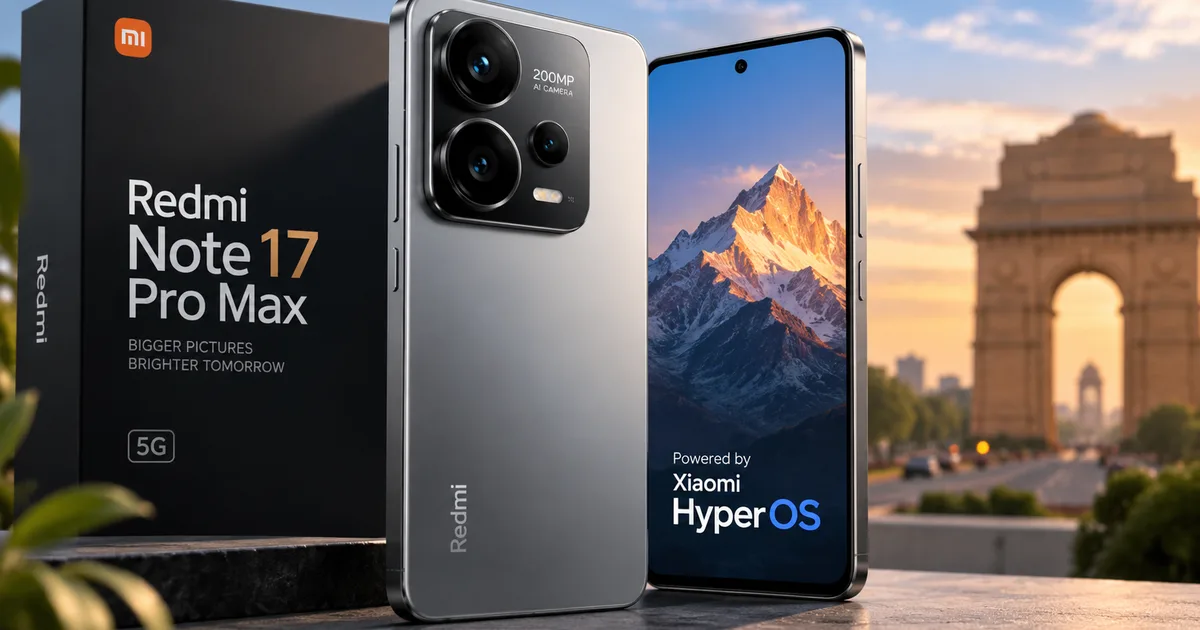
Let me tell you about a phone launch that has everyone talking right now. The Xiaomi Redmi Note 17 Pro Max 2026 India launch is right around the corner. And honestly? The leaks are wild. We hear about a monstrous 10,000mAh battery. But there's a serious price bump that moves the Note series far away from its budget roots. If you're waiting to upgrade your smartphone this Diwali season, you need to pay close attention to this one.
Redmi is the king of the Rs 15,000 to Rs 20,000 bracket in India. I remember when the Note series was the default recommendation for college students and budget buyers. But things are changing fast. The brand is pushing into premium territory. Look, they're targeting young professionals who might buy a OnePlus or a Samsung instead. It's a huge shift. And the Note 17 Pro Max is their biggest swing yet. I think this strategy is super risky.
So, what exactly are we getting with the Note 17 Pro Max? Is it just a large battery? Let's break down the leaked specs and the expected pricing. We'll see if this device is actually worth your hard-earned money.
Expected price of the Redmi Note 17 Pro Max in India
Prepare yourself. This is going to sting a bit if you're used to old Redmi pricing. The Note series is getting very expensive (annoying, I know). Tipster Abhishek Yadav says the standard Pro model has a massive price hike. And the Max? It's even pricier.
Here's the detailed breakdown of the current leaks.
- Redmi Note 17 Pro (8GB RAM + 128GB Storage): Expected to launch around Rs 39,000
- Redmi Note 17 Pro (8GB RAM + 256GB Storage): Expected to launch around Rs 42,000
- Redmi Note 17 Pro Max (Base variant): Likely starting above Rs 45,000, possibly touching Rs 48,000 for higher storage
The Redmi Note 15 Pro started at just Rs 31,999 last year. That's an Rs 7,000 to Rs 8,000 jump generation on generation. Xiaomi is putting this phone right up against the OnePlus Nord 6 and the Vivo V70 FE. That's a bold move. You have to wonder if Indian buyers will drop 45k on a Redmi phone. They could get a premium brand for similar money. I have my doubts. But the specs might justify the cost.
If you want something cheaper, you can check out the Redmi 17 5G India launch details. That phone is around the much more comfortable Rs 25,000 mark.
Release date and availability in the Indian market
The global launch for the Max variant already happened on August 27, 2026. They rolled it out in Japan and Singapore right away. But what about the Indian market?
Tipster Yogesh Brar points to a September 15th launch event in India. Xiaomi's Indian X account is teasing the Max branding for the Note series. The Indian market is very important for Xiaomi's numbers. So they won't delay this much longer. You can expect pre-orders on Amazon India or Flipkart just in time for the Diwali sales.
The massive 10000mAh battery upgrade
This is the real story here. The battery capacity on the Redmi Note 17 Pro Max is absurd. I'm not sure exactly why they went so big, but it's cool. The global variant has either a 9,210mAh or a 10,000mAh silicon-carbon battery. For the Indian market, we expect the 10,000mAh version.
Think about that. Most flagship phones today max out at 5,000mAh. This phone has double the capacity. You can easily go two to three full days without reaching for a charger. If you travel constantly on trains or use your phone for heavy BGMI gaming, this is exactly what you want.
And when you do need to charge it, the phone has 100W HyperCharge. Filling a 10,000mAh battery usually takes forever. But with 100W, you're back to 100 percent in under an hour. Plus, it has 27W reverse wired charging. That means you can plug in a Type-C cable and fast charge your TWS earbuds or a friend's dying phone. It's basically a power bank with a screen.
The Redmi Note 17 Pro Max raises the bar with a massive 10,000mAh silicon-carbon battery, 100W HyperCharge, and 27W reverse wired charging. Both devices also feature Xiaomi's Surge G1 Battery Management Chip for improved battery health.
Camera specs and the 200MP confusion
Let's clear up some major rumors. Early leaks suggested the Note 17 Pro series had crazy 200MP camera upgrades. The reality is different. But honestly, it's still very solid hardware.
Based on the global launch specs, the Redmi Note 17 Pro Max has a 50MP primary camera. Don't let the lower megapixel count fool you. It is a high-quality sensor with real Optical Image Stabilization (OIS). And it has an 8MP ultrawide lens. Megapixels aren't everything in photography. A good 50MP sensor with proper OIS and good software processing takes much better photos than a cheap 200MP sensor, especially in low light.
The real upgrade is on the front of the device. The standard Redmi Note 17 Pro 5G has a 16MP selfie shooter. But the Max variant has a much sharper 32MP front camera. If you take a lot of video calls for work or post to Instagram, you'll notice the difference in clarity.
Display and premium build quality
Xiaomi didn't cut corners on the screen. The phone has a large 6.83-inch 1.5K AMOLED display. It has a super smooth 120Hz refresh rate and is ridiculously bright. It has up to 3,500 nits of peak brightness. That means you have zero issues reading WhatsApp messages or scanning UPI QR codes under the harsh Indian afternoon sun.
The Max model also has HDR10+ and Dolby Vision support baked in. If you watch a lot of Netflix on your daily metro commute, the colors and contrast look fantastic.
On the design front, both phones have a flat AMOLED display and a vertically aligned dual-camera module on the rear. They have Gorilla Glass Victus 2 protection on the front. This is flagship level glass. They also have IP68/IP69K ratings for water and dust resistance. You can drop this phone in a bucket of water or take it out in heavy monsoon rain without panicking (which makes sense, actually, given the price). But they have a plastic frame and back. This is a bit disappointing for a phone that costs over Rs 40,000. If you ask me, they should have used a metal frame.
Performance hardware and the new Snapdragon chip
Under the hood, the standard Note 17 Pro has Qualcomm's Snapdragon 6S Gen 4 processor. But the Pro Max has the newer and much faster Snapdragon 6 Gen 5 chipset.
On paper, the Snapdragon 6 Gen 5 has much higher benchmark scores. It is paired with top-tier LPDDR5X RAM and UFS 4.1 storage. Basically, the phone is incredibly fast. Apps open instantly. And you won't feel any lag when jumping between heavy applications. The numbers here are a bit fuzzy, but the performance jump is real.
If you care about gaming, this processor and the massive battery make the Note 17 Pro Max a very interesting gaming phone. You get sustained performance without the battery anxiety.
HyperOS 3 and Google Gemini AI features
We absolutely need to talk about the software experience. The phone has HyperOS 3, which is built directly on top of Android 16. Xiaomi revamped its user interface over the last few years. They moved away from the bloated MIUI days. HyperOS is clean and fast.
They promise five years of major Android OS upgrades and six full years of security updates. That's massive for a device in this segment. If you spend Rs 45,000 on a phone today, you want to know it is still secure in 2030. Xiaomi is finally delivering on that front.
The most interesting part of the software is the deep AI integration. Xiaomi partnered with Google to bring Gemini-powered AI features to the phone's gallery and system apps. You get tools like AI Erase Pro. It lets you remove random people from the background of your vacation pictures. This is the kind of advanced computational stuff we usually only see on Pixel or Galaxy flagship devices costing twice as much. For a deeper dive into how artificial intelligence is changing our daily tech, keep an eye on our Tech Explainers section.
Should you wait for the India launch?
If you have a budget of around Rs 40,000 to Rs 50,000 and desperately need a smartphone that won't literally die on you during a long day, yes. You should wait for September 15th. The 10,000mAh battery alone makes this a highly unique device in the crowded Indian market.
But the expected pricing is a bit of a mess. If the rumors are accurate and it pushes past the Rs 45,000 mark, you have to ask yourself a tough question. Do you want a maxed-out Redmi? Or would you rather pick up a discounted premium phone from last year during the upcoming Big Billion Days sale?
I'll be keeping a close eye on the official pricing announcement when it drops next week. Until then, you can track all the Latest Tech News on our homepage to see how the competition responds to this battery monster.