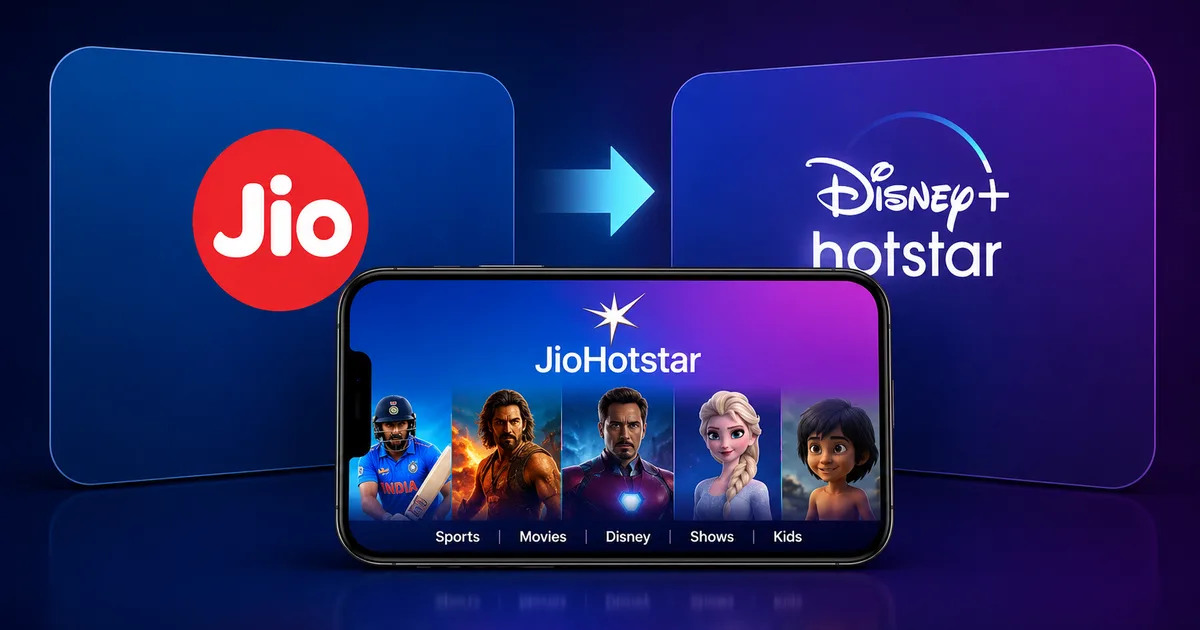
Imagine you're settling in for the weekend after a long week at the office. You want to watch the IPL on your living room TV, your spouse wants to catch up on a Marvel series on their tablet, and maybe put on some regional Malayalam or Telugu movies for your parents in the other room. A year ago, that meant juggling three different subscriptions and wondering which UPI mandate was going to hit your bank account next. Now, the JioHotstar Merger 2026 has fundamentally changed how we pay for and watch content in India. Honestly, it's about time we sat down over chai and made sense of what this actually means for your wallet.
I remember when Hotstar was just that cricket app that crashed during the last two overs of an India-Pakistan match. And JioCinema was the free extra app you got with your Jio SIM card. Nobody really paid attention to it until they disrupted everything by streaming the IPL for free. Look at them now. They've merged into this massive entertainment giant. The transition is a bit of a mess for everyone, actually. Social media is full of complaints about bugs and plan changes. So let's cut through the corporate jargon. We need to talk about what this means for you and your monthly entertainment budget.
What the new JioHotstar plans actually look like
Here's the deal. The days of everything being completely free on JioCinema are fading fast. The newly consolidated JioHotstar has 9 new subscription plans. They start at just Rs 79 per month. At first glance, that sounds incredibly cheap, right? It's cheaper than a decent cup of coffee. But there is a catch.
The Rs 79 plan is basically an entry-level, mobile-only tier. It gets you in the door and lets you watch some daily soaps and reality shows. But don't expect crisp 4K streaming on your big screen OLED TV. If you want the full family experience, the prices scale up quickly. If you ask me, the smartest move right now is checking your current billing cycle. Because if you're holding onto an old annual premium plan, prices are going up starting January 28. If your renewal date is coming up before then, you might want to manually renew. Lock in the old rate while you still can. (I know, it's annoying.)
- The Rs 79 per month tier gives you mobile-only streaming. It has heavy ads included and basic resolution. This is mainly good for solo watching on a daily commute.
- The mid-tier plans from Rs 199 to Rs 399 offer better 1080p resolution. You get fewer ads on premium content and basic smart TV support for one or two screens.
- The premium annual plans provide full 4K HDR support and an ad-free experience for most non-sports content. This tier supports four concurrent devices, but the price is increasing on Jan 28.
And for my friends who bragged about getting free cricket just because they had a Jio 5G SIM, I have bad news. The free ride for major ICC tournaments like the T20 World Cup and ODI World Cup is changing. You will likely need one of these paid tiers to watch the big games without interruption. It was fun while it lasted. But we all knew the free sports strategy was just to get users before tightening the net.
App consolidation and what happens to the old apps
So, you currently have the Disney+ Hotstar app and the JioCinema app sitting on your phone's home screen. What happens now? Do you delete them?
Basically, they're pulling everything under one massive roof. The website Jiostar.com showed a "coming soon" banner for a while. That caused a lot of confusion. The backend engineering teams have been working overtime to migrate millions of user accounts. If you have an active Hotstar subscription right now, don't panic. Your watch history and remaining subscription duration are moving over to the new JioHotstar ecosystem automatically.
I tried logging into my old Hotstar account last week on my Android TV. The prompt directed me to update the app. After a hefty 80MB download, the app became the new JioHotstar interface. It's a bit jarring at first. The UI is a slightly clunky mix of both old platforms. You have the familiar live sports tabs from Hotstar on the left. But the endless reality TV scroll from JioCinema dominates the homepage. You can read more about how to navigate these interface changes in our streaming guides.
One good thing is you only need to deal with one login now. You can link it to your primary mobile number via OTP. You only need one e-mandate on your Google Pay or PhonePe app instead of tracking multiple recurring UPI payments. In my experience, having everything in one place is actually a huge relief for senior citizens who struggle with managing multiple digital subscriptions.
Understanding the technical side of the server merge
Something nobody is talking about is the massive technical challenge of combining these two platforms. Hotstar ran on a highly customized infrastructure. They built it over years to handle massive concurrent traffic spikes, such as when MS Dhoni walked out to bat. JioCinema just brute-forced their way through the IPL. They did this by relying on Reliance Jio's massive underlying network infrastructure.
Merging these two distinct tech stacks is a nightmare for developers. If you've noticed the app glitching or throwing weird error codes over the last few weeks, this is exactly why. They're trying to merge two completely different databases of user profiles and payment gateways while the car is still driving down the highway at 100 kmph. Honestly, it's going to take a few months for the new JioHotstar app to feel as stable as the old Hotstar app did.
And let's talk about the recommendation algorithm. Right now, it's a complete mess. The systems are combining two very different sets of watch histories. So the app might suggest a gritty crime thriller right next to a children's cartoon. It doesn't quite know who you are yet in this new combined ecosystem. I'm not sure exactly why it struggles so much with this, but it does. My tip is to spend a few minutes actively adding shows you actually like to your watchlist. This manually forces the algorithm to understand your preferences faster. It stops it from pushing random reality shows onto your homepage.
The end of free cricket and the global impact
You don't need a business degree to see why Reliance and Disney joined forces in the first place. It's a pure numbers game. And cricket is the biggest number of all in India. During the recent India-England semifinal, digital viewership hit a global record with 65.2 million peak concurrent viewers. That's a massive amount of internet traffic. It puts immense strain on telecom networks.
By combining their streaming rights, this new entity controls almost all the cricket that matters to an Indian audience. They recently named Abhimanyu Khanna as Head of Rights Acquisition for the BCCI. That tells you exactly where their corporate focus is right now. They want total dominance over Indian sports broadcasting. If you want more background on telecom and streaming corporate moves like this, check out our detailed explainers section.
"When one single company controls both the telecom pipes delivering the data and the content flowing through them, the pricing power shifts entirely away from the consumer."
I know a lot of people on Twitter are worried about a streaming monopoly. It's a very valid concern. In my experience, these things rarely work out well for the customer. When you don't have to aggressively compete with Hotstar for IPL broadcasting rights because you just bought the company, you no longer have to offer the tournament for free to win viewers away from them. You can start charging Rs 79 a month today. Then you slowly increase it by 20 rupees every year. Without serious competition from SonyLIV or Prime Video in the live sports space, Indian consumers don't have anywhere else to go to watch their favourite teams play.
What about international viewers in the USA and UK?
This isn't just an Indian headache. A huge number of NRIs rely on these platforms for their daily fix of Indian content and live sports. If you're trying to figure out how to watch JioHotstar in the USA in 2026, the process requires a bit more technical effort now. The merger means global licensing rights are getting very complicated.
You can't just fire up a basic free VPN and expect it to work seamlessly anymore. The new app has aggressive geoblocking measures in place. You'll need specific workarounds. Or you'll have to rely on official international partner apps like Hulu or ESPN+ depending on what specific content you want to watch. This fragmentation abroad is frustrating for the diaspora who just want a simple way to watch Indian television.
Final thoughts on your streaming budget
Look, the JioHotstar Merger 2026 was probably inevitable. The streaming wars were burning too much cash for both companies. And in the Indian market where consumers are notoriously price-sensitive, offering endless free content was never a sustainable long-term business model. Consolidation is the name of the game now across the entire tech sector.
My honest advice is to take five minutes today to check your current subscription dates. Open the app and see when your plan expires. Be ready for that January 28 price hike on the premium annual plans. Don't blindly let auto-renew trigger if you only ever watch shows on your phone during your metro commute. Switch down to that new Rs 79 monthly plan and save your hard-earned money.
It's not all doom and gloom, though. Having one single app instead of two saves precious phone storage space, especially if you're using a budget smartphone. It also stops the annoying game of guessing which app a movie is streaming on every Friday night. Make no mistake, you will eventually have to pay a premium for that convenience (which makes sense, actually). Keep an eye on our latest tech news section. We'll be tracking any sketchy new plan changes they roll out in the coming months.