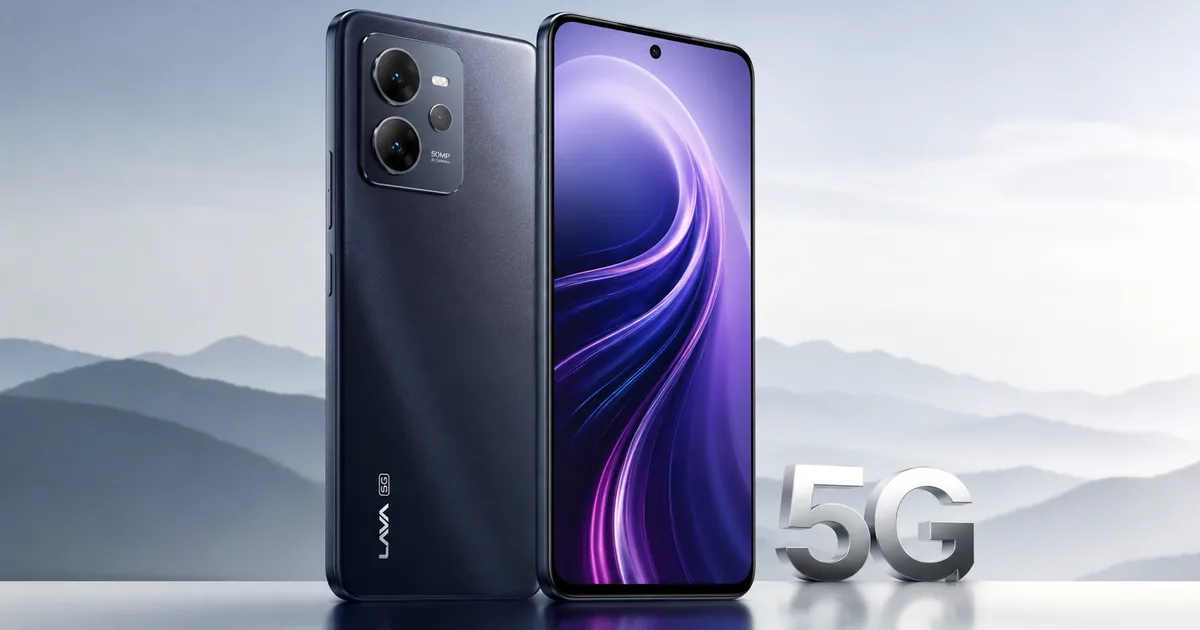
Buying a budget smartphone in India usually involves making a frustrating compromise. You pay less upfront, but you end up paying with your attention. Your notification shade fills up with weird ads. Your app drawer is stuffed with games you never installed. The Lava Virat V1 5G changes that conversation entirely. This new device arrived this week with a very specific pitch for Indian buyers.
Lava is trying to win the budget segment by offering something almost nobody else has at this price point. A completely clean experience. They just launched the Lava Virat V1 4G and Virat V1 5G in India. The base 4G model starts at Rs. 8,999. The 5G version is Rs. 11,999. You can buy them on Flipkart starting July 31.
But the price tag is only half the story. Honestly, I want to explain exactly what you get for your money. So here is a breakdown of the specs and the features (which makes sense, actually, given the hype). I think you need to see why this phone actually matters in the Indian market right now.
Why the clean Android 16 software matters
Most budget phones are cheap because the manufacturer makes money after they sell you the device. They pre-install apps, and they show you ads on the lock screen. This is bloatware. Over the last few years, the bloatware on budget phones has become a total mess. You buy a phone. Then you immediately have to spend time fighting its software just to use it normally.
Lava decided to skip that entirely with the Virat V1 5G. The phone is on Android 16 out of the box. There are no pre-installed third-party apps. And there are no sketchy notifications asking you to download random games or use alternative app stores.
Lava Virat V1 5G launches in India at Rs. 11,999 with full Android 16, no preinstalled bloatware, and a 6nm UNISOC T8200 chipset, an unusual pitch for the budget 5G segment that forgoes ad-revenue.
For someone buying their first smartphone or upgrading from an older device, this makes a massive difference. The phone is faster because there are no background apps eating up memory and battery. The interface is simple. If you ask me, buying a phone for your parents is easier now because you won't have to spend an hour uninstalling junk apps before handing it to them. You won't get panicked calls from them asking why their phone is showing an advertisement for a casino app.
Lava is giving up a major revenue stream by keeping the software clean. Ad-supported phones make a lot of money over their lifetime, so choosing not to do that is a big risk to get customer trust. You can learn more about how software impacts your phone in our smartphone buying guides.
A 6000mAh battery built for Indian usage patterns
We spend a staggering amount of time on our phones in India. We stream movies on JioCinema and make countless UPI payments using PhonePe or GPay at local shops. We navigate heavy traffic using Google Maps. We store our Aadhaar and driving licenses in DigiLocker. Our phones are our wallets and our entertainment centers. All of this heavy usage drains a battery very quickly.
The Lava Virat V1 5G has a massive 6,000mAh battery. For context, most phones in this price bracket have a 5,000mAh battery. That extra 1,000mAh capacity matters a lot in daily life. It means you can easily get through a full day of heavy usage without desperately looking for a power bank or a wall charger by 5 PM.
If you use your phone less frequently, just checking messages and taking a few calls, you might even push it to two full days of battery life. This is really useful if you commute long distances on trains or buses (which is a nightmare, I know). It's also a huge benefit if you work in areas with patchy network coverage. Poor network signals drain phone batteries much faster because the device has to work harder to stay connected to the tower. A 6,000mAh battery gives you a very comfortable safety net.
Understanding the processor specs and performance
Under the hood, the Lava Virat V1 5G is on a 6nm UNISOC T8200 chipset. Processor names sound highly technical. But here is what you actually need to know about this one.
The 6nm part refers to how small the transistors on the chip are. Smaller transistors mean the processor is more power-efficient. It generates less heat while working, and it consumes less battery power. In the Indian summer heat, a phone that stays cool is a big advantage. I'm not sure exactly why other budget brands ignore this, but Lava gets it.
For everyday tasks like scrolling through social media feeds and messaging on WhatsApp, this processor is enough. It will handle standard apps smoothly without stuttering. It's not designed for heavy competitive gaming. If you want to play graphically intense games on the highest settings for hours, you need to buy more expensive devices. But for casual games and daily multitasking, the UNISOC T8200 gets the job done.
Display features that improve daily use
The phone has a large 6.75-inch display. A big screen makes watching YouTube videos or reading long articles much more comfortable on your eyes.
And the display supports up to a 120Hz refresh rate. The refresh rate is simply how many times the screen updates with new visual information every second. A standard older phone screen is usually 60Hz. A 120Hz screen refreshes twice as fast.
This makes a very noticeable difference when you use the phone. Scrolling through your Instagram feed feels incredibly smooth. The text stays sharp while moving. System animations look fluid. It's one of those features that you stop noticing after a while, but you immediately miss it if you ever have to go back to a slower 60Hz screen. Check out our technology explainers to understand more about how display technologies have improved in budget phones.
Durability, cameras, and extra features
Look, Indian conditions are tough on electronics. Our summers are hot and dusty, and the monsoons are heavy. Our phones take a serious beating over their lifespan. Lava included an IP64 rating on the Virat V1 series to help with this.
Basically, an IP64 rating means the phone is completely protected against dust entering the internal components. It can also withstand water splashes from any direction. You can't dunk the phone in a bucket of water. But if you get caught in a sudden rain shower while waiting for an auto, or accidentally spill some water on the dinner table, the phone will survive.
The phone also has a dual rear camera setup. We don't have the complete sensor megapixel details yet, but the numbers here are a bit fuzzy. Still, early reports indicate it is a capable system for everyday photography. You should get decent photos for social media in good daytime lighting conditions. Budget phone cameras generally struggle in low light situations or indoors at night, and I expect the Virat V1 will perform similarly.
Key features of the Lava Virat V1 5G
- A massive 6,000mAh battery for extended daily usage
- Clean Android 16 operating system with zero bloatware
- Large 6.75-inch display supporting a 120Hz refresh rate
- UNISOC T8200 6nm processor for efficient performance
- IP64 rating for dust and water splash resistance
The 5G advantage in India
When you buy a phone in 2026, 5G is no longer just a luxury feature. It's the standard. Airtel and Jio have rolled out 5G across most major Indian cities, and they are expanding into smaller towns and rural areas.
Using 5G on a device like the Lava Virat V1 5G changes how you consume content. Downloading large files happens in seconds. Streaming high-definition video on YouTube buffers instantly. Video calls on WhatsApp are much clearer and drop less frequently, even when you are traveling.
Many people ask if they really need 5G right now. My answer is usually yes, if you plan to keep your phone for more than a year. Buying the 4G version of the Virat V1 saves you some money today. But a year from now, as 4G networks become more congested, you'll wish you had the faster speeds. The Rs. 11,999 price tag for the 5G model makes the technology accessible to a much wider audience.
Security and peace of mind
One aspect of clean software that people often overlook is security. When your phone isn't loaded with third-party apps from unknown developers, the risk of data leaks goes down significantly.
In India, we link everything to our phone numbers now. Our bank accounts via UPI and our identity via Aadhaar. We use government apps like DigiLocker to store sensitive documents. Keeping this data secure is incredibly important.
A clean Android 16 installation means you only have Google's standard security measures and Lava's necessary system files. You don't have to worry about a random pre-installed flashlight app quietly collecting your location data and selling it to advertisers. This peace of mind is worth a lot, especially in a budget device where security is sometimes treated as an afterthought.
The naming strategy: Why Virat?
There is also an interesting branding angle here. Lava chose the name Virat for this series. The word itself means huge or massive in Hindi, which perfectly aligns with the large 6,000mAh battery. But it also obviously brings to mind Virat Kohli, one of India's biggest icons.
It's a clever marketing move by the Indian smartphone maker to get attention in a market dominated by Chinese brands. Using a familiar name helps the phone stand out on store shelves and online listings. People remember the name easily. This kind of local connection is something Indian brands have struggled to build against massive marketing budgets from competitors. Seeing Lava lean into it is refreshing.
We see a lot of confusing naming schemes with budget phones. Random letters and numbers that mean nothing to the average buyer. Calling a phone Virat is direct. It sets an expectation of performance and reliability right away. In my experience, we'll see if the phone actually lives up to that heavy name over the next few months of real-world testing.
Should you buy the Lava Virat V1 series?
The budget smartphone market in India is incredibly crowded right now. Brands like Xiaomi and Realme launch new devices almost every single month. It's hard for any single phone to stand out from the noise. You often have to dig through confusing spec sheets to find out what is actually different between ten different phones priced at Rs. 12,000.
Lava is making a very smart play here. They aren't trying to win a meaningless spec war on paper by throwing in a useless 2-megapixel macro camera just to call it a triple-camera setup. They are focusing heavily on the actual, day-to-day user experience. A huge battery that lasts and a completely clean Android 16 interface make for a very compelling package for normal users. The smooth 120Hz display is just the cherry on top.
If you have a budget of around Rs. 12,000 and you hate dealing with pre-installed junk apps, the Lava Virat V1 5G deserves your attention. It has a straightforward, reliable experience without the usual compromises of a budget phone. It is a device that respects your time and your data privacy. You can keep an eye on our daily tech news section for detailed hands-on reviews once the phone officially goes on sale.
The sale begins on July 31 via Flipkart. The 4G variant priced at Rs. 8,999 is also a solid option. It makes sense if you live in an area without 5G coverage yet, or if you just want to save a bit of money and don't care about fast internet speeds. But given how Jio and Airtel are expanding their 5G networks across India, spending the extra Rs. 3,000 for the 5G model is a smart long-term investment. It ensures your phone won't feel outdated in a year.