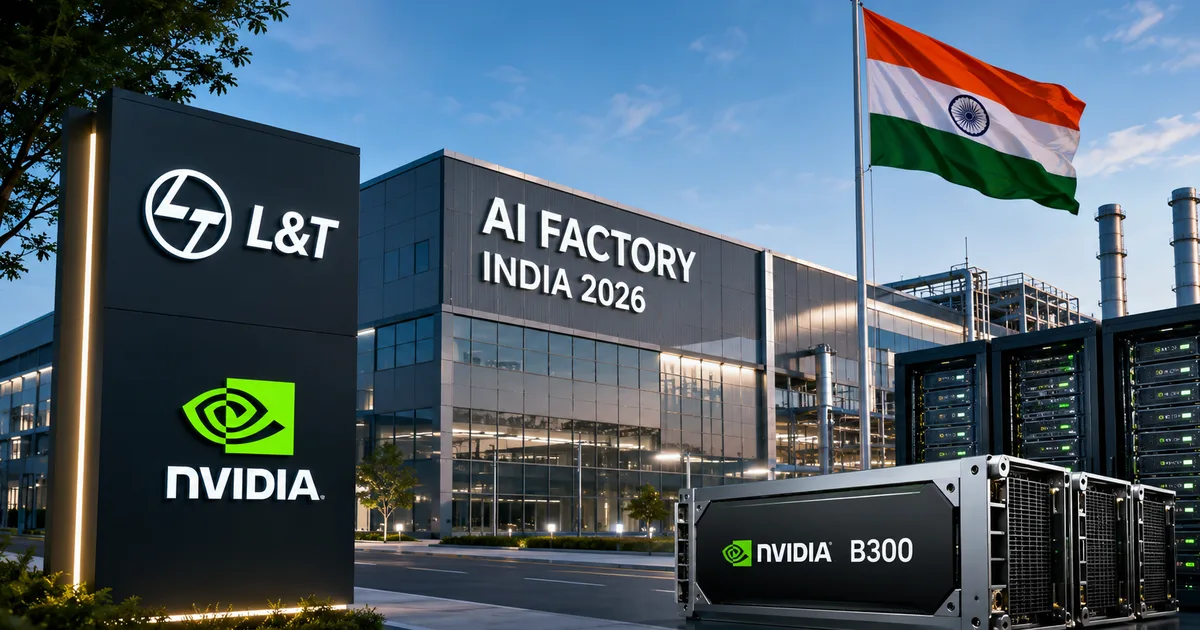
We just got some massive news in the Indian tech sector. The L&T and NVIDIA B300 AI factory setup in India 2026 is officially happening, and the numbers are absolutely wild. L&T's subsidiary, LTN Compute, just secured an order worth somewhere between Rs 10,000 crore and Rs 15,000 crore (roughly $1.05 billion to $1.57 billion) to build this thing.
Honestly, when I first read the press release, I had to double-check the zeros. Rs 15,000 crore is a lot of money. It's wild.
But here's the deal: this is exactly what Indian IT infrastructure needs right now. We've spent the last two decades building software for the world. We write the code. We manage the networks. But when an Indian startup wants to train a serious AI model, they have to rent server space in Virginia or Frankfurt. They pay in US dollars.
This new deal changes the math.
L&T is building a facility that will house 10,000 NVIDIA B300 GPUs. If you track hardware news, you know the B300 is NVIDIA's latest heavy hitter. It's basically a supercomputer shrunk down into a server rack. It processes data at speeds we could barely imagine five years ago.
So, why does a construction and engineering giant want to build an AI factory? I'm not sure exactly why they pivoted so hard, but the money is clearly there.
The shift from bridges to server racks
Most of us think of Larsen & Toubro when we see massive metro pillars or bridges being built. They also do huge offshore oil platforms for ADNOC. But over the last few years, L&T has been quietly turning itself into an AI-driven conglomerate. In my experience, legacy companies usually mess this up. L&T actually seems to be pulling it off.
They set up LTN Compute specifically for this kind of infrastructure. Thing is, building an AI data centre isn't like building a normal IT park. It's essentially an industrial cooling problem.
These NVIDIA B300 chips generate a ridiculous amount of heat. You can't just put them in a standard air-conditioned room. You need specialized liquid cooling systems and massive power redundancy to handle the weight of the server racks. It's heavy, physical engineering.
L&T has the engineering chops to build complex industrial plants. Now they're just applying those same skills to data centres. They're laying the literal groundwork for the next generation of computing.
I find it fascinating that a company known for pouring concrete is now the one securing our AI future. It makes sense when you think about it. The virtual world relies entirely on massive physical infrastructure (which makes sense, actually). And nobody in India builds physical infrastructure quite like L&T.
What this means for Indian startups
Look, if you run an AI startup in Koramangala or Hyderabad right now, your biggest expense is compute. You're buying time on AWS or Google Cloud. You're feeling the pain every time the rupee drops against the dollar. The exchange rate alone can eat up a massive chunk of your seed funding.
Having 10,000 NVIDIA B300 GPUs sitting physically in India changes a few things.
First, there's the latency. If your servers are in Mumbai instead of Ohio, data moves faster. That matters for real-time applications like voice AI or self-driving car navigation. Milliseconds actually count in these fields.
And then there's billing in INR. We don't have the exact pricing models yet. But renting local compute capacity usually means local currency billing. It makes financial planning much more predictable for founders who don't want to worry about forex fluctuations. You know exactly what your server bill is going to be next month. If you ask me, this is the biggest win here.
I'm not saying it'll automatically be cheap. NVIDIA hardware is expensive everywhere. But it'll at least be accessible. You won't have to jump through hoops with international credit cards just to train a basic language model.
The vernacular language advantage
There's another huge benefit here. India has dozens of major languages and hundreds of dialects. If we want AI tools that understand Hindi, Tamil, Bengali, or Marathi properly, we have to train them ourselves.
The big American models are great at English. They're terrible at understanding local Indian context and regional slang. If you want to build an AI tutor for a student in rural Bihar, or a voice assistant for a farmer in Punjab, you need a custom model. Training that model takes a lot of computing power. You have to feed it millions of pages of local text and thousands of hours of local speech.
Local AI factories mean local researchers can finally afford to build these vernacular models. We can stop relying on clunky translations. We can start building native AI brains. I think this is how the internet actually becomes useful for the next 500 million Indian users who don't speak English.
Job creation in unexpected places
When we talk about AI, the conversation usually turns to job losses. But building physical AI factories creates a different kind of employment.
You need mechanical engineers to design the cooling systems. You need electrical engineers to manage the massive power loads. You need security personnel and facility managers. This Rs 15,000 crore investment doesn't just buy silicon chips. A good chunk of it goes into the local economy where the data centre is built.
We're seeing a new class of blue-collar and grey-collar tech jobs emerging. It takes a literal army of skilled workers to keep 10,000 GPUs running without melting down.
The data sovereignty angle
This is the part that usually puts me to sleep. But it actually matters here.
The Indian government has been pushing hard for data localization. If you look at the Digital Personal Data Protection (DPDP) Act, there are strict rules about where certain types of data can travel.
If a hospital in Delhi wants to train an AI model on patient X-rays, they probably shouldn't be sending that medical data to a server in Europe. Our own regulators, like CERT-In and the RBI, are very clear about keeping sensitive data within Indian borders.
Think about our existing digital public infrastructure. We process billions of UPI transactions a month. We have Aadhaar data for over a billion people. We store millions of documents in DigiLocker. I think the scale is just hard to grasp sometimes.
If the government or major banks want to run complex AI models on these datasets, they need domestic compute power. They can't outsource the processing of Aadhaar-linked financial data to a foreign data centre (which is sketchy, honestly). The security risks are just too high.
This L&T facility finally gives them a place to do that safely. You can check our explainers on the DPDP Act if you want the full legal breakdown. The short version is that local data needs local servers.
"Data is the new oil, but compute is the refinery. You can't process your own oil if you don't have a refinery on your own soil."
The power problem nobody is talking about
Let me get a bit ranty for a second.
Everyone loves to announce huge data centre projects. The press releases always sound amazing. But nobody talks about the electricity.
A single NVIDIA B300 rack consumes a massive amount of power. Multiply that by enough racks to hold 10,000 GPUs, and you're looking at the power requirements of a small Indian city.
Where is that electricity coming from?
India's power grid is already under strain during the summer months. We still see power cuts in major tech hubs. If we start dropping massive AI factories across Maharashtra and Karnataka, we need a serious plan for energy generation. Specifically, green energy.
If this Rs 15,000 crore facility runs entirely on coal power, we're just trading one problem for another. The carbon footprint of training AI models is already a massive global issue (annoying, I know).
I haven't seen clear details from L&T on the renewable energy mix for this specific site yet. It's something we need to keep an eye on. I'm hoping they tie this project to solar or wind farms. Because otherwise, the local power grid is going to struggle.
Is 10,000 GPUs actually enough?
Yes and no.
For context, Meta reportedly has hundreds of thousands of GPUs in their clusters. OpenAI is building models on massive arrays of compute. In the global AI arms race, 10,000 GPUs isn't going to make you the biggest player in the world.
But for India? It's a massive upgrade.
We don't necessarily need to train the next GPT-5 from scratch right now. The numbers here are a bit fuzzy, but most Indian companies just need compute to fine-tune existing open-source models for local use cases.
Here's what they actually need it for:
- Building AI assistants for agriculture that can diagnose crop diseases from photos.
- Creating local healthcare bots that can triage patients in rural clinics.
- Developing vernacular customer service systems for regional banks.
- Running complex financial models for the stock market.
For those specific tasks, 10,000 B300 GPUs is enough horsepower. It gives our developers a massive sandbox to play in.
The long game for Indian IT
For decades, the Indian IT services model was based on cheap labour. Companies grew by providing thousands of engineers to do the work that was too expensive to do in the US or UK.
That model is breaking right in front of us.
AI can write basic code now. AI can do basic QA testing. The days of throwing a thousand freshers at a software problem are ending. If you read our guides on tech careers, you already know the entry-level job market is a mess right now.
If the Indian tech sector wants to survive the next decade, we have to move up the value chain. We have to build our own models. We have to create our own AI products. We have to shift from being a services hub to a product hub.
You can't do that without the hardware.
This L&T and NVIDIA partnership is the physical foundation for that shift. It's the concrete and steel version of a software update. The Rs 15,000 crore price tag is steep, but the cost of not building this infrastructure would be much higher. We'd just remain a consumer of Western AI products forever.
I'll be watching to see how quickly LTN Compute can actually get this facility online. Setting up the building is one thing. Getting all those NVIDIA chips delivered and networked is a completely different challenge.
If they pull it off by the end of the year, we might actually see a boom in homegrown Indian AI platforms. And honestly, it's about time we stopped renting our tech future. We have to start building it ourselves.