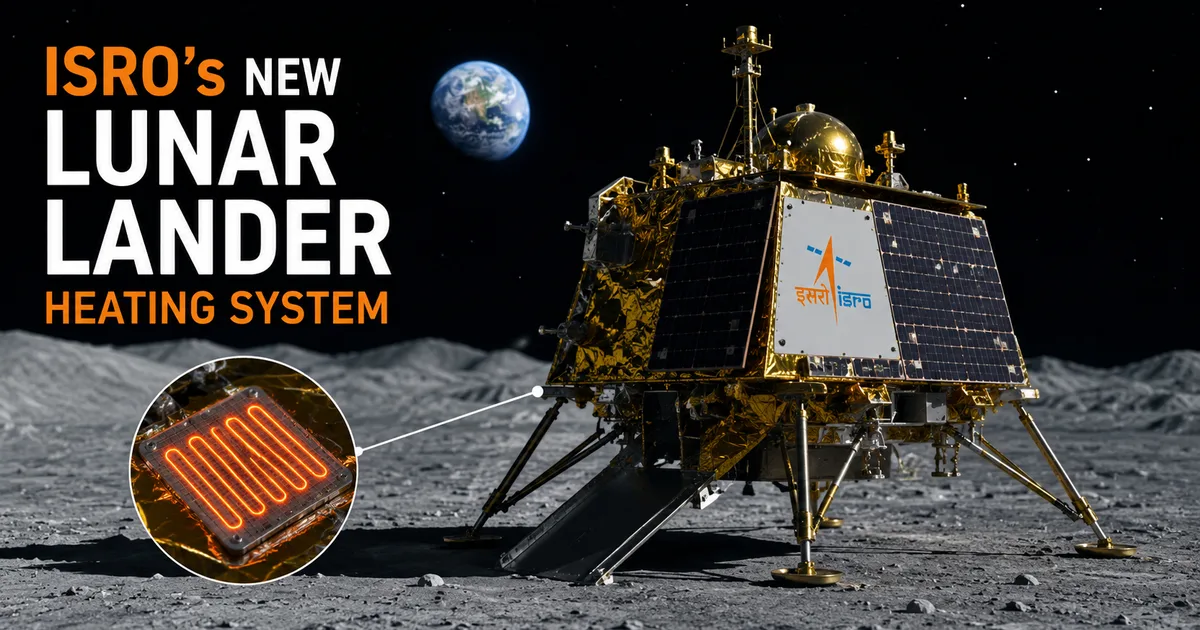
When India's Chandrayaan-3 lander touched down on the moon, we all celebrated. But two weeks later, the sun went down. The temperature dropped to a freezing minus 130 degrees Celsius, and the lander fell silent forever. Solar panels don't work in the dark. So ISRO wants to fix this problem. They've partnered with the Department of Atomic Energy (DAE) to build a new lunar lander heating system that could keep future Indian spacecraft alive for up to 200 days.
Honestly, it's the change we needed. Really. If you ask me, the freezing lunar night has always been our biggest bottleneck. A single day on the moon lasts around 14 Earth days, which is long enough, but then you have to face another 14 days of complete, pitch-black darkness.
Look, batteries don't work in extreme cold. They just don't. Without a steady heat source to keep them warm, the delicate scientific instruments inside simply freeze to death. That's why Vikram and Pragyan stopped working after one lunar day. They did a great job, but when the sun rose again, they couldn't wake up. I think it's about time we stopped treating these expensive landers as short-term visitors (which makes no sense, really).
The problem with the moon's freezing nights
Space is a tough place. There's no thick atmosphere on the moon like we have on Earth to trap heat. So when the sun is up, the ground gets hotter than boiling water. But the moment the sun goes down, all that heat radiates straight back into space, leaving the lander freezing. Near the poles, the temperature drops to minus 129 degrees Celsius or lower. I think these freezing nights are incredibly harsh. According to reports from the space tech updates team, these temperatures can ruin sensitive camera lenses and crack delicate wiring.
Basically, the lunar night brings three distinct challenges for any visiting spacecraft:
- The long period of darkness lasts for about 14 Earth days.
- The surface temperature drops below minus 129 degrees Celsius.
- Solar panels cannot generate any electricity to run heaters.
Look, standard lithium-ion batteries are just useless here. They die. Their chemistry breaks down in the extreme cold. If you ask me, it's like trying to use your phone during winter in Ladakh, where the battery dies in minutes. But on the moon, it's a thousand times worse.
ISRO tried waking Vikram up after that first freezing night. Nothing happened. The hardware was too cold to respond. Honestly, that wasn't a failure, it was just the design. But we can't keep sending expensive spacecraft just to watch them die in two weeks. We need them to last. If you ask me, to build a permanent base or find south pole water ice, we need machines that survive this brutal dark.
How the Department of Atomic Energy supports the lunar lander heating system
This is exactly where the Department of Atomic Energy comes in. Thing is, you can't use solar panels without sunlight. And carrying heavy batteries to power electric heaters for two weeks is just not possible. The only real way out is nuclear heat. By using the heat from the natural decay of radioactive isotopes, we can keep the lander's insides warm without needing any sun at all.
The joint project focuses on developing Radioisotope Heating Units (RHUs) and Radioisotope Thermoelectric Generators (RTGs). Basically, these contain small pellets of Plutonium-238. As these isotopes break down, they release a steady stream of heat.
According to the Bhabha Atomic Research Centre, which is leading the atomic tech side, this system is going to provide enough heat to keep the spacecraft's core electronics comfortable. It really is. Even if the outside of the lander is freezing at minus 130 degrees, the inside stays warm. The circuits survive. So, the spacecraft can sleep during the night and wake up when the sun rises, or it can even stay active in the dark.
What are radioisotope heating units
A Radioisotope Heating Unit is a simple device. There are no moving parts. Basically, a radioactive source is surrounded by layers of carbon and platinum to block any radiation leaks. The heat goes directly to the electronics through thermal straps, which are just metal paths that conduct heat.
The role of the Department of Atomic Energy
The DAE handles all nuclear tech here in India. And building these heaters requires handling radioactive materials. That means strict safety protocols and specialized facilities are a must. DAE will produce the isotopes and package them safely, while ISRO integrates them into the lander's structure.
Honestly, this kind of team effort is exactly what India needs. It is. The announcement came from ISRO Chairman V. Narayanan during the RISE Conclave in Bengaluru. He pointed out that this technology is part of a broader effort to build local space capabilities.
The challenge of handling radioactive material in space
Radioactive stuff is not easy to work with. There are strict international treaties and safety rules we have to follow. If a rocket crashes during launch, we can't have radioactive material scattering over the Earth. So the casing has to be tough. The Bhabha Atomic Research Centre has to design a container that can survive explosions, extreme pressure, impact, and heat.
"We are developing the technology to keep lunar landers alive for up to 200 days. This collaboration with the Department of Atomic Energy is essential for our future moon survival plans." Dr. V. Narayanan, ISRO Chairman, speaking at the RISE Conclave.
So, the safety testing is going to be intense. They'll drop the container from high altitudes and test it under extreme pressure so we know it never leaks. Only then does it get cleared for launch.
Why moon survival for 200 days is a massive deal
To see why this is a massive change, we have to look at the numbers. Right now, a lunar lander only works for 14 days. If we can stretch that to 200 days, the mission lasts fourteen times longer, which is a massive upgrade. It completely changes how we explore the moon.
Imagine a team of scientists trying to study the lunar soil. With only 14 days, they have to rush. They can only collect a few samples and run quick experiments, which is not ideal. But with 200 days, they can take their time. They can observe how the moon's environment changes over multiple day and night cycles. They can monitor lunar quakes, track dust movement, measure surface temperatures, and study the thin atmosphere over a long period.
And honestly, it's about the money too.
More science for every rupee spent
Space missions are incredibly expensive. Chandrayaan-3 cost our government around 615 crore rupees. That's cheap compared to other countries, but it's still a massive amount of money for us. If the lander dies after just 14 days, the daily cost is around 44 crore rupees. But if it lasts 200 days? That cost drops to just 3 crore rupees daily. We get much more scientific value for the same launch budget. Better data. And much better scientific discoveries.
So, this is a smart financial move. Honestly, we're getting more value from every rupee our taxpayers spend. If you want to compare this with other national tech budgets, check out our Indian tech guides. It shows how India manages to do so much with a tiny budget compared to Western nations.
What this means for everyday Indians
Right now, you're probably wondering why any of this matters. Most of us aren't rocket scientists. We're just busy with our own jobs and families. We use UPI to buy groceries and DigiLocker to keep our documents safe. So space seems far away.
But here's the deal: space tech always trickles down to daily life. The software and materials we build for rockets eventually find their way into everyday products. For example, the tech used to make lightweight, heat-resistant materials for spacecraft can improve batteries for electric two-wheelers in India, making them safer in our hot summers. It can also improve solar panels and the power storage systems we use at home.
But more importantly, it builds our engineering talent. When ISRO and DAE tackle these massive problems, they train a new generation of Indian engineers and scientists. These experts then work in our local industries and startups. This boosts our tech sector.
I think this is a huge step forward. We've shown we can reach the moon, and now we're showing we can stay. It is a long road ahead. But Indian engineers are finally building the tools to survive it.