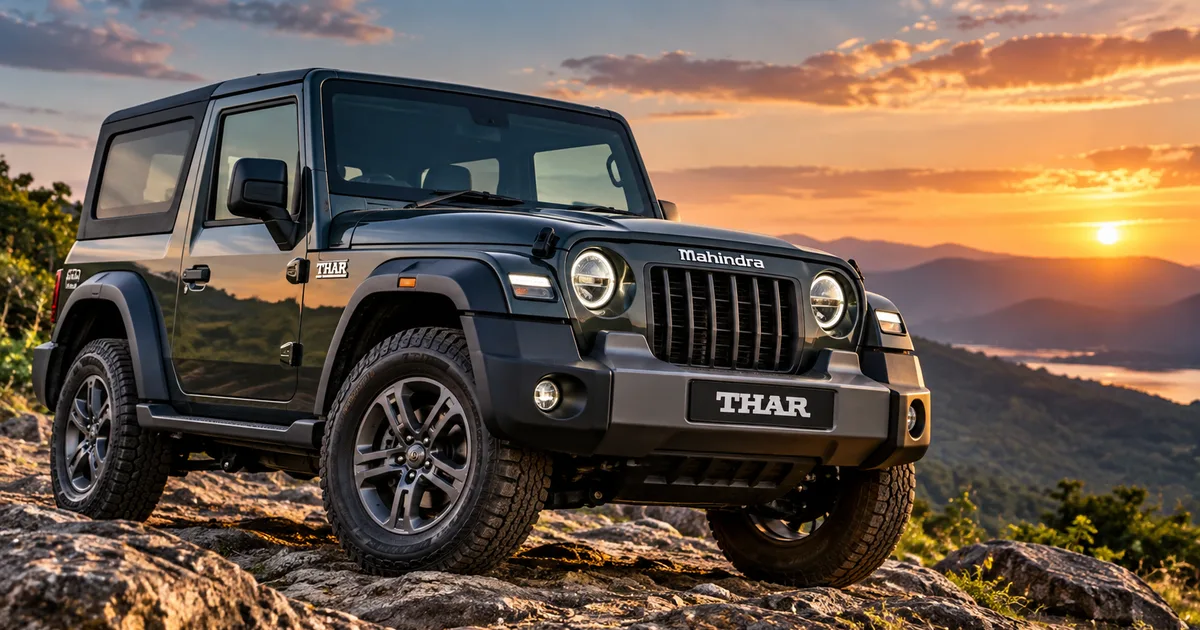
Picture this scenario. You are stuck in a sudden monsoon downpour on an infamously waterlogged stretch of road in Gurugram or Bengaluru. Small hatchbacks are floating toward the footpath, city sedans are turning back, and you are sitting high up, wondering if you should take a shortcut through a mud track. That raw, go-anywhere confidence is why the 3-door Thar captured India's imagination in the first place. Now, Mahindra has officially launched the Mahindra Thar OG 2026 with an introductory starting price of Rs 10.32 lakh (ex-showroom), bringing some much-needed upgrades to its iconic short-wheelbase off-roader.
Why the new name? When Mahindra rolled out the larger, family-oriented 5-door Thar Roxx, people wondered what would happen to the classic 3-door. Some thought it would get discontinued. Others worried it would stay trapped in its barebones, bouncy past. Instead, Mahindra gave it the "OG" badge, standing for "Original", and quietly brought over the modern cabin tech and chassis improvements from the Roxx. I took a deep dive into the official specs, variant breakdowns, and user feedback to explain what has changed, what got fixed, and whether this off-roader belongs in your garage.
Why Mahindra added the OG badge to the 3-door
Names matter in the auto world. Mahindra had a branding headache the minute the Thar Roxx hit showrooms. Dealerships had buyers asking for the "small Thar" or the "regular Thar", while marketing campaigns focused heavily on the larger 5-door sibling.
By officially branding this updated model as the Thar OG, Mahindra gives the 3-door its own clear standing. It is no longer just the older brother waiting to be phased out. It is the focused, compact, enthusiast-first 4x4. The short wheelbase makes it far more nimble on narrow mountain trails in Himachal or tight village tracks than the Roxx. And let us be honest, the proportions of the classic 3-door simply look cooler to most off-road purists. You can read more about Mahindra's newer tech strategies in our look at the Mahindra XEV 9e BaaS 2026: Battery-as-a-Service Model, Expected Price, and Features Explained.
Mahindra Thar OG 2026 price list and variant lineup
Let us talk money first, because this is where buyers will either celebrate or pause. The Thar OG keeps its introductory entry price at Rs 10.32 lakh for the base rear-wheel-drive (RWD) diesel variant. That is aggressive pricing for a vehicle with this kind of road presence.
Mahindra also reshuffled the trim names. The confusing old AX, AX(O), and LX trims have made way for a cleaner three-tier structure: AXT, LXT, and the top-spec ZXT. Here is how the pricing breaks down across the board:
- AXT (Base Trim): Starts at Rs 10.32 lakh (ex-showroom). Available primarily in RWD with the 1.5-litre diesel engine, aimed at budget buyers who want the look without expensive 4x4 mechanicals.
- LXT (Mid Trim): Priced between Rs 12.80 lakh and Rs 15.50 lakh. Adds alloy wheels, basic digital conveniences, and the option for both petrol and diesel 4WD setups.
- ZXT (Top Trim): Ranges from Rs 15.90 lakh up to Rs 17.60 lakh for the fully loaded 4x4 diesel automatic.
Keep your regional taxes in mind before heading to the showroom. In states like Karnataka or Maharashtra where road taxes are steep, that top-end ZXT 4x4 automatic will cross Rs 21.5 lakh on-road. That is real money. If you are comparing this purely for city use against compact crossovers, check out our breakdown of the Tata Nexon Camo Edition 2026: Expected Price, New Features, and Booking Details Explained before signing any paperwork.
Cabin tech and interior upgrades explained
If you have ever sat inside the older 2020 Thar, you know the cabin was utilitarian. Water-resistant, yes, but also plasticky, loud, and equipped with a 7-inch touchscreen that felt out of place by 2024 standards.
The 2026 Thar OG borrows heavily from the Roxx's interior design book. The centre console now houses a crisp 10.25-inch touchscreen running Mahindra's AdrenoX software. It supports wireless Apple CarPlay and Android Auto right out of the box, meaning you do not have loose cables dangling near the gear lever anymore. The instrument cluster behind the steering wheel is also completely digital on the ZXT trim, displaying navigation maps and off-road pitch-and-roll angles directly in your line of sight.
The biggest relief inside the Thar OG isn't the bigger screen. It is the relocation of window switches and the addition of proper storage cubbies that make daily driving tolerable.
Mahindra also sorted out basic ergonomic annoyances. The window switches have finally moved to the door armrests where your hands naturally rest, instead of sitting clustered awkwardly around the handbrake. You also get rear AC vents mounted on the centre console, soft-touch padding on contact points, and a wireless phone charging pad tucked beneath the climate controls.
Suspension fixes: Does it still bounce like a boat?
Let us address the elephant in the room: ride quality. The previous 3-door Thar had a terrible habit of tossing passengers from side to side whenever it encountered rumble strips, highway expansion joints, or broken pavement. On smooth highways, it was jittery. On broken roads, it felt like an amusement park ride you wanted to get off.
For the Thar OG 2026, Mahindra swapped out the rear suspension hardware. It now uses a refined multi-link rear setup paired with Frequency Selective Damping (FSD) shock absorbers. This tech reacts differently depending on the bump frequency. When you hit sharp, high-speed potholes, the dampers soften up to soak up the jolt. On smooth stretches, they stiffen slightly to prevent that annoying side-to-side body roll.
Will it ride as plush as a family monocoque crossover? No. It is still a ladder-frame chassis with a solid rear axle. Physics is physics. But the improvements are obvious from the first kilometer. Your rear passengers will no longer complain of neck aches after an hour on state highways, which is a massive win for weekend road trips.
Engine options and the updated 4WD system
Under the hood, Mahindra stuck with its proven trio of powertrains, though engineers recalibrated the engine maps for cleaner low-end torque delivery and better fuel efficiency numbers.
- 1.5-litre D117 CRDe Diesel (RWD): Produces 117 bhp and 300 Nm of torque, paired only with a 6-speed manual. This remains the commuter spec that saves on sub-4-metre small car tax brackets.
- 2.0-litre mStallion Turbo-Petrol: Good for roughly 150 bhp and 320 Nm of torque (bumped to 320 Nm on automatics). It is silky smooth, incredibly fast, and drinks petrol like a thirsting camel in city jams.
- 2.2-litre mHawk Diesel (4WD): The sweet spot for tourers. It makes 130 bhp and 300 Nm, offering dependable pulling power for mountain trails and highway cruising.
The major mechanical news is the revised 4WD selector. In the older Thar, switching into 4-High or 4-Low required pulling a stiff manual lever that occasionally took serious muscle to engage. The Thar OG introduces an electronic shift-on-the-fly dial. You can switch from 2H to 4H while driving at low speeds with just a twist of a knob. For tricky mud ruts and slush, the top ZXT trim includes an electronically locking rear differential that detects wheel slip automatically and transfers power to the wheel with grip.
Safety tech: 6 airbags now standard
Safety was another area where the old 3-door model was beginning to show its age. While it scored an admirable 4-star Global NCAP crash rating back in 2020, it only came with dual front airbags.
The 2026 Thar OG rectifies that. Six airbags are now standard equipment across the lineup, alongside Electronic Stability Program (ESP), Hill Hold Assist, Hill Descent Control, and ISOFIX child seat anchor points on both rear seats. You also get a 360-degree surround-view camera on the ZXT trim, which makes parallel parking in tight Indian bazaar lanes much less stressful than before. For deeper dives into automotive tech standards and consumer trends, explore our Tech Explainers section.
Should you buy the Thar OG or a family SUV?
Here is my honest take. If you have elderly parents at home or need a primary car for daily school runs and grocery shopping, do not buy the Thar OG. Climbing into the back seats of a 3-door SUV through the front passenger door requires genuine gymnastic ability. The boot space with both rear seats up can barely fit two duffle bags. For purely family duties, a traditional urban crossover like the Creta makes infinitely more sense, and you can see how that vehicle holds up in our guide to the Hyundai Creta Next Gen 2026 Upgrades: Expected Price, New Features, and India Launch Details Explained.
However, if this is a secondary weekend car, or if you are a solo driver or couple who loves heading into the hills without worrying about broken roads, the Thar OG 2026 fixes almost every major gripe the community had. It is safer, significantly more comfortable on rough tarmac, and equipped with modern cabin tech that doesn't feel like a compromise anymore. At Rs 10.32 lakh starting ex-showroom, it keeps the spirit of the original Indian jeep alive while finally joining the modern era.