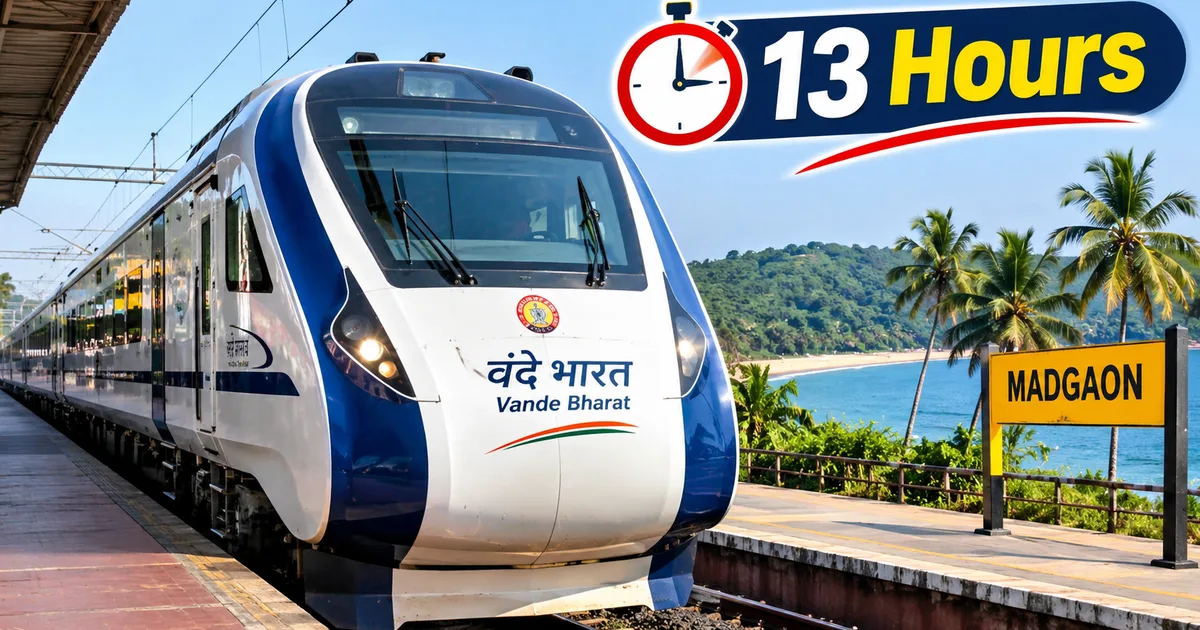
If you planned to book the new Yeshwantpur-Madgaon Vande Bharat Express expecting a lightning-fast dash from Bengaluru to Goa, check the railway timetable first. The train clocks an official journey time of nearly 13 hours. That's longer than many existing trains on the same route.
Modern semi-high-speed trains are supposed to cut travel times. They really are. When news broke that Indian Railways approved a direct Vande Bharat service linking Bengaluru's Yeshwantpur junction to Madgaon in South Goa via Mangaluru, travellers expected an eight-hour sprint. Instead, the proposal landed with a staggering 13-hour runtime. That makes it the slowest Vande Bharat route in the country by average speed. But honestly, the painful travel time isn't even the biggest mess brewing around this service.
The real disruption hits everyday passengers along coastal Karnataka.
To carve out an operating slot for this single train, railway timetable committees have to reschedule 13 existing trains running across the coastal rail network. I'm not sure why planners thought this schedule would fly, but it's a huge headache. That reshuffling directly hits roughly 15,000 daily passengers who depend on regular intercity expresses and local passenger shuttles for work and college every morning.
Why the 13-hour runtime makes this the slowest Vande Bharat
Look at the route map. The train leaves Yeshwantpur, heads west through Arsikere and Hassan, drops through the Western Ghats down to Mangaluru Junction, and then runs north along the coast past Udupi and Karwar to reach Madgaon. The total track distance is around 650 kilometres.
The math is pretty brutal. Covering 650 kilometres in 13 hours means an average running speed of just 50 kilometres per hour. Think about that for a second. For a train capable of hitting 130 km/h on plain routes, 50 km/h is an agonizing crawl.
So why can't the train go faster? If you ask me, it comes down to brutal mountain terrain and strict railway safety mandates.
The biggest hurdle sits right in the Shiradi Ghat stretch between Sakleshpur and Subrahmanya Road. Over just 55 kilometres, the railway line drops nearly 600 metres down the mountain slopes. The track twists through dozens of sharp curves and tunnels with a harsh 1-in-50 gradient. South Western Railway enforces a strict speed limit of 30 to 40 km/h along this entire mountain descent (which makes sense, actually, given the terrain). You can't speed up here. And if a loco pilot tries to push faster, the risk of wheel slip or brake overheating climbs immediately.
And then there's Mangaluru Junction. Because the station layout doesn't have an easy continuous bypass toward the Konkan line, the train has to reverse operational direction or wait for track clearance. That adds another 25 to 30 minutes of stationary halt and shunting buffer.
As we often explain in our railway tech explainers, a modern train's acceleration means nothing if the underlying civil infrastructure forces constant braking.
The reality of spending 13 hours in an upright chair car
Sitting upright in an AC chair car for thirteen hours is a punishing physical test. In my experience, it gets miserable fast, especially when you compare it with existing travel options on the same route.
Most sensible travellers just book an overnight berth on the Panchaganga Express or the Karwar Express. You finish dinner, board at 8:00 PM in Bengaluru, sleep through the night in a three-tier AC berth for ₹1,100, and wake up right as the train enters coastal Karnataka. You reach your destination by morning without losing a productive working day.
The Yeshwantpur-Madgaon Vande Bharat, on the other hand, runs entirely as a daytime chair-car service. An AC Chair Car ticket will likely cost between ₹1,600 and ₹1,800 on IRCTC, while an Executive Chair Car seat will push past ₹2,800. (Paying premium fares to nurse a sore back for half a day is a bizarre bargain, if you ask me.)
Don't get me wrong. The daytime scenery through the ghats is genuinely pretty during the post-monsoon months. You get misty valley views and green mountain ridges right outside your window. But after four hours of looking at trees, the novelty wears thin. Your knees ache. And you realize you still have seven hours of sitting ahead of you.
Until Indian Railways starts rolling out dedicated sleeper rakes like those planned on Bengaluru to Mumbai rail corridors, daytime chair cars on 12-plus-hour routes are just an uncomfortable compromise.
How train rescheduling disrupts 13 coastal rail services
The operational friction reaches far beyond travel fatigue. To run this new service, railway authorities have to fit it into a crowded coastal corridor. Thing is, the single-line Konkan Railway network running from Thokur near Mangaluru all the way to Madgaon has only one set of tracks for both directions. When a premium Vande Bharat enters a single-track line, railway rules demand an absolute priority corridor. That means every other train must pull into a side loop line and wait until the high-status train zooms past.
Commuter groups in Mangaluru and Udupi, along with passenger forums in Karwar, have raised serious alarms because the new timetable forces changes on 13 existing trains:
- Daily passenger shuttles between Mangaluru Central and Madgaon face departure delays of 30 to 75 minutes, which throws morning office commutes into disarray.
- The Karwar-Madgaon Special and regional DEMU services will spend extended periods idling on crossing loops to let the Vande Bharat pass.
- Long-distance intercity expresses like the Matsyagandha Express and Netravati Express face revised departure windows and altered crossing points.
- Local MEMU trains that carry vendors and daily wage workers across Udupi and Bhatkal will see their regular arrival times pushed back.
Commuter associations along the coastal belt argue that delaying regular trains carrying 15,000 working-class passengers to give priority to an expensive 1,100-seat train creates unnecessary public hardship.
Around 1,100 travellers on an expensive train get an uninterrupted green signal, while roughly 15,000 ordinary commuters lose their predictable daily transit schedule. If you ask me, that trade-off doesn't sit well with anyone who relies on Indian Railways to make a living.
The infrastructure roadblock: why single tracks choke Konkan rail
When the late E. Sreedharan led the construction of the Konkan Railway in the 1990s, building a rail line across rugged coastal rivers and unstable clay hills was an engineering triumph. But to keep construction costs manageable, the line was built almost entirely as a single track. Passing stations sit 10 to 15 kilometres apart. It's a tight squeeze. If one train runs 20 minutes late, that delay cascades like dominoes to four other trains running in opposite directions.
Double-tracking this terrain is painfully slow and expensive. Cutting new tunnels through loose laterite soil and building massive river viaducts requires thousands of crores in capital funding. And while Indian Railways has expanded electrification and upgraded modern railway safety systems, laying a second parallel track along the coast will take years of sustained work.
Without double tracks, adding premium trains directly cannibalizes track capacity from existing passenger trains. It's that simple.
Who should actually book this train?
The train makes sense for certain travellers, even if it fails end-to-end passengers.
Look, if you live in Bengaluru and want to reach Goa quickly, take a flight from Kempegowda International Airport. You can book an economy ticket on IndiGo or Air India for ₹2,800 to ₹3,500 using UPI on any travel app, land at Dabolim or Mopa in 75 minutes, and be on the beach by lunchtime. If you want to save money, take an overnight bus or the Panchaganga Express overnight sleeper.
So who should take this train?
- Leisure travellers and photographers who want daylight panoramic views of the Western Ghats without driving through mountain hairpin turns.
- Business travellers moving between intermediate coastal towns like Udupi and Karwar, where travel times are just two to three hours.
- Families traveling from Hassan down to coastal towns who previously had limited direct day train options.
For intermediate journeys, the train makes complete sense. But for an end-to-end Bengaluru to Madgaon trip, it just asks for too much patience.
What Indian Railways needs to change
Bengaluru and Goa definitely need faster rail links. No doubt about that. But the execution needs practical thinking.
First, Indian Railways should swap this chair-car rake for a sleeper version as soon as overnight Vande Bharat sleeper routes enter full commercial service. Running this train overnight eliminates the 13-hour chair fatigue completely. You board at night and wake up at your destination, while the train navigates the ghats when passenger lines are clear.
Second, the Railway Board has to protect local train timings. Passenger associations shouldn't have to fight to keep their 8:00 AM work shuttle on time every time a new express train gets inaugurated. We track these scheduling disputes constantly in our daily transport news updates, and honestly, the pattern repeats across multiple railway zones.
Until track doubling catches up with rail ambition, adding prestige services without expanding track capacity will keep squeezing the daily commuters who rely on these trains to get to work.