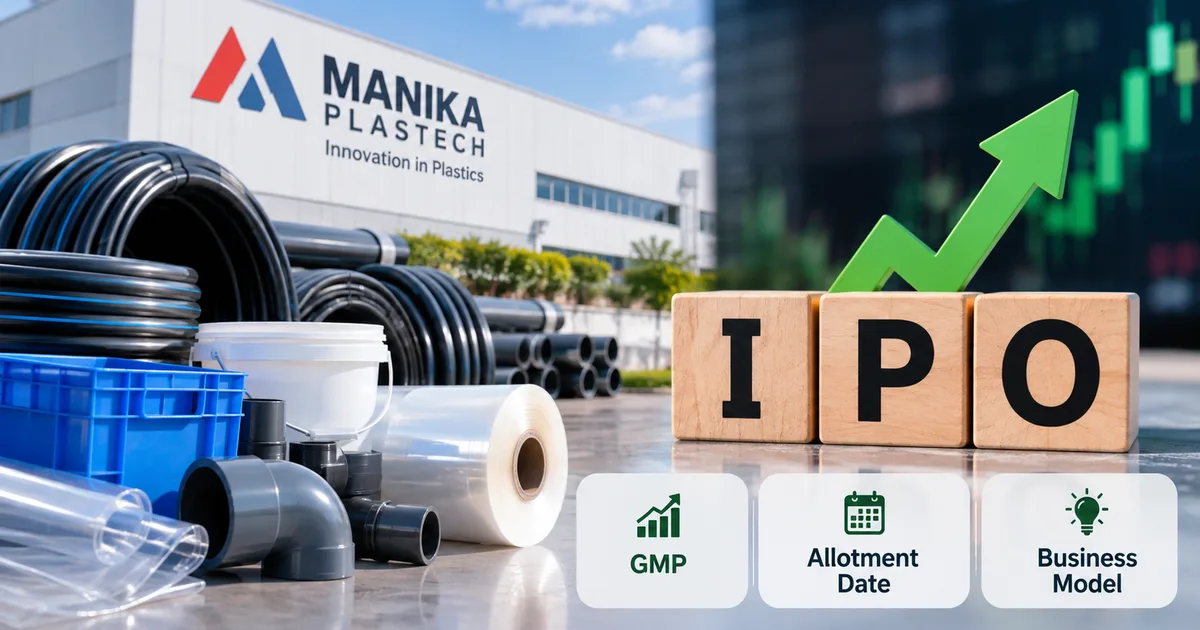
So you've probably heard the buzz around the Manika Plastech IPO 2026. If you're like most retail investors in India, your WhatsApp groups are likely flooded with messages about GMP, allotment status, and listing gains. Honestly, trying to cut through the noise during an IPO rush can be exhausting.
But let's take a step back. Before you tie up your hard-earned rupees, you need to know what you're actually getting into. Thing is, we see too many people blindly throwing ₹15,000 at every SME or mainboard IPO without understanding the business. That's a mess.
We're going to look at the expected GMP, how to check your allotment date safely, and the business model behind Manika Plastech. We aren't just looking at the hype here. We're looking at the cold numbers and what this means for the Indian manufacturing sector. (Which makes sense, actually, given the current market).
What exactly does Manika Plastech do?
Think about the last time you bought a sturdy plastic bucket. Or maybe you've seen those heavy-duty black battery casings for home inverters or cars. That's essentially what Manika Plastech manufactures. They make rigid polymer packaging products. We're talking battery casings and large industrial pails. They also make thinwall containers.
It isn't a glamorous business like an AI startup or a new fintech app. But it's necessary. As India's manufacturing and automotive sectors grow, the demand for reliable industrial packaging grows right along with it. FMCG growth helps them too.
The company operates seven different manufacturing facilities across the country. Their total installed capacity is around 29,200 metric tonnes per annum (MTPA). That's a huge amount of plastic processing. When you look at the Make in India initiative, companies supplying basic industrial components are the backbone of that push.
In the financial year that ended in March 2026, they reported a total revenue of ₹436 crore. That's up from ₹406.5 crore the previous year, which is a 7.3% growth. And their profit jumped almost 16% to ₹22.4 crore in FY26 from ₹19.3 crore in FY25. In my experience, these kinds of numbers are pretty solid for this sector.
When looking for Tech Explainers on traditional businesses, you want to see this kind of steady, boring growth. Boring is usually good in manufacturing. It means predictability.
The Manika Plastech IPO details explained
Here's the deal on the IPO itself. The Manika Plastech IPO is a ₹125.50 crore book-built issue. They opened for public subscription on September 11, 2026, and officially closed on September 16, 2026. The price band was set fairly conservatively at ₹40 to ₹43 per share.
For retail investors like you and me, the lot size was 348 shares. That meant a minimum investment of ₹14,964 if you applied at the upper end of the band. You can't just buy 10 shares in an IPO. You have to bid in these fixed lots.
The demand was quite strong. The IPO was subscribed a total of 29.5 times overall by the final day. Retail investors subscribed 24 times over their quota. But the non-institutional investors (NII) really went wild, subscribing over 67 times. The qualified institutional buyers (QIB) were more modest and filled their portion 11.22 times.
Before the IPO even opened to the public, they got ₹37.6 crore from four anchor investors. The Wealth Company Alternates Trust, which is owned by a Pantomath Group subsidiary, took the biggest chunk. They invested around ₹17.6 crore. Other notable funds like Trust Mutual Fund also jumped in, picking up shares worth about ₹10 crore. It's a decent sign when institutional money steps in early at the upper end of the price band.
Where is the IPO money actually going?
This is a question I always ask before looking at any stock. Are the promoters just cashing out, or are they building the business?
Out of the total ₹125.50 crore issue size, ₹92.5 crore is a fresh issue of equity shares. The remaining ₹33 crore is an offer for sale (OFS) from the promoter entity, VRIDAA Holding Trust. So yes, the promoters are taking some money off the table. This is normal. But the majority of the funds are going directly into the company.
For the fresh money coming in, Manika Plastech plans to spend ₹54.9 crore on capital expenditure. Basically, they're buying new plant and machinery to expand their manufacturing capabilities. Another ₹15 crore will go directly toward paying down existing debt. The rest is set aside for general corporate purposes.
Expanding capacity and paying down debt is a sensible use of funds. It shows they want to scale up operations and clean up their balance sheet.
Manika Plastech IPO GMP today: The grey market premium
Now for the part everyone asks about. The Grey Market Premium (GMP). I know many investors track this obsessively to guess their listing day profits.
The latest GMP signals point to a very modest listing. Right now, the GMP is hovering around ₹2 per share. On an issue price of ₹43, that's roughly a 5% premium. So the estimated listing price based on the grey market is around ₹45 per share. Some reports even suggest a flat listing right at the ₹43 mark on the BSE and NSE. I'm not sure exactly why it's so subdued, but that's what the numbers say.
Honestly, a 5% GMP isn't going to make anyone an overnight crorepati. If you were hoping for a massive 50% pop on listing day, this issue might disappoint you. But remember, the grey market is entirely unofficial. It fluctuates wildly based on broader market sentiment and liquidity.
Sometimes stocks list flat even with a high GMP. Sometimes they surprise us. The flat listing expectations are partly why we aren't seeing a crazy frenzy around this specific stock compared to some tech offerings. If you're tracking other upcoming issues for comparison, you might want to read our SS Retail IPO 2026: Expected GMP, Allotment Date, and Investment Guide Explained to see how different sectors are pricing their issues right now.
How to safely check your allotment status
The share allotment is expected to be finalised today. If you applied, you're probably hitting refresh on your browser right now wanting to know if you got lucky.
Here's exactly how you check your Manika Plastech IPO allotment status. And please, listen carefully. Don't fall for random links on WhatsApp or Telegram that claim to offer "guaranteed allotment checks" or VIP results. Those are usually phishing scams designed to steal your PAN or demat account details. It's a bit sketchy out there. Always use the official registrar's website or the NSE/BSE portals. If you want to know more about staying safe online during these events, check out our Scam Alerts & Safety section.
Checking via MUFG Intime India (the official registrar)
The safest way is to go straight to the source.
- Go to the official MUFG Intime India IPO allotment page on your browser.
- Select "Manika Plastech" from the drop-down menu of recent issues.
- You can enter either your PAN, your application number, or your DP/Client ID. (PAN is usually the easiest).
- Click Submit. Your allotment status will pop right up showing how many shares you applied for and how many you got.
Checking via the NSE website
You can also check directly through the stock exchange.
- Visit the official NSE IPO Allotment page.
- Under the issue type option, select "Equity".
- Choose "Manika Plastech" from the dropdown list of companies.
- Enter your application number or your PAN number.
- Fill in the security captcha correctly and click search.
If you got the allotment, congratulations. The shares will be credited to your demat account very soon. The listing date is tentatively scheduled for September 21, 2026, on both the BSE and NSE platforms.
The Indian packaging industry context
To really understand Manika Plastech's potential, you have to look at the broader Indian packaging and plastics industry. The shift away from single-use plastics has forced a lot of companies to pivot toward rigid and reusable polymers for industrial use.
India is a massive consumer of lead-acid batteries, both for automotive use and for home inverters given our power infrastructure. The casing for these batteries is a highly specialized product. It needs to withstand acid and intense heat. By positioning themselves as a reliable supplier in this space, Manika Plastech has secured a steady revenue stream. Quick tech changes won't easily disrupt it.
Also, their expansion into thinwall containers targets the FMCG sector. Think food packaging and paint buckets. As domestic consumption rises, the demand for these containers scales linearly. You might want to compare their business trajectory with other manufacturing plays we've covered, like the Technocraft Ventures IPO 2026: Expected Valuation, GMP, and Allotment Status Explained, to understand the different margins in the manufacturing sector.
Understanding the business risks
No investment is without risk. Manika Plastech is no exception. While their growth looks solid on paper, you have to consider the macroeconomic factors at play here.
First, their business is heavily dependent on raw material prices. The polymers and plastics they use are derived from crude oil. If global oil prices spike due to geopolitical tensions, their profit margins could take a severe hit. That is, unless they can pass those costs onto their customers immediately. In competitive B2B markets, passing on costs isn't always easy.
Second, there is the concentration risk. A significant portion of their revenue comes from the battery casing segment. The battery market is growing, but any disruption could impact their primary business line. For example, a rapid shift towards different battery technologies that require different casing materials. (This is a long-term risk, obviously, but still real).
And finally, they operate in a highly fragmented and competitive industry. There are hundreds of unorganised plastic manufacturers in India. While Manika Plastech has scale and quality certifications on its side, they constantly have to fight off cheaper alternatives in the market. It's a tough business environment.
Should you hold or sell on listing day?
I get asked this all the time on Twitter. "I got the allotment, now what do I do?"
Look, I can't give you personalized financial advice. Your risk appetite is different from mine. But I can tell you how to think about it objectively.
With a GMP of only 5%, or possibly a flat listing, there isn't a huge incentive for flippers. Flippers are investors who only apply for quick listing day gains and sell immediately. The heavy subscription from NIIs suggests there is solid fundamental interest from high net-worth individuals. But the retail portion wasn't as aggressively oversubscribed as we've seen in some recent SME IPOs. The numbers here are a bit fuzzy.
If you're in it for the long haul, you need to look at the business fundamentals we discussed earlier. They are profitable. They are growing revenue year over year. And they're using the IPO funds primarily to expand manufacturing capacity and reduce their debt burden. These are all objectively positive signs for a traditional manufacturing business operating in India.
If the broader stock market stays stable, it could be a steady, compounding performer over the next few years. It won't be a multi-bagger overnight. But it has a solid foundation.
If you're just looking for quick cash, you might want to temper your expectations for September 21st. Sometimes it makes sense to take a small profit. Or you might even exit at your cost price if the market turns volatile and you need the capital elsewhere.
Ultimately, investing in mainboard IPOs requires patience and a bit of nerve. Don't panic if the stock doesn't double on day one. Evaluate the company. Keep an eye on their quarterly results over the next year. You should make your decisions based on real financial data, not just the temporary grey market hype.