Picture this. You've dropped a cool ₹80 lakh on a shiny new Mercedes. You pull into your regular petrol pump in Delhi or Mumbai, tell the guy "full tank", and notice the E20 sticker on the dispensing machine. Suddenly, a WhatsApp forward flashes in your mind. Didn't some famous YouTuber just say this new petrol ruined his luxury car's mileage? Panic sets in. Do you stop the pump?
That's exactly what thousands of Indian luxury car owners are feeling lately. And it's why we're talking about the Mercedes-Benz E20 Compatibility Advisory 2026 today. Look, I get it.
If you own a Merc or any modern BS VI car in India right now, you need to understand what is actually going on with this new fuel blend. I spent the last few days digging into the official statements. I dug into the engineering behind it too. And obviously the drama that started it all. So here's the deal.
The YouTuber drama that started it all
It all blew up when Sourav Joshi, one of India's biggest vloggers, posted a video. He complained about a massive drop in his Mercedes-Benz's mileage. He pointed his finger squarely at E20 petrol. The video went completely viral. Overnight, WhatsApp groups were full of people debating if the government fuel policy was quietly destroying expensive engines. (Honestly, my own family group was going crazy.)
Thing is, I get why people freaked out. When a guy with millions of subscribers says a specific fuel broke his expensive toy, people listen. But the internet reaction was split. Some owners checked their manuals and found conflicting info. Others said they've been using E20 for months without a single hitch. The confusion was real. It spread fast.
It got so loud that Mercedes-Benz India couldn't ignore it. They had to step in. They had to clear the air before it affected their brand trust.
What did the official Mercedes-Benz E20 compatibility advisory 2026 actually say?
The company released a formal customer advisory to shut down the rumors. They didn't name Joshi directly in their blast. But everyone reading it knew exactly what prompted the sudden announcement.
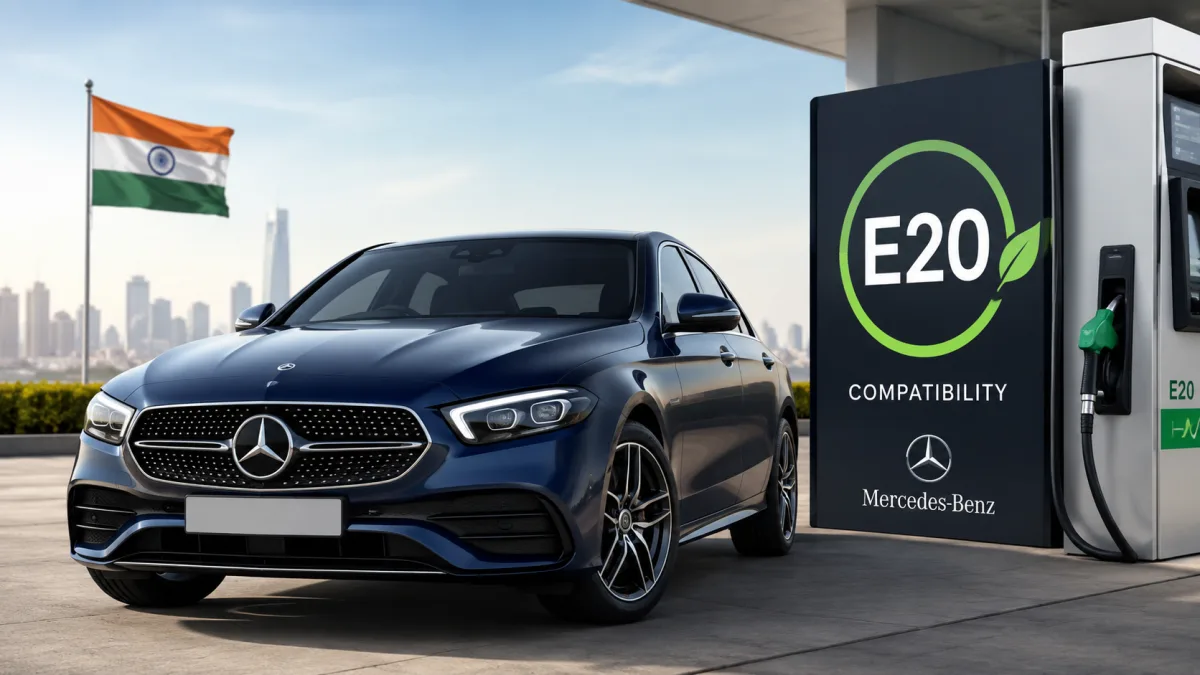
Their statement is incredibly clear. There is no room for interpretation: All BS VI petrol vehicles from Mercedes-Benz are fully compatible with E20 fuel.
They confirmed that if you have a modern Merc built to BS VI emission standards, you can fill it up with the 20% ethanol blend. You don't have to stress about engine damage or voiding your precious warranty. This is a massive relief for anyone who was sweating bullets at the petrol pump yesterday.
"Mercedes-Benz India has clarified that all its BS VI petrol vehicles are fully compatible with E20 fuel, addressing concerns about engine performance and mileage."
But what about older models? If you are driving a BS4 or earlier model, you really need to be careful. In my experience, older engines weren't built with this much ethanol in mind. The rubber seals, plastic parts, and fuel lines in those older cars might not handle it well over time. I'll get into the science of that later.
Wait, what even is E20 fuel?
Before we get into the mechanics, we should back up a second. What exactly is E20? And why is it suddenly appearing at every petrol pump from Kochi to Kanpur?
E20 simply means the petrol you buy is a blend. It is 80% regular fossil-fuel petrol mixed with 20% ethanol. Ethanol is a biofuel. In India, we mostly make it from sugarcane, broken rice, and other excess crops.
The Indian government is pushing this transition incredibly hard for a few solid reasons:
- Cutting our import bills: We import a massive amount of our crude oil. It drains our foreign exchange reserves. Mixing in 20% locally produced ethanol saves the country billions of dollars every single year. That's real money staying within the economy.
- Helping Indian farmers: Sourcing ethanol locally means more direct income for Indian sugarcane and grain farmers. It creates a secondary market for their produce, especially when there's a surplus.
- Reducing tailpipe emissions: Ethanol burns cleaner than pure fossil-fuel petrol. It produces less carbon monoxide. In cities like Delhi where the air quality index routinely hits dangerous levels, every little bit of emission reduction helps.
We started with E10 a while ago. Now, the push is to make E20 the standard across the entire country by 2025-2026. You will see E20 dispensing nozzles at Indian Oil, Bharat Petroleum, and HP pumps everywhere. This is a major change to how every petrol car in India runs. For more background on how government tech initiatives impact our daily lives, check out our explainers section.
Does E20 actually ruin your mileage?
This is the million-rupee question. Sourav Joshi said his mileage tanked terribly. Mercedes says the fuel is perfectly fine to use. Who is telling the truth?
Look, the raw physics of fuel aren't debatable. Ethanol has roughly 30% less energy by volume compared to pure petrol. So when you mix 20% ethanol into the fuel, the overall energy density of a liter drops slightly. It is just science. I am not sure exactly why people get so confused about the basic math.
Does this mean your mileage will drop? Technically, yes. You might see a slight dip. We are talking maybe 3% to 5% at most. If your GLC usually gives you 10 kmpl in heavy Mumbai traffic, it might drop to 9.5 or 9.6 kmpl. Most drivers wouldn't even notice that fluctuation unless they track it with a spreadsheet.
But a catastrophic drop that makes you think your engine is broken? That's highly unlikely to be caused solely by E20 fuel. Modern BS VI engines are smart. They have smart engine control units (ECUs). These computers monitor the exhaust gases. They adjust the fuel injection and spark timing on the fly to compensate for exactly what is in the tank. They adapt to these blends seamlessly.
If you are suddenly losing 20% or 30% of your fuel efficiency, something else is probably wrong. It could be bad fuel quality at a specific sketchy pump. Incorrect tire pressure is another culprit. Clogged air filters or driving a bit too aggressively can ruin mileage too. Blaming E20 for a massive drop is a mess.
How does ethanol affect car engines over time?
Let's get a bit nerdy for a minute. Why were people so worried about engine damage in the first place? Why did this rumor gain traction so fast?
Ethanol has a couple of tricky chemical properties that mechanics worry about:
- It absorbs water: Ethanol is highly hygroscopic. This means it pulls moisture right out of the air. If E20 fuel sits in your car's tank for months without being used, say, if you leave your car parked while traveling abroad, it can absorb enough water to cause phase separation. The water and ethanol mix separates from the petrol and sinks to the bottom of the tank, which can lead to serious corrosion and poor running when you finally start it up.
- It can be corrosive to older parts: High concentrations of ethanol can act as a solvent. In older cars, it can eat away at rubber seals, plastic fuel lines, and certain unprotected metals in the fuel delivery system.
This is exactly why older cars struggle with it. Their fuel lines start degrading from the inside out over time. But car makers have known this E20 mandate was coming for years. Any BS VI car sold in India recently has fuel lines, high-pressure pumps, and seals made from modern materials. These parts are engineered to resist ethanol corrosion. Your new C-Class or GLE is built tough enough to handle it without breaking a sweat. You can ignore the doom-scrolling warnings if your car is relatively new.
What should Indian Mercedes owners do now?
So you read the Mercedes-Benz E20 Compatibility Advisory 2026. What's the practical takeaway for you?
First, don't panic. If you have a BS VI model, keep filling up at your trusted petrol pump. Just make sure it is a reputed outlet that maintains its underground storage tanks well.
Second, pay close attention to your driving habits. Stop-and-go traffic in Bangalore will kill your average fast. Aggressive acceleration on the highway will also kill it far faster than a 20% ethanol blend ever will. Drive smoothly. Keep your tires inflated to the right pressure. Get your regular services done.
Third, if you have an older Mercedes (pre-BS VI), you need to be careful. Check your physical owner's manual right now. Call your authorized service center. Speak to the service manager. Don't just guess. Don't listen to a WhatsApp forward. If your manual specifically says "up to E10 only", do not put E20 in it. The fuel system repairs will cost you far more than whatever you think you're saving.
I think the biggest lesson here is how quickly misinformation spreads online. One viral video from someone who isn't a mechanical engineer caused a nationwide panic among luxury car owners. We need to rely on official advisories. We need to rely on actual mechanical facts rather than YouTube drama. We see this pattern all the time, especially with online fraud. Read our scam alerts to see how quickly panic makes people make bad decisions.
The bigger picture for the Indian auto industry
The Mercedes advisory isn't happening in a bubble. Every single car maker in India is dealing with the E20 transition right now. Maruti Suzuki, Hyundai, Tata Motors, Mahindra. They've all had to quietly upgrade their engines. They've had to clarify their stances to confused customers.
The government's roadmap is fast. They want 20% blending across the board to save foreign exchange. They want to boost the local farm economy. It is a massive logistical shift for the whole country. Oil refineries had to change their processes. Petrol pumps had to upgrade their underground tanks and dispensing machines. Automakers had to tweak their engine maps and materials.
For the everyday Indian driver, it is mostly a seamless transition. That is, assuming you are driving a relatively new car. But the communication from the top down hasn't always been great (which makes sense, actually). The confusion we saw with the luxury car segment recently is just a symptom of a much larger shift happening at the pumps. We need clearer labeling at fuel stations. We need much better education from dealerships when you actually buy a car. When you drop that kind of money on a vehicle, you shouldn't have to rely on a vlogger to tell you what fuel is safe to use. You can explore more about these shifts in our guides section.
Wrapping it up: the E20 verdict
Basically, the entire panic was massively overblown. The Mercedes-Benz E20 Compatibility Advisory 2026 did exactly what it needed to do. It provided a clear, factual, and official answer to a messy internet debate.
Your BS VI Mercedes is totally fine with E20. The mileage drop is minimal. You might not even notice it at all in daily city driving. Keep enjoying the premium drive. Stick to good quality fuel stations. Maybe take viral automotive advice with a hefty pinch of salt next time.
And honestly, if you are truly that worried about daily fuel costs while driving an ₹80 lakh Mercedes, maybe it's time to look at their EQ range of electric vehicles instead. The EV charging infrastructure in India is getting better every month. Electricity is cheaper per kilometer than even the most heavily blended petrol. Just a thought. But for now, your engine is perfectly safe.