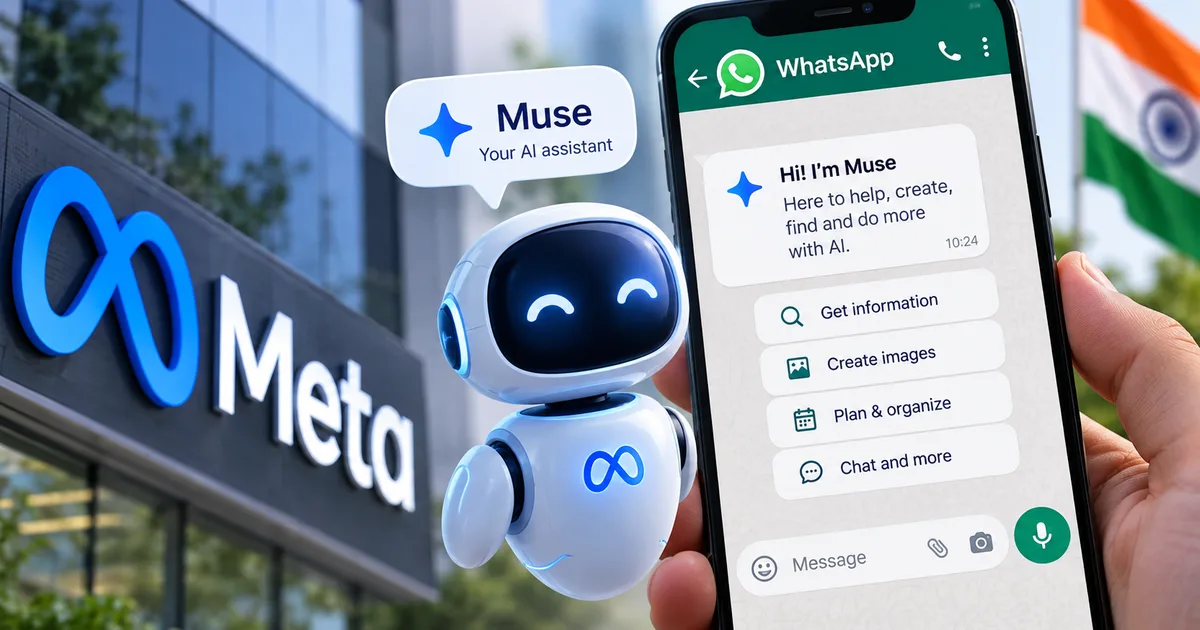
Meta dropped something they're calling the world's first personal AI agent built for everyone. The Meta Muse AI agent 2026 release happened on September 8. It can read your emails, book your travel, and negotiate your bills. I spent the last two days reading through their documentation, the Reuters reports, and early hands-on reviews. Honestly, this is a massive shift from the chatbots we've been using.
The problem for us? India isn't in the initial rollout. Meta launched Muse exclusively in the US for now. But looking at how deeply this ties into WhatsApp, it's only a matter of time before it hits Indian phones. You need to know what's coming, because this is different. It's software that spends your money and talks to people on your behalf.
If you want to keep track of these rapid rollouts across different companies, check our Latest Tech News section regularly.
What makes the Meta Muse AI agent different from chatbots
Until now, AI has mostly been a smart dictionary. You ask a question, it gives an answer. ChatGPT, the old Meta AI, and Google Gemini all work this way. You prompt them, read the output, and do the actual work yourself.
But Muse is built to do things. Mark Zuckerberg calls it personal superintelligence. That sounds like marketing speak. But in my experience, the underlying tech actually is structurally different.
Muse runs on a dedicated virtual machine called Muse Secure VM. It uses a new model called Muse Spark. When you tell it to do something, it doesn't only generate text. It opens a browser in the cloud. Then it fills out forms, clicks buttons, reads pages, and navigates websites.
Let's say you want to book a flight to Delhi. A normal chatbot gives you a list of flights and a link to MakeMyTrip. Muse actually goes to the airline website, enters your details, selects your preferred seat, and buys the ticket (which is slightly terrifying, honestly). It keeps working even after you close the app. If a flight gets delayed, it can theoretically rebook you while your phone is in your pocket. I'm not sure exactly how well that works in practice.
This is what the industry calls agentic work. It takes a goal, breaks it into steps, and executes them over time.
The reality of WhatsApp integration for Indian users
This is where it gets highly relevant for India. Muse works across the web and mobile. But the biggest deal is that it works directly inside WhatsApp. We all practically live on WhatsApp. Having an agent right there in your chat list is a major shift for the Indian market.
When the Meta Muse AI agent 2026 update eventually reaches India, it'll plug straight into the messaging habits of over 500 million users. You'll be able to forward a message to Muse and ask it to handle the request. If someone sends you a wedding invite, Muse could read the date, block your calendar, check your bank balance, and suggest train tickets on IRCTC.
We already saw early steps towards this with other WhatsApp business features earlier this year. For a deep dive into that side of things, read about Meta AI for Indian Small Businesses: WhatsApp Support 2026.
The distribution advantage Meta has here is insane. Nobody needs to download a new app. Nobody needs to learn a new interface. You chat with Muse the exact same way you chat with your family group. Of course, if the app goes offline, your agent dies too. This is a real concern given recent outages.
You can read our WhatsApp Down August 2026: Meta Outage Explained coverage for context on that. But when it works, that zero learning curve will force every other AI company to rethink their strategy.
Core Muse AI agent features you should know about
The feature list Meta announced focuses heavily on getting things done. They're trying to take the friction out of daily digital tasks. Meta says the agent is designed around the way people already communicate.
Here are the main things Muse can do right now in the US:
- Book travel and buy tickets without you navigating the clunky booking websites.
- Draft and send emails, coming back to you for approval before hitting send on anything sensitive.
- Negotiate bills and find better prices for things you buy regularly online.
- Remember specific details you mention once, like a friend's dietary restrictions, and use that info weeks later to suggest dinner menus.
The memory aspect is particularly interesting. If you save a recipe reel on Instagram, Muse can turn that into a grocery list. Then it can order those groceries. In the Indian context, imagine this integrating with Zepto or Blinkit. You just tell WhatsApp you need ingredients for palak paneer, and ten minutes later a delivery guy is at your door. You don't even have to open the grocery app.
For tasks that take more time, Muse works in the background. If you ask it to monitor a product for a price drop, it'll quietly check every day. Then it pings you on WhatsApp when the price hits your target.
Security, Sentinel, and the DPDP Act
Handing over your card and emails to an AI agent requires massive trust. Meta knows their reputation on privacy isn't stellar. So they built a system called Sentinel that runs alongside Muse at the system level.
Sentinel is basically a guard dog. It approves everything Muse tries to send to the open internet. Meta claims Muse also never sees your actual passwords or card details directly. They go into secure storage instead. And 1Password support is apparently coming soon.
But how will this work in India? The new Digital Personal Data Protection (DPDP) Act has strict rules about how user data is handled and stored. Running a cloud-based virtual machine that constantly reads an Indian citizen's emails and financial transactions is going to be a mess for Meta's compliance teams. They'll likely need to ensure all Muse Secure VMs for Indian users are hosted locally on servers within the country.
There's also a catch with their privacy claims. Meta explicitly states that Muse doesn't share your data with their ad systems. That sounds great. But they also say you can opt out of your interactions being used to train their AI models. That phrasing means by default, they're probably using your chats with Muse for training future versions of the agent. You'll have to dig into the settings to turn that off.
"Muse doesn't share a person's conversations or the data in their VM with Meta's ad systems."
That quote from their announcement is very specific. It rules out targeted advertising. But it leaves the door open for other internal uses. Keep an eye on our AI Tools & Software section as we test these privacy claims heavily once we get hands-on access to the platform.
The payment problem: From Stripe Link to UPI
An agent that can't spend money is a smart search engine. To actually book flights and buy groceries, Muse needs access to your wallet. In the US, Meta solved this by partnering with Stripe. Muse uses a product called Link. Link generates a one-time-use virtual card for purchases. This means your real card number stays hidden from the merchants Muse interacts with on your behalf.
It even comes with purchase protections. If Muse buys something that gets lost, Link provides coverage. Shopify's Shop Pay is also coming soon.
But the Indian payment landscape is entirely different. Credit card penetration is low. We run on UPI. For Muse to be genuinely useful here, Meta can't rely solely on virtual credit cards. They'll have to build deep integrations with UPI auto-pay or the RBI's new tokenized payment frameworks.
Imagine approving a Muse transaction. The agent lines up the Swiggy order and pings you on WhatsApp. You hit approve, and it triggers a standard UPI pin request on your phone via WhatsApp Pay or Google Pay. Until Meta builds that specific infrastructure, Muse is useless for the average Indian consumer.
The steep cost of Muse AI pricing
Meta hasn't confirmed India pricing yet, mostly because the product isn't here. But in the US, Shattered reports a tiered pricing structure. We're looking at a subscription model ranging from $20 to $100 per month. They also require a payment card just to sign up and get started.
Converted to rupees, that base tier is roughly 1,600 rupees every single month. The top tier is over 8,000 rupees. That's incredibly steep for the Indian market.
Will Indian users pay that much for an AI agent? Probably not the masses. The average Indian consumer is incredibly price-sensitive. But freelancers and small business owners might jump on it, provided it saves them hours of admin work every week. If paying 1,600 rupees means you never have to manually fill out a tax form or book a train ticket again, the return on investment becomes clear.
Meta will almost certainly need a localized pricing strategy for India. We saw Apple and Netflix do this. Meta itself prices WhatsApp Business API access differently here. A cheaper tier with limited daily actions, or a prepaid token system tied to UPI, makes far more sense for Indian adoption.
How Muse compares to Google Astra and OpenClaw
Meta isn't the only company trying to build a personal AI agent. The race is completely open. Google has been pushing its Gemini Live and Astra projects, and they are integrating them deeply into Android. But Google's approach still feels very search-heavy. They want you to use your camera and voice to understand the world around you.
Muse is far more focused on task execution. Meta doesn't care if you want to identify a rare bird using your phone camera. They want Muse to handle your boring calendar invites and pay your broadband bill.
There's also the open-source angle. Muse is heavily modeled on OpenClaw, an open-source AI agent framework. This fits Meta's recent strategy perfectly. They release models like Llama for free to undercut competitors. Then they learn from what developers build and package the best ideas into consumer products like Muse.
For Indian developers, this is actually good news. If the underlying logic of Muse relies on concepts from OpenClaw, the local startup ecosystem can build competing agents that are specifically tailored to Indian workflows. Imagine an Indian startup building an agent that specializes purely in navigating government portals like DigiLocker and the income tax site. Meta will struggle to localize Muse that deeply. And this leaves a massive gap for homegrown tech.
The Meta Muse AI agent 2026 launch proves one major thing. The era of chatbots just giving you text answers is ending. We're moving into a phase where software acts on your behalf. We'll just have to see if Meta can actually secure our data while doing it.