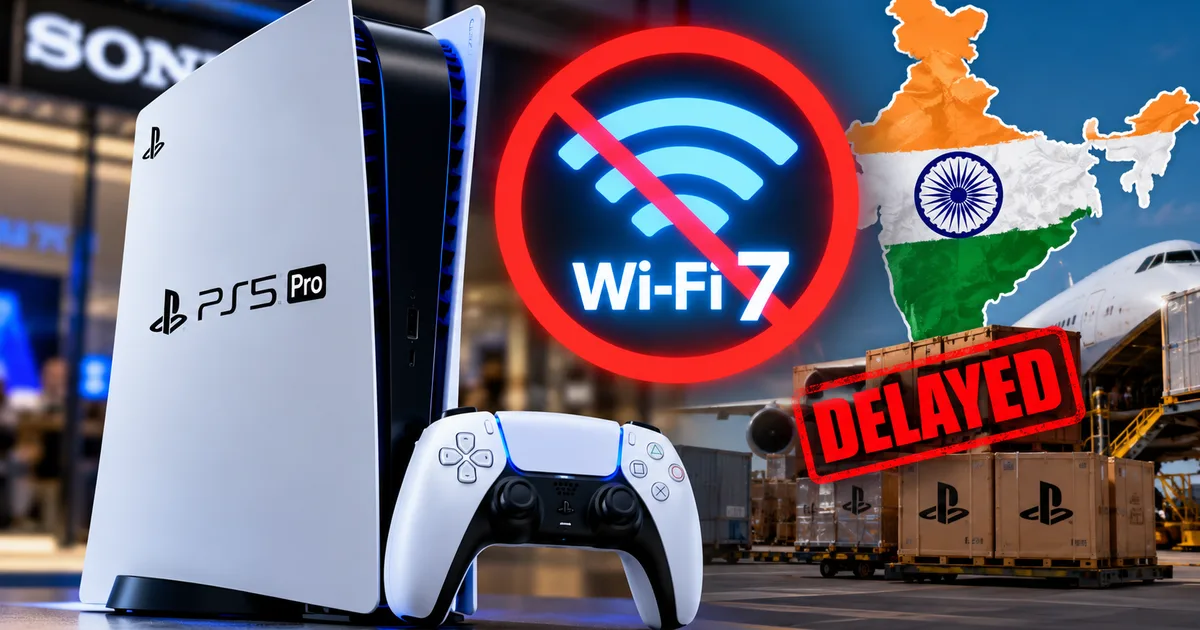
If you spent the last year waiting to buy a flagship PlayStation console in India, you already know the frustration. The Sony PS5 Pro India launch delay turned what should have been an exciting holiday release into a bizarre waiting game. Sony launched the console globally back in November 2024, yet Indian shelves remained completely bare. Walk into a Sony Center in Delhi or Bengaluru, ask the staff about the Pro model, and you'd get polite shrugs.
It wasn't supply chain shortages this time. And it wasn't customs paperwork or shipping snarls either.
Instead, the console ran straight into a brick wall of Indian telecom regulations. Wi-Fi 7 was the culprit. Specifically, the console has Wi-Fi 7 hardware built to transmit over the 6 GHz radio spectrum. That single component made it legally impossible for Sony to sell the box here without breaking national radio laws (annoying, I know). But things are finally moving. A fresh Bureau of Indian Standards filing surfaced in early 2026, and the Indian government officially changed its stance on wireless airwaves. If you ask me, it's about time. Here's the deal on why this regulatory fight happened, and when you can actually plug a console into your TV.
How Wi-Fi 7 spectrum regulations halted Sony
To understand this mess, you have to look at the networking chip inside the box. Sony built the PS5 Pro to support the new IEEE 802.11be standard, which everyone calls Wi-Fi 7.
Wi-Fi 7 is fast. Ridiculously fast, actually.
It hits those multi-gigabit speeds and low latency by transmitting across three distinct frequency bands: 2.4 GHz, 5 GHz, and 6 GHz. Now, the older 2.4 GHz and 5 GHz bands have been open for Indian consumer Wi-Fi for decades. Every home router and laptop in the country runs on them. But the 6 GHz band (specifically the frequencies between 5925 MHz and 7125 MHz) was restricted government property in India. Without official approval, no consumer device could legally broadcast on those frequencies inside the country.
So Sony had an awkward engineering choice to make. They could either manufacture a stripped-down hardware variant just for India with the 6 GHz radio physically disabled, or they could just wait out the Indian bureaucracy. Sony chose to wait. In an official release addressing regional rollout hurdles, the company put its cards on the table:
"PS5 Pro will not be available in some countries (which presently includes India) where 6GHz wireless band used in IEEE 802.11be (Wi-Fi 7) has not yet been allowed."
Honestly, Sony's reluctance to build a special Indian model made total sense. I think redesigning motherboards and spinning up separate factory testing pipelines for a single mid-generation console would've bloated manufacturing costs way too much. So Sony just hit pause on Indian shipments.
The 6 GHz band fight between telcos and tech firms
Why did India lock away the 6 GHz band in the first place? It comes down to corporate greed. Basically, two opposing camps spent three years fighting over every single megahertz.
On one side was the Cellular Operators Association of India (COAI), which lobbies for Reliance Jio and Bharti Airtel, alongside Vodafone Idea. The telco pitch was straightforward. Mobile data demand in India is skyrocketing, so the government should auction the full 1200 MHz chunk of 6 GHz spectrum for 5G expansion and future 6G setups. Telcos wanted exclusive licensed rights. That would've also poured thousands of crores into government pockets through spectrum auctions. In fact, COAI pushed so hard that the group formally demanded bans on imported Wi-Fi 6E routers. Amazon India even scrubbed grey-market gear off its site.
On the other side were tech giants like Google, Meta, Microsoft, and Amazon, represented locally by the Broadband India Forum (BIF).
Their argument was just as practical. Mobile towers can't handle indoor internet traffic alone. High-speed home broadband offloads roughly 80 percent of all digital data consumption to indoor Wi-Fi setups. If you cut Wi-Fi off from 6 GHz airwaves, indoor gigabit broadband gets jammed up fast. Countries like the United States, South Korea, Japan, and the European Union opened up the band years ago to power next-gen wireless gear (which makes sense, actually).
The fight ended in total gridlock. When the government-backed Bharat 6G Alliance published a paper recommending that India reserve the whole band for telcos, the tech lobby fired back immediately. I'm not sure why regulators let the standoff drag on for so long, but consumer gadgets ended up paying the price. For more background on how government frequency allocations impact everyday gadgets, check our in-depth Indian tech explainers covering digital infrastructure policy.
How the DoT notification changed the game
The breakthrough finally landed on January 20, when the Department of Telecommunications published an official gazette notification that split the difference.
Instead of giving all 1200 MHz to telcos or handing it entirely to Wi-Fi, the DoT delicensed the lower half of the 6 GHz band. Specifically, frequencies between 5925 MHz and 6425 MHz (a 500 MHz block) are now officially open for unlicensed indoor use.
This compromise lets low-power indoor gadgets and very-low-power outdoor gear transmit on 6 GHz airwaves without an individual license. The rules have some boundaries, of course. You can't mount these transmitters on commercial drones or operate them inside moving cars. Look, for regular folks sitting on the couch, those limits don't matter at all.
What does this mean for your home setup?
Pretty much everything. Routers with Wi-Fi 6E and Wi-Fi 7 can now transmit freely without running into wireless monitoring authorities. Modern phones like the iPhone 17 family, Google Pixel 10 devices, newer OnePlus flagships, and Samsung Galaxy S25 handsets can finally turn on their 6 GHz antennas in India instead of choking on crowded 5 GHz channels. In my experience, 5 GHz is way too congested in Indian apartment blocks anyway. And best of all, the legal roadblock keeping Sony from importing the PS5 Pro disappeared overnight. You can track other regulatory clearances across our latest Indian tech news section as hardware makers update their Indian product roadmaps.
What the new BIS certification means for Indian gamers
Clearing telecom rules is one thing, but getting local safety certification is another. That brings us to the paperwork recently spotted on the Bureau of Indian Standards portal.
In early 2026, regulatory databases showed a new Sony device registered under model number CFI-7121. Hardware enthusiasts quickly identified it. It's the 2025 production revision of the PS5 Pro chassis.
Look, companies don't pay registration fees and submit test units to the BIS for fun. When an electronic device clears the BIS database, store availability usually follows within four to eight weeks. Importers use this time to line up warehouse logistics and slap mandatory Indian rupee MRP stickers on the packaging.
Sony India hasn't pinned down an official launch date on its social feeds yet. Still, the paper trail shows that distribution gears are actively turning. If you want updates on stock drops and retail alerts, keep an eye on our PS5 Pro India pre-order guide for confirmed booking details.
Expected PS5 Pro price in India and import risks
Now for the elephant in the room: how much is this console actually going to cost when it lands on Indian store shelves?
Brace your wallet. It won't be cheap.
Sony originally launched the console globally at $699.99 (roughly ₹64,200). Then, in August 2025, Sony added a $50 price bump, pushing the international sticker price to $749.99 (around ₹68,850). When gadgets cross Indian customs borders, they get hit with Basic Customs Duty, social welfare surcharges, freight fees, and an 18 percent Goods and Services Tax (GST). Factor in retail distribution margins, and I think realistic Indian launch pricing will land between ₹79,990 and ₹84,990.
That's a huge pile of cash for a console that doesn't even come with a disc drive or vertical stand.
Hardware upgrades under the hood
So what are you actually buying if you drop that kind of money?
The upgrades are all about graphical muscle and frame stability, not a brand-new architecture. Sony bumped the graphics compute units, pushing raw GPU performance to 16.7 teraflops compared to 10.3 teraflops on the launch model. Even better, the console has PlayStation Spectral Super Resolution (PSSR). That's an AI-driven upscaler that sharpens 1080p and 1440p renders into crisp 4K images without dragging down frame rates.
Here is what the upgraded hardware delivers:
- Significantly faster ray-tracing calculations that simulate realistic lighting reflections and shadow diffusion in supported games.
- A built-in 2 TB solid-state drive that doubles internal storage space over the standard launch edition.
- Advanced hardware upscaling through dedicated machine learning silicon for sharper rendering at high refresh rates.
- Full Wi-Fi 7 compatibility with access to 6 GHz channels for reduced wireless latency during online multiplayer matches.
If you game on a standard 1080p screen, you'll barely see any difference. But if you have a 65-inch 4K OLED running at 120Hz, the jump in visual clarity is obvious right away.
The grey market warranty trap
Because of the long wait, hundreds of desperate gamers turned to grey market importers in places like Delhi's Gaffar Market and Mumbai's Heera Panna, or sketchy storefronts on e-commerce sites.
I strongly advise against doing that.
Grey market sellers are currently asking ₹90,000 to ₹95,000 for units brought in from Dubai or Japan. Thing is, beyond the painful scalper markup, there's a much nastier catch: the warranty. Sony India has a strict regional warranty policy. If your imported box develops a faulty power supply or disc drive glitch down the line, authorized Sony service centers in India will refuse to touch it, even if you offer to pay cash. You end up with a very expensive paperweight.
Waiting for official retail boxes gets you a full one-year domestic warranty, proper 230V Indian power cables, genuine receipts, and local customer support. If you're comparing different entertainment setups, check out our broader hardware purchasing guides before making a move.
Final verdict for Indian gamers
The long delay for the PS5 Pro in India was frustrating. It really showed what happens when consumer hardware crashes headfirst into national spectrum politics.
For more than a year, new Wi-Fi 7 gear was stuck because of policy battles between cellular operators and tech companies. Now that the DoT opened up 500 MHz of the 6 GHz spectrum and the BIS cleared official test units, that roadblock is history.
If you already have a standard PlayStation 5, there's zero rush to upgrade. Honestly, stick with your current games and let scalpers sit on their overpriced grey market boxes. Waiting saves you thousands of rupees and keeps your warranty safe. That's a win in my book.