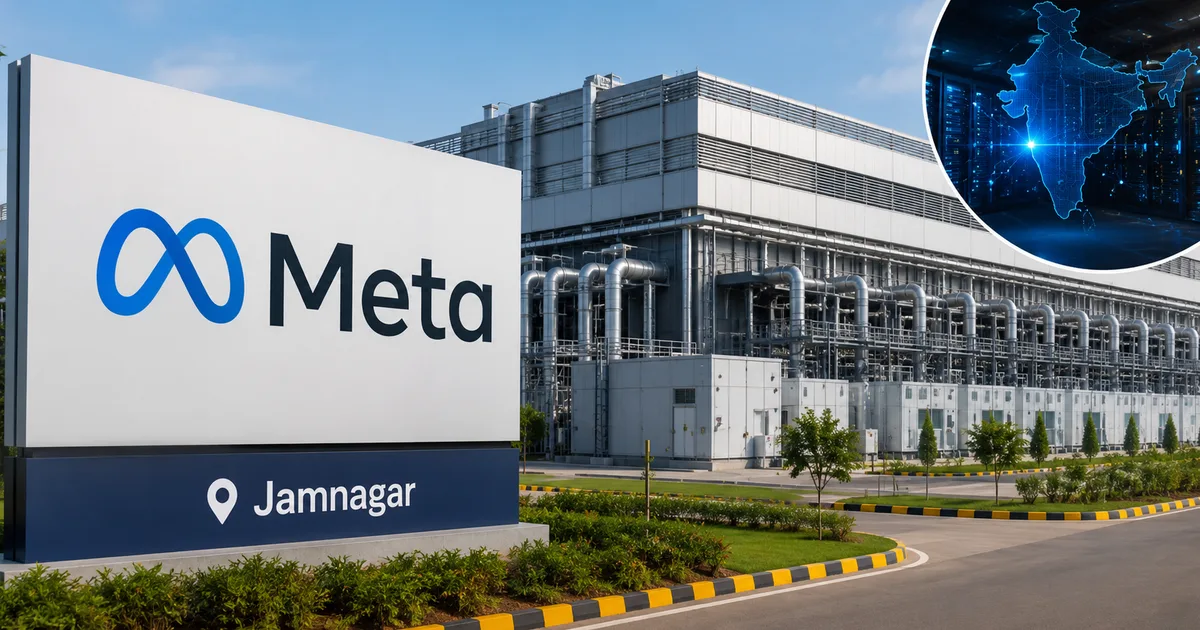
Imagine trying to stream a high-definition video on your phone, but the server is sitting in Virginia. You get that annoying loading wheel. Now imagine millions of people asking AI to generate videos or code, and every single request has to fly across the ocean to America and back. That's exactly why the upcoming Meta-Reliance AI Data Center in Jamnagar is a massive deal for our digital life.
This project is a massive step. Honestly, it completely changes how we think about internet and tech speed in India, if you ask me.
Let's look at the facts. Reliance Industries is teaming up with Meta, the parent company behind Facebook and Instagram, and also WhatsApp. They're setting up a massive 168 MW facility in Jamnagar, Gujarat. Meta's going to lease this capacity to run its AI workloads, and they plan to finish the build within two years.
Why the first AI data center in India matters for you
Right now, if you use Meta AI on WhatsApp to translate a Gujarati recipe or generate a picture for a school project, that request travels a long way. It goes to servers over in Europe or the US. It's slow. That wait is what we call latency, which is basically the annoying delay between you hitting enter and actually seeing the result on your screen. In my experience, even a few seconds of lag ruins the whole experience. Plus, it costs a massive amount in international data transfer fees.
But if we keep those computations local, things get fast. Incredibly fast.
There's another angle here. Data privacy's a huge deal these days. The government has been tightening rules around where citizen data sits. While Meta AI queries might not contain your bank details (which is a relief, obviously), they still contain personal patterns. So, keeping this data within our borders makes compliance much cleaner. It matches the guidelines from the Indian Computer Emergency Response Team, also known as CERT-In.
We've all seen how digital services like UPI payments or retrieving documents on DigiLocker need instant response times. If you wait ten seconds for a transaction to go through, it fails. Honestly, AI apps are going to need that exact same speed.
You can read more about this in our tech explainers section.
Let's talk money. India has over 32 crore WhatsApp users. That's Meta's largest user base in the world, actually. Yet, until now, Meta didn't have a single data center in the country. This new setup changes all of that.
How Jamnagar shapes AI infrastructure in India
Jamnagar's a smart choice for this. The Reliance campus there has the space and the security, plus plenty of power. Most importantly, it has access to green energy.
AI data centers are huge power hogs. They consume massive amounts of electricity just to keep thousands of computer chips cool (which is a real challenge, to be honest). If you run them on coal power, your carbon footprint shoots right through the roof. If you ask me, that's just a bad idea. So Reliance has been building massive solar farms across Gujarat. And they plan to run this entire Jamnagar facility on clean, renewable power.
This fits right in with the global push to make computing cleaner.
But how does a data center actually work? Think of it as a giant, air-conditioned warehouse packed with rows of supercomputers. Instead of basic office computers, these machines use GPUs. Honestly, these GPUs are the real heavy lifters of the AI world. They handle the complex math needed to train and run massive models, like Meta's Llama 3 family.
Without these chips, AI simply doesn't work.
If you ask me, there are three main reasons why this location makes sense:
- The Jamnagar complex has a massive physical area for expansion.
- Reliance has direct access to high-capacity electricity grids.
- The project can easily tap into local solar power generation.
We've all seen how expensive these setups are. Building a 168 megawatt facility costs thousands of crores of rupees. By partnering with Reliance, Meta gets the infrastructure (which makes sense, actually) without having to buy land or deal with local construction regulations from scratch. Reliance gets a high-profile tenant that guarantees steady revenue. It's a practical partnership.
The connection between your phone and Jamnagar
You might wonder how this affects your daily apps. Honestly, this project is going to affect a lot more than just Meta AI on WhatsApp.
Meta wants to use this facility to power its local services. Think about the reels you watch on Instagram. The recommendation algorithms that decide what video you see next need massive computing power. Right now, those decisions happen on servers far away. But once the Jamnagar facility is online, those reels will load much faster.
And we'll see new features too.
For instance, think about real-time voice translation. Imagine speaking in Hindi while the person on the other end hears it in Tamil instantly. To do that without lag, the server has to be close by. In my experience, this new data center is exactly what will make those futuristic scenarios possible.
Here's the deal: this facility could also help local developers. Meta's been open-sourcing its Llama models lately. So many Indian startups use these models to build local tools. If Meta hosts them locally, developers can get access with lower latency (which is huge for startups). That's going to spark a wave of local AI tools built specifically for Indian languages.
You can stay updated on these developments by reading the latest Indian tech news on our portal.
What about the competition
Meta and Reliance aren't the only players in this space. Other global giants are moving incredibly fast, though I'm not sure exactly why they're all rushing in at once. Google and Microsoft have already established multiple cloud regions in India. Also, local giants like Adani and Yotta are building massive data centers because they want a piece of the growing AI pie.
But this deal's different.
Most other data centers are general-purpose cloud facilities. They just lease space to anyone who wants to host a website or a database. But the Jamnagar facility is optimized specifically for AI workloads. That means it uses liquid cooling alongside advanced network architectures designed for GPU clusters.
It's a specialized tool for a specialized task.
Also, the sheer scale of 168 MW is just huge. To put that in perspective, a typical large data center in India is around 20 to 50 MW. If you ask me, this single facility is many times larger than anything we're used to. It really shows how big Meta is betting on the Indian market.
Regulatory hurdles and security concerns
It's not all smooth sailing. Honestly, building something this huge comes with some serious challenges.
First, there's the water issue, which is a bit of a mess. AI data centers use millions of liters of water every single day just for cooling. But Gujarat is a dry state. So, managing water resources without affecting local communities is a very delicate task. Reliance claims they'll use advanced closed-loop systems that recycle water (which they'll definitely need to do), but we'll have to wait and see how that actually works in practice.
Second, there's security.
A facility holding the data of millions of Indians is a prime target for cyberattacks. So developers have to coordinate with CERT-In to make sure they have the best physical and digital security. In my view, a single breach could expose user patterns on a massive scale, which is pretty sketchy, though the details of how they prevent that are a bit fuzzy.
According to a recent report by the Telecom Regulatory Authority of India (TRAI), domestic data storage is essential to securing India's digital economy from cross-border vulnerabilities.
Then there's the question of sovereign AI.
The government wants India to control its own AI destiny. They've launched the IndiaAI Mission with a budget of over 10,000 crore rupees to build local computing capacity. While private partnerships like Meta-Reliance help, the state still wants independent infrastructure so we don't rely entirely on foreign tech giants.
You can learn more about digital safety and regulations in our digital guides.
The technology inside the warehouse
Let's look at what actually goes into an AI-enabled data center. Honestly, building a facility like this requires a lot more than just stacking some computers on shelves.
A standard data center hosts websites and stores photos. Those tasks are pretty simple. The computer just reads a file and sends it to your screen. AI is completely different, though. To generate a single paragraph of text, an AI model has to perform billions of calculations in a fraction of a second. That's why it needs a totally different kind of hardware.
The servers in Jamnagar are going to use high-end AI chips.
These chips generate intense heat. Normal air conditioning just can't cool them fast enough. That's why these new facilities have to use liquid cooling. Pipes carry a special liquid directly to the chips to absorb that heat, which works sort of like the radiator in your car.
This technology is expensive. Honestly, it requires a lot of specialized engineering, if you ask me.
Another factor is the network speed inside the building itself. The chips have to talk to each other constantly. If the cables connecting them are slow, the whole system just bottlenecks. So, the Jamnagar facility's going to use high-speed fiber optic networks to link thousands of GPUs together.
Basically, this turns separate computers into one giant supercomputer.
The local economic impact
This project doesn't just affect your phone screen. In my experience, it's going to have some big economic consequences for the local area.
Building a facility of this scale requires thousands of workers. Engineers, electricians, construction crews, and security staff will all find work in Jamnagar. And once the facility is operational, it'll require highly skilled systems administrators and cybersecurity experts.
But the broader impact is on the Indian startup ecosystem, if you ask me.
Right now, Indian AI startups spend a massive chunk of their funding on foreign cloud providers. They pay in US dollars just to run their models on servers over in Oregon or Frankfurt (which is incredibly expensive). This drains valuable capital right out of the country.
If local options become available, those costs should drop.
Startups could pay in Indian rupees for local cloud compute. This'll keep capital within the Indian tech ecosystem. Honestly, it could make building an AI startup in India so much cheaper. We might see more localized apps, like AI tools that understand regional dialects or help farmers analyze soil health.
These are real benefits, not just corporate spin.
What this means for the future of Indian internet
So, where does this leave us? By 2026, the way we interact with the internet's going to change completely. We'll see more voice-based interfaces and real-time translations. And the virtual assistants on our phones will get much smarter and faster.
This data center is the foundation for that future, if you ask me.
It provides the raw computing power needed to make these services actually work. Without local infrastructure, India's just a consumer of foreign tech. But with facilities like Jamnagar, we become a hub where these technologies get processed locally.
It's a subtle shift, but a really important one.
We'll have to see if the project meets its two-year timeline. Infrastructure projects in India often face delays. But given Reliance's track record with rapid rollouts, like we saw with Jio, I think there's a good chance they'll deliver on time.
For now, it's definitely a project worth watching.