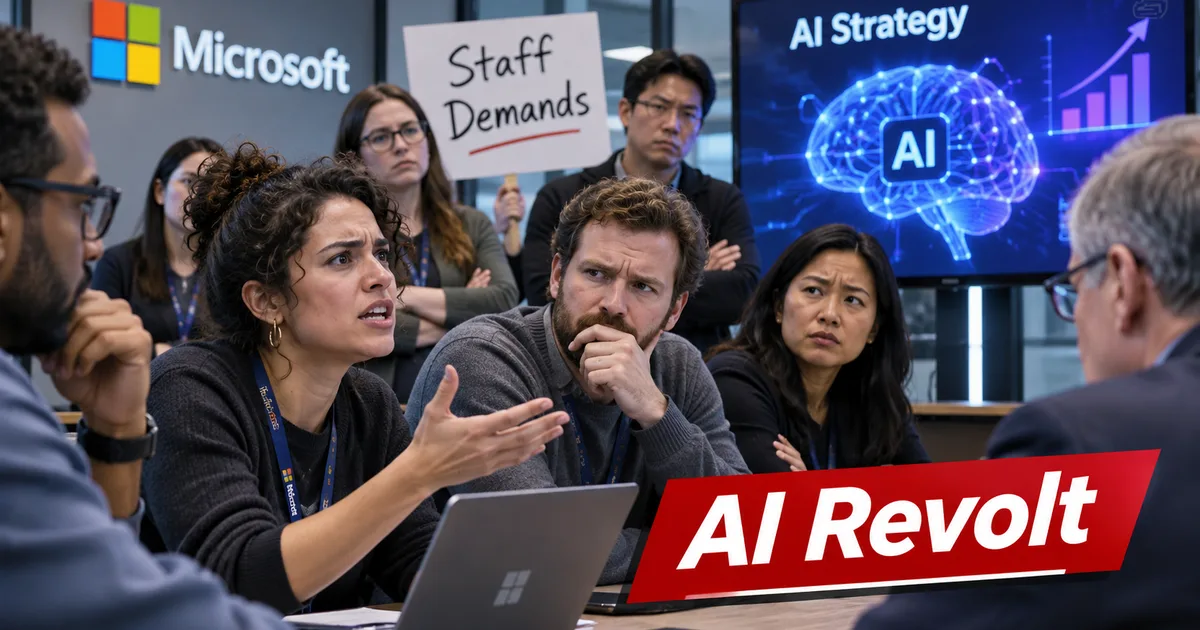
If you work in software in Bengaluru, Hyderabad, Pune, or Chennai, your WhatsApp groups have probably been buzzing about this all week. When thousands of engineers inside Microsoft pushed back against leadership, the tech world paused. The recent Microsoft staff revolt over AI push is an open confrontation between corporate executives and working developers. Management wants to spend billions on datacenters, while telling engineers to change how they work every day or take a package and walk away.
It's rare to see this kind of pushback at Microsoft. Usually, folks quietly update their LinkedIn profiles and move on.
This time is different. In my experience, Indian engineers rarely cause a public fuss unless things are truly broken. After months of subtle pressure and restructuring meetings, staff circulated an open letter challenging the entire direction of the company. Workers accused management of turning everyday coding into a hollow numbers game. And they pointed out that executive leadership seems far more obsessed with inflating artificial intelligence statistics for Wall Street analysts than building software people actually want to use.
And when you look at the raw numbers, you begin to understand why tempers flared. The company poured over $100 billion into cloud and artificial intelligence infrastructure during the 2026 financial year alone. (Which is an absurd pile of cash, if you think about it.) Yet, almost in the same breath, management presented voluntary exit packages to tens of thousands of staff.
Why Microsoft employees wrote an open letter
Here's the deal: nobody likes being treated like an obstacle in their own company. For two straight years, engineers across teams like Windows, Office, Teams, and Azure heard constant promises that artificial intelligence would give them superpowers. But daily reality was completely different. Developers spent mornings fixing broken machine-generated code and afternoons logging surveys about how many prompts they typed.
The daily work turned joyless.
That exact word, "joyless", showed up over and over in employee chats and the letter itself. Instead of designing solid systems or solving deep architecture problems, senior engineers were basically babysitters for buggy automated output. One internal memo described a culture where engineering pride took a back seat to vanity metrics. Managers started pushing teams to show constant artificial intelligence activity, tracking how many tokens they burned each week. If you weren't generating code with automated assistants, leadership treated you like dead weight. If you ask me, that kind of micromanagement kills any team's motivation fast.
For readers who follow our in-depth technology explainers, you know developer frustration has been brewing across the tech industry for months. But at Microsoft, the gap between executive marketing slides and actual engineering work got way too wide to ignore. And the open letter gave voice to thousands who felt their craft was simply being trashed.
The 60,000 buyout offers and shrinking budgets
The spark that lit the fuse was money. Plain and simple. Microsoft rolled out a massive voluntary buyout scheme aimed at roughly 60,000 employees across India, the United States, the United Kingdom, and Canada. The offer targeted staff at level 67 and below who met specific tenure and age criteria (mostly senior folks with higher salaries). Sales workers on commission were excluded. Think about that scale for a second. With Microsoft employing around 228,000 people globally as of mid-2026, offering buyouts to 60,000 staff means targeting more than a quarter of the company's entire workforce.
Management pitched the package as a gentle exit ramp. But on internal message boards, staff saw right through it.
Workers viewed the program as a desperate cost-cutting move to fund monstrous infrastructure expenses. The New York Times reported that even the safest positions in big tech don't offer real stability anymore. Meanwhile, The Times of India reported that Microsoft is preparing to cut up to 5,500 additional jobs in another layoff round, affecting fewer than 2.5 per cent of global headcount across sales, consulting, support, and the Xbox gaming unit. The exact acceptance numbers here are a bit fuzzy, since internal trackers aren't public, but the mood on Slack was reportedly grim.
Look at the timing here. The company laid off about 6,000 employees, then cut roughly 9,000 more positions in July 2025. Now another 5,500 jobs face the axe. I think if you're an engineer watching thousands of colleagues walk out the door while your CEO brags about spending endless billions on silicon, you'd feel pretty uneasy too.
The token paradox and why AI costs are exploding
Here's where things get wild. Executives sold artificial intelligence as a magic wand to slash overhead. The pitch was simple: swap expensive engineering hours for dirt-cheap compute. But reality hit like a truck in 2026. Fortune reported that running massive frontier models at enterprise scale is actually costing companies more than paying human programmers.
The math just collapsed.
Tech firms started pushing engineers to do what developers call tokenmaxxing, which means firing off automated background jobs constantly to pump internal vanity stats. Thing is, every single prompt costs real hardware cycles. Nvidia applied deep learning vice president Bryan Catanzaro put it bluntly in a recent interview:
"For my team, the cost of compute is far beyond the costs of the employees."
That compute bill quickly triggered a full-blown internal panic. In an embarrassing about-face, Microsoft started canceling internal Claude Code licenses for its own engineers, based on reporting from The Verge. Just six months earlier, managers told everyone to experiment with Claude. But once usage blew up, the monthly seat fees and inference bills got out of hand (which makes sense, actually, given how token-hungry these tools are). In my experience with enterprise tooling, bean counters always react by slamming the brakes. So leadership pushed staff toward GitHub Copilot CLI instead, and pointed to recent changes in cloud infrastructure spending across divisions.
Uber hit the exact same wall. Uber Chief Technology Officer Praveen Neppalli Naga revealed that his company burnt through its entire 2026 artificial intelligence coding budget in just four months. That's absurd. When your automated tools cost more than the developers holding the keyboard, the whole logic behind staff buyouts falls apart.
What this means for software engineers in India
If you're sitting in an office in Hyderabad or Bengaluru, this hits uncomfortably close to home. Microsoft has built up a massive engineering presence in India over decades, with thousands of developers working on Azure, Windows, Office, and enterprise cloud tools. At its recent AI Infrastructure Summit, Microsoft announced that its Hyderabad datacenter region, named India South Central, is officially live. State politicians celebrated the announcement as a massive win for local tech.
Server farms don't hire coders. They just don't.
These massive brick-and-mortar facilities need concrete, power grids, industrial water cooling, and backup generators. They don't hire thousands of fresh campus grads from local engineering colleges. If you ask me, politicians love confusing server real estate with software jobs. While Microsoft spends crores on land and server racks in Telangana, ordinary developers face a chilly job market. In recent months, Indian tech workers have already witnessed layoffs across AI annotation teams and entry-level IT positions. The voluntary buyout offer puts experienced Indian devs in a brutal spot, especially anyone juggling family expenses and heavy Bengaluru home EMIs.
And then there's the visa mess. As The Times of India noted, Microsoft continues to rank among the top six sponsors for American H-1B visas. That dynamic creates huge tension. US labor groups often push back on tech firms importing foreign talent while pushing out domestic staff. Meanwhile, Indian engineers abroad on H-1Bs live with nonstop anxiety, knowing any sudden layoff gives them just sixty days to scramble for a new sponsor or pack their bags.
What the staff revolt demands from leadership
The open letter takes aim at flawed management, not the technology itself. Nobody's asking Microsoft to dump artificial intelligence completely. Instead, developers want leadership to stop turning everyday workflows into a rigid compliance test. The document spells out clear open letter demands targeting how the company evaluates success and treats engineering talent.
Specifically, the circulating open letter calls on senior leadership to commit to four immediate adjustments:
- Stop evaluating engineering performance based on arbitrary metrics like weekly prompt counts or automated token volume.
- Allow individual project teams to choose the development tools and models that actually solve their technical problems.
- Halt back-door headcount cuts and provide honest transparency around future restructuring plans.
- Publish clear accounts showing how much datacenter compute spending is directly impacting employee compensation and departmental budgets.
I think former Microsoft chief security advisor Sarah Armstrong-Smith nailed the core problem at the Dive In Festival, warning that corporate bosses will trigger massive employee burnout if they shove tech down everyone's throats without listening:
"If I am too far behind, I no longer have competitive advantage. But if I am too far ahead, I risk having real challenges in my organization with how this AI is going to be used."
Her warning matches recent high-profile research departures at Microsoft, where veteran scientists walked away after growing fed up with corporate pivots.
The friction inside Microsoft is a direct result of a leadership miscalculation. Good software still requires skilled, motivated humans who care about what they build. When a company pushes out thousands of experienced staff to fund expensive server clusters, it loses deep institutional knowledge and team morale at the same time. The remaining developers end up burnt out trying to keep everything afloat.
Management can buy all the GPU clusters they want. But if the best engineers refuse to touch the tools, you're left holding a very expensive paperweight.