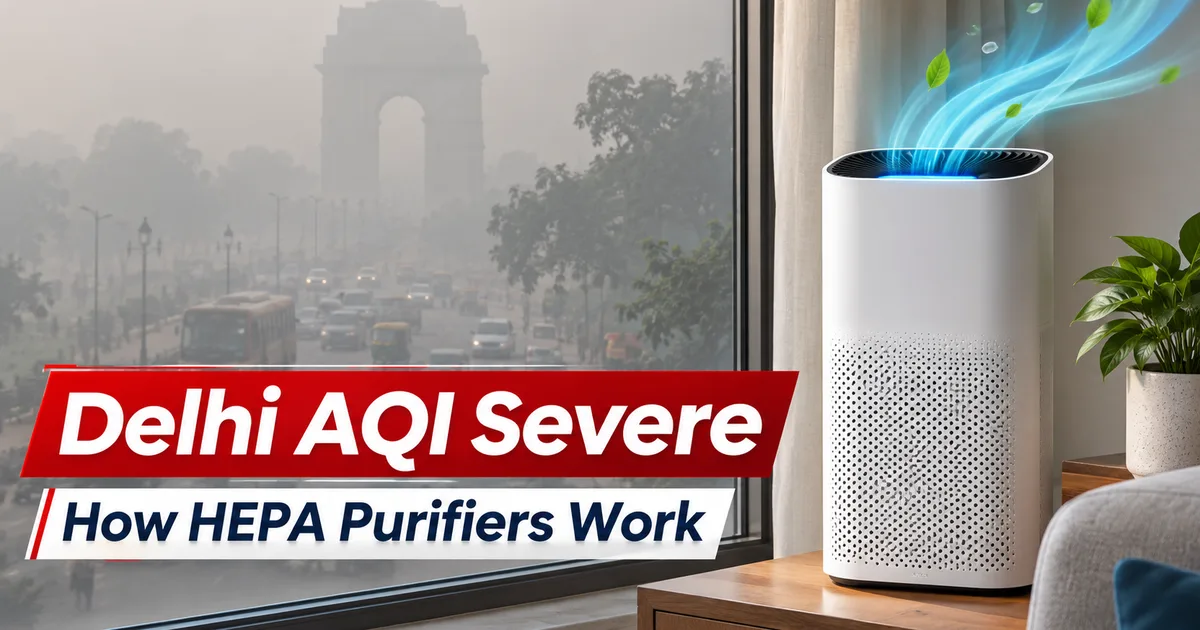
Waking up in Delhi this morning felt like breathing straight from an exhaust pipe. As the Delhi AQI severe crisis pushed air quality beyond the 400 mark across Burari Crossing and DTU, plus out in Vivek Vihar on Monday, November 9, 2026, panic buying of HEPA air purifiers kicked off across online stores and neighborhood electronics shops. It happens every single November without fail.
The Commission for Air Quality Management (CAQM) invoked Stage III restrictions under the Graded Response Action Plan (GRAP) across Delhi-NCR.
Honestly, roadside dust vacuuming and construction bans don't clear the toxic soup sitting inside your living room right now. Not even close. You can shut every single window tight and pull the heavy curtains shut, but the flat still smells like burnt sulfur.
In my experience, having spent the last four winters testing different air cleaners in North Indian apartments, most people buy these machines totally blind. Someone drops ₹30,000 on a shiny machine and expects magic. Midnight arrives, and their eyes are burning anyway. Total mess. And it's because purifiers get sold on vague marketing buzzwords rather than hard technical specs.
How HEPA filters capture microscopic PM2.5 pollution
Most people picture an air filter as a wire chai strainer. Dirty air blows in, and anything bigger than the mesh holes gets trapped. Clean air drifts out. Simple, right? But if that was how air purification actually worked, a filter fine enough to catch smoke particles would choke your fan motor in about five minutes flat.
A True HEPA filter is about particle physics, not wire netting. HEPA stands for High Efficiency Particulate Air. Look inside one, and you won't find a neat grid. Instead, it's a tangled, dense thicket of microscopic borosilicate glass fibers pointing in every direction imaginable. And when room air rushes into this maze, floating pollutants get stuck through three distinct physical processes:
- Impaction happens when heavy dust particles travel in a straight line and crash head-on into a glass fiber because inertia prevents them from turning with the airflow.
- Interception catches mid-size particles that follow the air stream around a fiber but brush slightly too close, causing them to stick to the glass strand permanently.
- Diffusion traps the tiniest particles below 0.1 microns, including soot and chemical aerosols, because Brownian motion causes them to zig-zag wildly until they bump into a fiber.
This setup creates a strange, counter-intuitive quirk in fluid dynamics. Filters aren't weakest against the tiniest particles. If you ask me, this is where most people get tripped up. The filter is actually weakest against particles measuring exactly 0.3 microns across (which makes sense, actually, given how air velocity works). Aerosol scientists call this the Most Penetrating Particle Size. Anything smaller gets knocked sideways by gas molecules and collides with glass fibers through diffusion. Anything larger crashes straight into fibers through pure inertia.
According to Central Pollution Control Board monitoring benchmarks, particulate matter under 2.5 microns penetrates deep into human lung tissue and enters the bloodstream, making mechanical filtration essential during peak winter inversions.
Thing is, standard HEPA filters only catch solid particles. They don't touch nasty gases like nitrogen dioxide or sulfur dioxide from firecrackers and vehicle exhausts. That's why decent purifiers have an activated carbon bed sitting right behind the glass mat. These carbon pellets are treated with oxygen. That opens up millions of microscopic pores between carbon atoms. And those pores trap chemical fumes and sharp cooking odors before the air cycles back into your living room.
Understanding CADR ratings and room coverage for Indian homes
Never buy an air purifier based on the room size plastered on the box. It's a trap. I'm not sure exactly why brands still get away with it, but companies love claiming a machine covers 400 square feet. That rating comes from testing an empty room with low eight-foot ceilings in mild European weather. Put that same unit in a drafty apartment in Noida or Gurugram with ten-foot ceilings and an outdoor AQI of 440, and the math falls apart completely.
The only metric that actually counts is the Clean Air Delivery Rate, or CADR. Basically, CADR measures the volume of clean, particle-free air the fan pushes out each hour, shown in cubic meters per hour (m³/h). Higher CADR means the machine pulls soot out of your bedroom much faster. Simple as that.
When pollution gets severe, you need at least four to five air changes per hour (ACH). If you ask me, most buyers completely overlook this turnover rate. In practice, the machine has to filter every bit of air in your room once every twelve to fifteen minutes. If it cycles air only twice an hour, outdoor smog leaks through balcony cracks faster than the purifier can clean it.
Here's the simple math for a typical Indian master bedroom measuring 150 square feet with 10-foot ceilings:
- Calculate room volume: 150 square feet multiplied by 10 feet gives 1,500 cubic feet, which converts to roughly 42.5 cubic meters of air.
- Multiply volume by required turnover: 42.5 cubic meters multiplied by 5 air changes per hour equals 212.5 m³/h.
- Choose your machine: You need an air purifier with a CADR rating of at least 215 m³/h for that single bedroom.
Now, take that exact same 215 m³/h unit and drop it into a 350-square-foot living room. You'll barely scrape two air changes per hour. The fan motor will scream on turbo all night long. Your power bill will spike. Worst of all, your indoor PM2.5 readings won't drop below 120 µg/m³ (annoying, I know). For big living rooms, you want a CADR of 400 m³/h or higher, or you should run two smaller units at opposite corners.
We break down detailed room volume calculations and airflow measurements across our in-depth buying guides for home appliances.
Why official AQI and your purifier app show different numbers
This confusion always blows up on social media right after Diwali. Government monitors run by the CPCB showed Delhi's overall AQI sitting around 400 to 440, but private apps like IQAir and plenty of purifier dashboards flashed wild numbers above 900 or even 1,000 out in Burari and Anand Vihar. People immediately assumed the state was hiding real numbers, while others accused private apps of drumming up panic.
The discrepancy is really about math and time windows. The Indian National AQI turns eight different pollutants into a sub-index using a 24-hour rolling average. That smoothing math stops sudden spikes, like five minutes of dense cracker smoke floating past your balcony, from skewing the official 24-hour score straight to 1,500.
Your smart purifier is different. It has an onboard real-time laser sensor right by the air intake vent. These tiny sensors shine an infrared beam through incoming air, counting light bounces off passing dust particles. They report instant one-minute or five-minute PM2.5 spikes. And in my experience, they usually map those readings against the US AQI scale, which caps at 500 or uses linear math extending well into four digits (which confuses almost everyone).
So when your purifier app screams 850 while Delhi government portals show 410, both are technically right about what they measure. The portal tells you what the whole city inhaled over an entire day. Your purifier is telling you about the smoke that blew past your balcony two minutes ago.
You can read more about how local sensor networks interpret atmospheric data in our consumer tech explainers.
Dyson vs Philips: comparing real filtration tech and value
Walk into any Croma or Reliance Digital store in North India right now, and the sales floor is basically a brawl between Dyson and Philips. I think they're two totally different philosophies of clean air. And understanding that divide will save you serious money.
Philips treats air purifiers like heavy industrial workhorses. Models like the Series 1000i and 2000i, or the larger 3000i line, have chunky cylindrical bodies built around thick, dense barrel filters. They push massive CADR numbers, usually between 300 and 520 m³/h. Meanwhile, prices start around ₹9,500 and top out near ₹26,000. When North Indian air gets genuinely apocalyptic, a Philips machine pulls a massive volume of grime through its pleats, clearing a smoky bedroom in ten minutes flat. Replacement filters cost between ₹2,200 and ₹3,800, and you can get them easily on Amazon or quick-commerce apps.
Dyson approaches things from pure luxury design. Their Purifier Cool and Hot+Cool machines cost anywhere between ₹39,000 and ₹69,000, which is four or five times the price of an entry-level Philips. Big difference. For that cash, you get their bladeless air multiplier tech, throwing steady airflow across the room without rattling fan blades. Their enclosures are also sealed to the HEPA H13 standard, so dirty air can't leak around the filter frame without going through the glass media.
Here's the real trade-off. Dyson's raw CADR delivery is pretty modest, typically hovering between 160 and 220 m³/h (the exact test numbers here are a bit fuzzy depending on the fan speed mode). In a sealed, air-conditioned room, a Dyson keeps air clean while working as a sleek bladeless fan. But let's be real. If you live in an older rented flat with rattling window frames and leaky doors, a ₹16,000 Philips pushing 400 m³/h cleans the room way faster than a ₹55,000 Dyson.
We looked at similar premium engineering decisions when analyzing Dyson's design engineering approach across modern consumer gadgets. If budget is what matters to you, Philips or Xiaomi gives you far more clean air per rupee spent.
Practical steps to keep your indoor air breathable
Buying a purifier is only half the job when November smog hits. If you run it wrong, you waste electricity and still inhale filthy air. Simple as that.
Follow these practical rules to get actual clean air inside your home:
- Position your purifier at least two feet away from walls and wardrobes so the intake vents can pull air from all directions without resistance.
- Keep the machine running on medium or high fan speed manually during severe air days, because auto mode drops fan speeds as soon as air reaches 50 µg/m³, which remains three times higher than healthy levels.
- Block corridor drafts by rolling up a damp towel along the bottom edge of your bedroom doors and taping foam strips on balcony sliding tracks.
- Unclip and wash the outer nylon pre-filter under running tap water every ten days to remove pet hair and coarse lint, drying it completely before reinstalling.
- Never wash the pleated paper HEPA filter with water because wet borosilicate fibers lose structural integrity and stop trapping particles permanently.
Tracking indoor air also helps you make sense of daily body fatigue. If you ask me, the real wake-up call comes when you pair room data with modern wearable health tracking sensors that track resting heart rates and blood oxygen drops while you sleep.
Filter replacements are an ongoing seasonal expense (and nobody likes paying it). You need to budget around ₹2,500 to ₹4,000 for a fresh filter pack every October. Don't reuse last winter's clogged filter. It only chokes the fan motor while blowing stale trapped stink straight back into your bedroom.