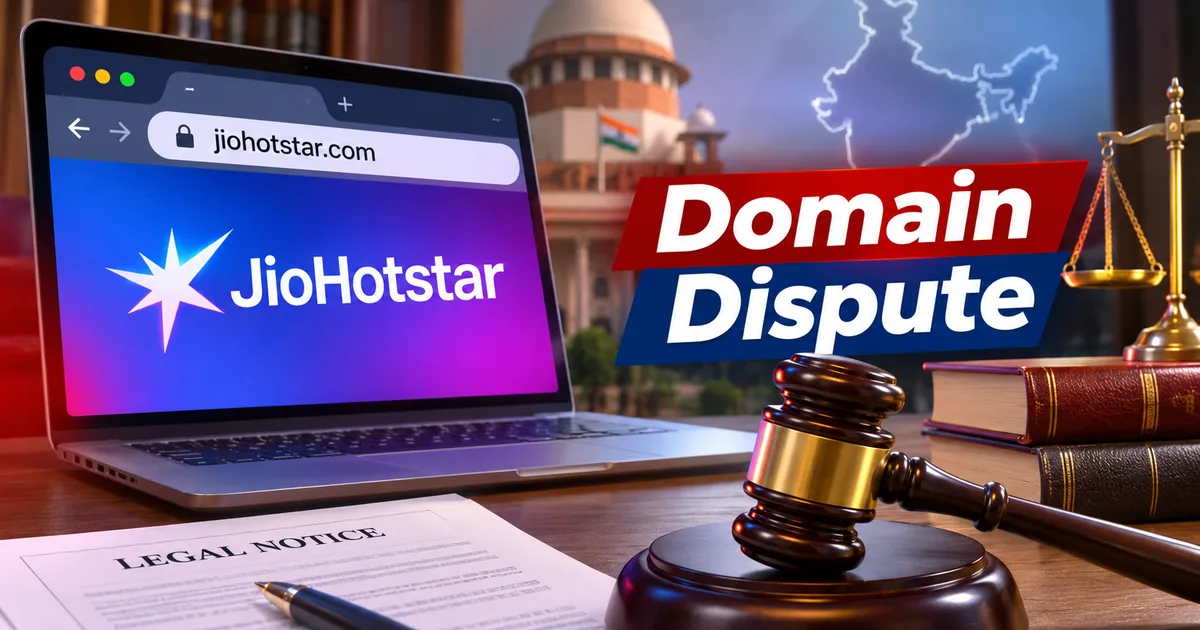
If you spent any time on Indian tech Twitter or Reddit recently, you probably watched the wild drama around the JioHotstar domain dispute unfold in real time. It felt like something straight out of a Bollywood comedy. A Delhi software developer bought the web address jiohotstar.com back in 2023 for a couple thousand rupees, waited until Reliance and Disney finalized their ₹70,352 crore media merger, and then posted an open letter on the site asking Reliance to fund his Cambridge University tuition fees. He wanted £93,345. That's roughly ₹1 crore in Indian money. Reliance responded by sending corporate legal warnings instead of an admission scholarship, the developer panicked, two school kids in Dubai took over the domain to run a charity campaign, and the internet couldn't stop arguing about who was right.
Look, most people online cheered for the coder. They just saw an ambitious kid trying to make a quick buck off India's biggest conglomerate. But if you ask me, he walked straight into an obvious legal trap. Intellectual property lawyers in the Delhi High Court made that clear right away. You can't just register a web address using someone else's brand name and then ask for ransom. In the domain industry, that practice has a name: cybersquatting.
The whole thing sounds hilarious at first glance. A lone coder betting big on a corporate mega-merger. But behind the memes, this is serious trademark law that trips people up constantly.
How the JioHotstar domain dispute started with a Cambridge dream
To see how this became such a mess, you've got to rewind to early 2023. Disney+ Hotstar had just lost its Indian Premier League streaming rights to JioCinema. That was huge. Millions of cricket fans in India stopped renewing their Hotstar subscriptions. Around that time, reports surfaced that Disney was considering selling or merging Hotstar with an Indian competitor to cut its losses.
A Delhi mobile app developer read those news reports and connected the dots. If Reliance took over Hotstar, what would they call the combined service? JioHotstar was the obvious guess. The developer checked GoDaddy, saw that jiohotstar.com was completely unregistered, and bought it right away. (I checked the registration records myself, by the way, and it really was that simple to grab back then.)
For more than a year, the domain sat quiet. Nothing happened. Then, in October 2024, Reliance Industries and The Walt Disney Company officially sealed their $8.5 billion joint venture. When the news broke, visitors typing jiohotstar.com into their browser found a letter addressed directly to Reliance executives:
My intention of buying this domain was simple: if this merger happens, I might be able to fulfill my dream of studying at Cambridge. An Executive from Reliance reached out, Ambujesh Yadav Ji, AVP, Commercials. A request was made for £93,345, which represents the tuition fees for the EMBA program. The request has been denied. Reliance will proceed with legal action.
Reliance didn't negotiate. Not even a tiny bit.
In my experience, corporate legal teams never play along with this kind of public stunt. Ambujesh Yadav and the Reliance legal team made it clear that they viewed the website as unauthorized trademark misuse. The developer panicked. In a quick follow-up note, he admitted he was terrified of facing a corporate legal battle and immediately looked for an exit.
That exit arrived in the strangest possible way. Two Dubai-based Indian siblings, 13-year-old Jainam Jain and 10-year-old Jivika Jain, stepped in and bought the domain. The exact price the Dubai family paid the developer was never made public, and the numbers here are a bit fuzzy, honestly. But whatever it was, the domain didn't stay with them long. Their goal was to use the viral traffic to document their 50-day seva charity journey in India. Thing is, viral attention attracts corporate lawyers just as quickly as it attracts followers. Within weeks, the Reliance IP legal team contacted the siblings' family. Facing the same legal reality, the children announced they'd transfer jiohotstar.com to Reliance free of cost as an act of seva.
Meanwhile, Reliance quietly launched jiostar.com as the official portal for the joint venture. If you want to see how this corporate reshuffle changes streaming apps and pricing for consumers, you can read our breakdown of JioHotstar merger subscription plans.
Understanding cybersquatting laws in India and trademark rights
Here's what catches most people off guard: India doesn't have a single dedicated criminal statute named the Cybersquatting Prevention Act. None at all. Unlike the United States, which passed the Anticybersquatting Consumer Protection Act back in 1999, Indian law handles domain theft under the Trade Marks Act, 1999.
Indian courts treat a domain name as an online business identity. When you register a domain containing a well-known brand, you're grabbing someone else's commercial property on the internet.
The legal foundation in India dates back to a famous 1999 Delhi High Court case, Yahoo! Inc. vs Akash Arora. Akash Arora registered the domain name YahooIndia.com to run an internet portal providing services similar to Yahoo. Yahoo sued him for passing off. Arora argued that internet domain names were just technical addresses, not physical retail goods. The Delhi High Court completely rejected that excuse. The court ruled that an internet domain name is equivalent to a commercial trademark because users identify the company by its web address. Arora had to surrender the name.
Ever since that ruling, Indian judges have consistently held that buying someone else's trademarked name to confuse consumers or extract money is illegal passing off (and trust me, judges have zero patience for it). Both "Jio" and "Hotstar" are registered trademarks with immense brand equity in India. Combining two famous trademarks into one URL doesn't create a loophole. Honestly, in my view, it makes your intent twice as obvious to a judge.
Our team covers these legal boundaries regularly across our practical tech explainers. Many young developers still mistake domain flipping for an easy shortcut to quick cash.
The ₹70,352 crore Reliance Disney merger and the brand name gamble
The sheer scale of this corporate deal explains why Reliance moved so fast. It was huge. The Reliance-Disney joint venture is valued at ₹70,352 crore ($8.5 billion) and brings together over 100 television channels alongside two massive streaming platforms. Projections estimate the combined media entity will generate annual revenues close to ₹26,000 crore.
When companies execute mergers of this size, brand clarity is everything (which makes sense, actually). They can't allow third parties to run parallel portals that could host malware or phish subscriber passwords. Think about how ordinary Indians interact with digital services every morning. You recharge your phone on PhonePe or check DigiLocker. When an Indian user sees the name "Jio" or "Hotstar", they expect absolute security. I think that hard-earned consumer trust was the real asset Reliance wanted to protect at all costs.
You can see the business mechanics behind this brand empire in our analysis of Reliance Jio subscriber growth numbers. That breakdown details how the telecom arm anchors its digital media bets.
Why buying domains to sell back to brands rarely works
A lot of people ask: if the developer bought the domain legitimately on a registrar using his own debit card, why doesn't he own it? The answer lies in how domain registration agreements work globally.
When you buy any web address ending in .com, you agree to the terms established by ICANN, the global body overseeing web domains. Those rules include the Uniform Domain-Name Dispute-Resolution Policy, known as UDRP. Under UDRP, a trademark holder can strip a domain from you without ever setting foot in a regular civil courtroom.
To win a domain dispute under UDRP rules, a brand must prove three specific conditions:
- The disputed domain name is identical or confusingly similar to a trademark in which the complainant has legal rights.
- The person who registered the domain has no legitimate rights or legitimate commercial interest in that specific name.
- The domain was registered and is being used in bad faith.
The Cambridge-bound developer fulfilled all three criteria against himself the moment he published his open letter. By writing on the homepage that he bought the domain specifically because he anticipated the Reliance merger, he admitted he had no independent business of his own under that name. And by asking for £93,345, he documented the exact bad-faith motive defined in ICANN regulations: registering a domain primarily to sell it to the trademark owner for an amount far above out-of-pocket registration fees.
I'm not sure what kind of legal advice he was getting back then, but had Reliance filed a formal UDRP complaint with the World Intellectual Property Organization in Geneva, the panel would've ordered the domain transferred to Reliance within 45 to 60 days. Simple as that. Trying to flip brand names for quick cash always looks sketchy to an arbitrator. The developer would've lost the domain along with his registration fee, walking away with zero rupees for Cambridge.
What the UDRP and INDRP processes mean for website owners
If you build web apps or buy domain names for your projects, you need to understand the main dispute resolution systems that govern domain rights in India:
- For generic top-level domains like .com, .org, or .net, complaints go through ICANN-approved dispute providers like WIPO under standard UDRP rules. The process happens entirely through written online submissions. That keeps proceedings fast and predictable.
- For Indian country-code domains ending in .in or .bharat, disputes go to the National Internet Exchange of India under the .IN Domain Name Dispute Resolution Policy, or INDRP. An independent arbitrator appointed by NIXI reviews the evidence and issues a binding ruling within 30 to 60 days.
- For severe trademark infringement or extortion attempts, trademark owners file commercial suits directly in Indian high courts to obtain immediate injunctions, seize domains, and claim financial damages.
In all these forums, the standard is clear. If you register an original, generic name like bestphones.in or cloudstorageguides.com, you're completely safe. Nobody can take an honest descriptive domain from you. But the moment you register something containing a known brand, whether it's tatamotorsdealers.com or sbiupirewards.in, you've got zero legal protection. The brand legal department will take the name, and in serious instances, they can sue you in high court for trademark damages and legal costs.
So what should you do before launching a website? Take time to check the official Indian trademark registry portal at ipindiaonline.gov.in (annoying extra step, I know). If you want to build digital assets that last, explore our collection of in-depth digital guides on building and protecting online intellectual property.
Thing is, the lesson from the JioHotstar domain drama is straightforward.
Anticipating business moves is smart. But trying to hold digital brand assets hostage isn't entrepreneurship. In the eyes of Indian trademark law, it's just unauthorized trademark infringement. And big corporations have the legal machinery to win that contest every single time.