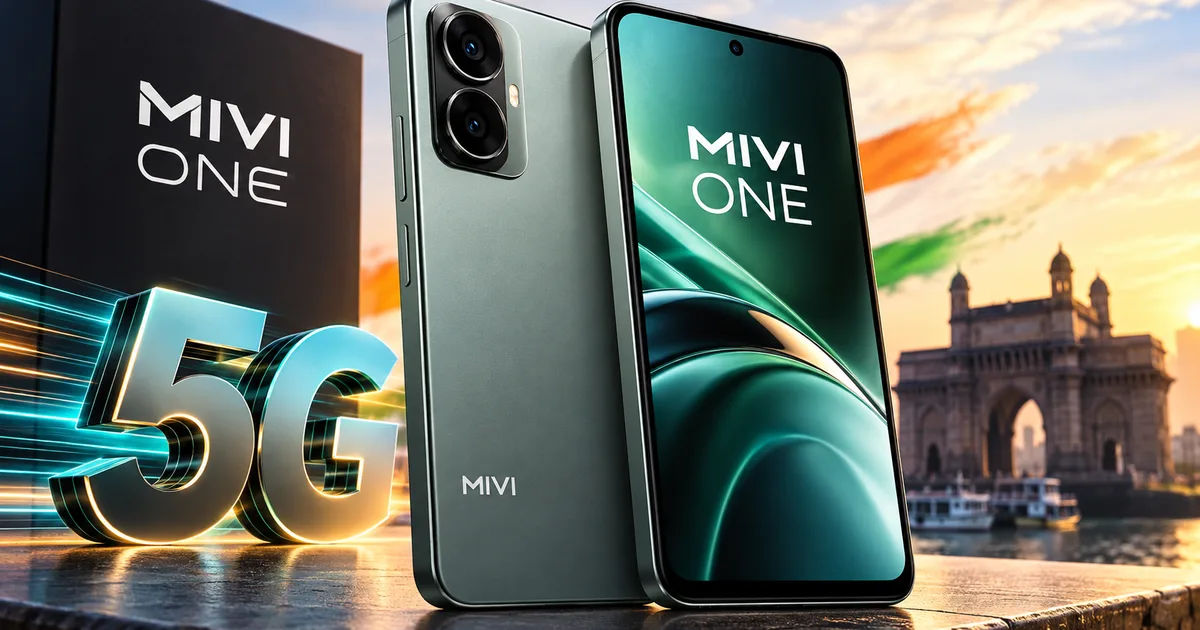
So, Mivi is making a phone. Yes, the same Hyderabad-based brand you probably know for their budget earbuds and Bluetooth speakers. They're taking a massive leap into the hyper-competitive Indian smartphone market, and everyone is talking about the Mivi One 5G phone 2026 India launch scheduled for September 24. And honestly, I'm genuinely intrigued.
When an audio company suddenly decides to build a phone, it usually goes one of two ways. Either it's a white-labeled mess with a slapped-on logo, or it's a carefully thought-out budget phone that actually tries to solve a problem. Looking at the leaks and official teasers for the Mivi One 5G, I think they're leaning toward the latter. We're talking about a Snapdragon 4 Gen 2 processor and a ridiculously large 6,000mAh battery. The software is supposedly clean, too. All of this is expected to sit comfortably under the ₹15,000 mark. If you follow Latest Tech News closely, you know the sub-15K segment has been a bit boring lately.
But let's break down exactly what we know about the expected pricing and the core specs. And whether you should actually care.
Mivi One 5G India launch date and availability
Mark your calendars for September 24. That's when Mivi is officially pulling the covers off this thing. What's interesting here is the distribution strategy.
Mivi confirmed this is a Flipkart exclusive. That makes sense. Building a physical offline retail network from scratch is incredibly expensive. Going online-only keeps the margins tight. They're also pushing the "Made in India" angle hard. The phone is apparently manufactured right in their Hyderabad facility. That's a big deal. Most budget phones claim to be made here, but they're usually just assembled from imported kits. If Mivi is doing deeper manufacturing (which is a pleasant surprise), that could explain how they're keeping costs down while packing in decent hardware.
I expect the first sale to align perfectly with the upcoming festive season sales. So if you're holding out for a budget 5G phone, you might want to wait and see what launch offers they bring to the table.
Expected price in India: Is it actually under ₹15,000?
Pricing is everything in this segment. You can have the best specs on paper, but if you price it ₹2,000 higher than the competition, Indian buyers will drop you in a heartbeat. Leaks suggest the Mivi One 5G will start somewhere around ₹11,999 to ₹14,999.
Some leaks point to a starting price of ₹11,999 for the base variant. Others suggest ₹14,999. I'm not sure exactly why the numbers here are a bit fuzzy. My guess? They'll launch the base model with bank offers to hit that psychological ₹11,999 price tag. The higher RAM variant will probably sit closer to ₹14,999. If they pull this off, they're in direct competition with the likes of the Poco X8 5G and the upcoming Realme P4s 5G.
Look, a 5G phone with a good processor for around twelve thousand rupees is the sweet spot for a huge chunk of the Indian market. Students buying their first phone or parents looking for an upgrade will be watching this. It's a brutal price segment to compete in. But the volume potential is massive.
The specs that matter: Snapdragon 4 Gen 2 and a massive battery
Let's talk hardware. Because this is where things get interesting.
First up, the processor. Mivi isn't going with a low-end MediaTek chip here. They opted for the Qualcomm Snapdragon 4 Gen 2. This is a very capable, power-efficient 4nm chipset that we've seen in slightly more expensive phones. It handles everyday tasks effortlessly. Multitasking and basic gaming won't make it break a sweat. It's not a gaming powerhouse, but for regular daily use, it's more than enough.
Then there's the battery. 6,000mAh. That's huge. Most phones max out at 5,000mAh. Combine a 6,000mAh battery with the power-efficient Snapdragon chip, and you have a phone that could easily last two full days for a moderate user. If you hate carrying a power bank or constantly looking for a plug point on a long train journey, this is the spec that should catch your eye.
The display is reportedly a 6.75-inch panel. Given the budget, I wouldn't hold my breath for an AMOLED screen. It's almost certainly an IPS LCD, hopefully with a fast refresh rate. But for media consumption and casual scrolling, a large 6.75-inch screen combined with that massive battery makes this a solid entertainment phone.
Bloatware-free software: The real game changer
This right here is what caught my attention the most. Mivi is pushing a "bloatware-free" software experience hard. If you've used a budget phone in India recently, you know the pain. You set up a brand new phone, and it immediately starts bombarding you with spam notifications and random games you never asked for. It's annoying, I know.
If Mivi actually delivers a clean Android experience without the intrusive ads and pre-installed junk, that alone could be a massive selling point. People are tired of paying for hardware only to be treated as a product by the software. A clean interface makes a budget phone feel significantly faster. It feels more premium than it actually is. We'll have to see how well they optimize their custom skin. But the promise of no bloatware is a huge step in the right direction.
Camera expectations: 50MP primary shooter
Cameras on budget phones are usually nothing to write home about. They get the job done in good lighting, but struggle when the sun goes down. Recent leaks confirm the Mivi One 5G has a 50-megapixel primary rear camera.
Now, megapixels don't tell the whole story. It comes down to the sensor quality and the image processing algorithms. I'm not expecting flagship-level photography here. What I do expect is decent daytime shots for social media and acceptable performance for video calls. They haven't detailed the secondary cameras yet. I wouldn't be surprised if there's a mostly useless 2MP macro sensor just to make the camera module look better. The focus is firmly on that main 50MP shooter.
Design and build: What to expect from the Mivi One 5G
We don't have all the official renders yet. But the teasers hint at a pretty standard modern phone design. You'll likely see a glass-like plastic back and a prominent camera module. Mivi teased that they paid special attention to the camera design to give it a slightly more premium look than your average budget slab. Given they want to make a big first impression, I expect them to offer some interesting color options. Maybe a matte finish to avoid fingerprints. And since they are an audio company, it would be a missed opportunity if they don't include a solid bottom-firing speaker. Oh, and I really hope they keep the 3.5mm headphone jack. A lot of buyers in the sub-15K segment still rely on wired earphones. Removing it would be a huge mistake.
5G connectivity and network support
This is a 5G phone, which is basically the bare minimum requirement for any new phone in 2026. The Snapdragon 4 Gen 2 has a capable 5G modem, so you can expect solid speeds on Jio and Airtel networks. If you live in a city where 5G is fully rolled out, this phone will let you stream high-quality video without a hiccup. Mivi needs to ensure they support a wide range of 5G bands so you don't lose connectivity when traveling across states. I'll be testing the call quality and network reception heavily when I get my hands on a unit. All the specs in the world don't matter if a phone drops calls consistently.
How does it stack up against the competition?
Let's talk about the competition. The budget 5G space in India is an absolute bloodbath right now. You have Motorola pushing aggressive specs with their G series and Poco undercutting everyone on price. And Samsung relies on brand trust with their M and F series phones.
For the Mivi One 5G to stand out, it needs to nail the basics. The Snapdragon 4 Gen 2 is a great start. It's the same processor powering the Redmi 12 5G and the Poco M6 Pro 5G, both of which have been incredibly popular. But Mivi is bringing that 6,000mAh battery to the fight. This gives them a distinct edge in endurance.
The real challenge for Mivi won't be the hardware. It will be after-sales service. When you buy a phone from established brands, you know there's a service center in almost every major city. Mivi has a decent track record with their audio products, but phones are far more complex to repair. They'll need to assure buyers that if something goes wrong, they won't be left hanging. This is a very big deal for anyone spending ₹12,000 on a phone (which makes sense, actually).
The significance of local manufacturing in Hyderabad
Let's touch on the manufacturing aspect again because it's worth exploring. The "Made in India" push is a huge government initiative, and seeing a homegrown brand try to build a phone from the ground up in Hyderabad is pretty cool. We've seen local brands like Micromax and Lava struggle to compete with Chinese giants over the last decade. They lost out heavily on specs-to-price ratios and software optimization.
Mivi seems to have learned from those mistakes. Instead of trying to release five different models at once, they're focusing on one solid offering in the Mivi One 5G. By manufacturing locally and selling only on Flipkart, they're cutting out middlemen. This approach lets them price the phone aggressively without cheaping out too much on components like the processor. If they succeed, it could encourage other Indian brands to expand beyond accessories.
Final thoughts: Should you wait for the Mivi One 5G?
If you're in the market for a phone right now and your budget is strictly under ₹15,000, I would say yes. Wait for September 24.
Don't misunderstand me. I'm not saying this will be the greatest phone ever made. But the combination of a Snapdragon 4 Gen 2 and a massive 6,000mAh battery is rare in this price bracket, especially with a clean software experience. Most brands force you to choose two out of the three. If Mivi can deliver all three without major hardware flaws, it's going to be a very compelling option.
Keep an eye out for the launch offers. Flipkart sales during the festive season often include heavy bank discounts and exchange bonuses. If you can grab the Mivi One 5G for closer to ₹10,999 or ₹11,499 with card offers, it becomes almost a no-brainer for a secondary phone or a primary phone for a light user. We'll have to see if they pull it off. But honestly, it's just refreshing to see a new player shake things up in the budget segment. For more deep dives into upcoming phones, you can always browse our Tech Explainers section.