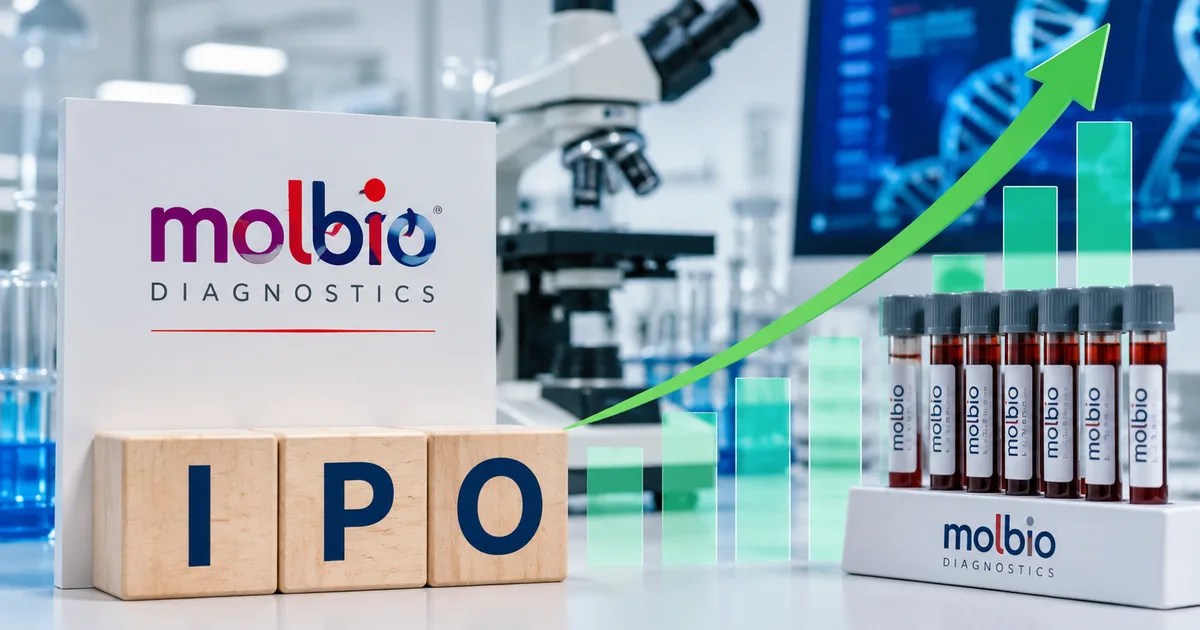
Look, I've been watching the Indian IPO market closely this year, and honestly, the hype around some of these companies is just ridiculous. We see software companies with zero profits asking for insane valuations, and retail investors just throwing money at them because of pure FOMO. But then you have something like the Molbio Diagnostics IPO 2026, and things get genuinely interesting. We're talking about a real healthcare company from Goa with a proven product. Not another generic tech service trying to cash in on a trend. If you haven't heard of them, Molbio Diagnostics is the company behind the Truenat technology. These are the portable, battery-operated RT-PCR machines that basically saved our lives during the pandemic by taking testing out of fancy city labs and into rural India.
So, should you actually care about this IPO? We're going to look at the facts. I know reading through a massive 400-page red herring prospectus is nobody's idea of a fun weekend. I read through the numbers for you. We'll cover the Molbio Diagnostics IPO issue size and the grey market premium (GMP) that everyone on Dalal Street is obsessed with. And we'll look at what this actually means for the Indian healthcare sector going into 2026.
The basics: Molbio Diagnostics IPO 2026 details
Here's the situation. The Molbio Diagnostics IPO opened on August 10, 2026. The response was completely insane. We're talking about a massive 70.26 times oversubscription by the time the issue closed. Retail investors and institutional buyers wanted a piece of this Rs 939.70 crore issue (which makes sense, actually). By day three, the institutional portion was booked nearly 5 times over. That usually gives the retail investors enough confidence to jump in with both feet.
We need to look at the exact numbers. That's what actually matters when you're deciding where to park your money. If you ask me, the details always tell the real story.
- The company set the price band at ₹768 to ₹807 per equity share.
- You had to bid for a minimum of 18 shares, meaning the minimum investment for a retail investor was ₹14,526 at the upper end of the price band. This is pretty standard for a mainboard IPO these days, keeping it accessible but requiring a decent chunk of cash.
- The total issue size is ₹939.70 crore. It's not a mega-IPO like LIC or Swiggy, but a very solid mid-sized offering that the market can easily digest without causing liquidity issues.
- The basis of allotment was finalised on August 13. If you applied, you've probably been refreshing the KFin Technologies portal trying to see if you got lucky.
- The shares are set to hit the National Stock Exchange (NSE) and Bombay Stock Exchange (BSE) on Monday, August 17, 2026.
And let's be honest. Getting an allotment in an IPO subscribed over 70 times is basically a lottery. It's entirely luck-based for the retail category. If you got it, congrats. If you didn't, welcome to the club of disappointed investors waiting for their UPI mandates to be revoked.
Decoding the Molbio Diagnostics IPO GMP (grey market premium)
Now we get into the stuff everyone asks about in my WhatsApp investment groups: the GMP. The grey market premium is an unofficial number. I can't stress this enough. It's not a guarantee of actual listing gains. The grey market can dry up overnight if global markets tank. But right now, it gives you a good idea of the street's current mood.
Right before the listing, the Molbio Diagnostics IPO GMP was around ₹138 per share. The numbers here are a bit fuzzy, so some sources had it slightly higher. Past ₹140 even. What does that actually mean for your wallet?
Take the upper price band of ₹807. Add that ₹138 premium. You're looking at an expected listing price of around ₹945. That's a solid 17% to 21% listing pop on day one. A 20% premium is massive for a company in the medical diagnostics space. Medical diagnostics just isn't as flashy as electric vehicle startups or new-age fintech apps. It shows real confidence in their business model and their cash flows.
But why the high demand? It's not blind speculation. Institutional investors are looking at Molbio's financials. They have an iron grip on the point-of-care testing market in India. They aren't just selling the Truenat machines. They sell the disease-specific testing chips. Molbio makes money every time a clinic runs a test. It's the classic razor-and-blades model. And the stock market absolutely loves predictable recurring revenue.
Is the hype justified by the financials?
I think it is. Largely because of their track record. Molbio actually makes money, unlike many tech startups hitting the market. Their revenue jumped a lot over the last three financial years. Government contracts and international exports drove most of this growth. But I'm naturally cautious when everyone rushes to buy the same thing (annoying, I know). A 70x subscription means a lot of institutional money is chasing limited shares. The real test is where the stock settles three or six months from now. The initial frenzy will die down. Then the company has to deliver on their quarterly earnings reports without the IPO hype.
"Molbio's real strength isn't just in making a portable testing device. Their true value comes from delivering accurate molecular diagnostics to Tier 3 and Tier 4 Indian cities where traditional lab infrastructure simply doesn't exist."
Beyond the money: the healthcare impact in India
This is where I get a bit passionate. We spend so much time talking about stock prices and GMPs. We completely forget what the company actually does. Molbio isn't just a ticker symbol. They're changing how healthcare is delivered in India. Specifically outside the major metros like Mumbai or Delhi.
Think about a primary health centre (PHC) in a remote village in Bihar or Rajasthan. Before Molbio came along, someone needing an accurate test for Tuberculosis (TB) had a real problem. The swab sample had to be physically transported to a district hospital. Or a private lab hours away. It took days to get a result. Samples got ruined in transit because they weren't kept cold. People didn't get treated in time. Diseases spread quietly through communities.
Molbio's Truenat system changed all of that. The machine is about the size of a landline phone. It's portable. It's battery-operated. That means it works perfectly fine even when the power goes out. And power goes out constantly in rural areas. Most importantly, it gives RT-PCR quality results in under an hour right there at the local clinic. The doctor can test a patient and prescribe the correct antibiotics before the patient even leaves the clinic. This is a huge deal for infectious disease control in a country of 1.4 billion people.
What they plan to do with the IPO money
When a company raises nearly ₹940 crore from the public, you have every right to know where that cash is going. They aren't just cashing out their early investors and buying yachts. The plan in their filings is to use the fresh funds to expand their manufacturing capacity at their Goa facility. They need to make more machines. They need to make millions more testing chips.
They're also pushing much harder into international markets. Places across Africa and South America have healthcare challenges very similar to India's. But closer to home, they're expanding their test menu. It's about more than TB and COVID now. They're actively developing rapid tests for Dengue, Malaria, HIV, and HPV. (I'm not sure exactly why they skipped some others, but those are the big targets). If they can make reliable testing available for all these diseases at the village level, it fundamentally upgrades public health management in India.
Should you buy on listing day?
Okay, the million-rupee question. If you didn't get an allotment, should you open your Zerodha or Groww app and buy Molbio shares the second they list on Monday, August 17?
I'm not a SEBI-registered investment advisor. Do your own research. But here's how I look at it. If the stock lists at a 20% premium, around ₹945 or higher, it's already pricing in a lot of its future growth for the next few quarters. Buying on listing day is always risky. The price is a mess in those first few hours of trading. You have algorithms and day traders pushing the price wildly up and down to capture small margins.
Are you a long-term investor who believes in the Indian healthcare story? Molbio is a very solid company to keep on your watchlist. Especially with the government's push for better rural healthcare infrastructure through schemes like Ayushman Bharat. But you might want to wait for the listing dust to settle over a few weeks. Let the short-term traders exit. See if you can buy the stock at a more reasonable valuation when things calm down.
If you're just looking for a quick flip to make a few thousand rupees, you missed the boat. Chasing a stock that's up 20% on day one is a great way to end up holding the bag when the price corrects. Stick to studying the fundamentals. Maybe read up on some investment guides before jumping in. And keep some cash ready in your trading account for the next solid opportunity.
How to check your Molbio IPO allotment status online
If you applied through your broker and you're still not sure if you got lucky, checking your status is pretty simple. You don't need to pay anyone or download any sketchy third-party apps to check. Seriously, watch out for financial scams right now. Scammers absolutely love IPO season. They send out fake allotment SMS messages with malicious APK links claiming to be from the BSE or NSE.
- Go to the official registrar's website. For the Molbio IPO, the registrar is KFin Technologies. Don't click random links on Twitter.
- Find the "IPO Allotment Status" section on their homepage.
- Select "Molbio Diagnostics Limited" from the drop-down menu of recent issues.
- Enter your PAN card number, your IPO Application Number, or your DP Client ID. Entering your PAN is usually the easiest and fastest way.
- Enter the captcha code and hit submit. The screen will tell you exactly how many shares, if any, have been credited to your demat account.
You can also check the status directly on the BSE or NSE official websites using your application details. If you didn't get an allotment, don't panic about your money. The UPI mandate block on your bank account should already be released. Or the ASBA amount will be unblocked automatically by your bank within a day or two of the allotment finalisation.
Basically, Molbio Diagnostics is a solid company. They have massive institutional demand and real potential to change healthcare access across India. Their expansion into new disease testing means they have a strong plan. I'll be watching them closely in the coming months.