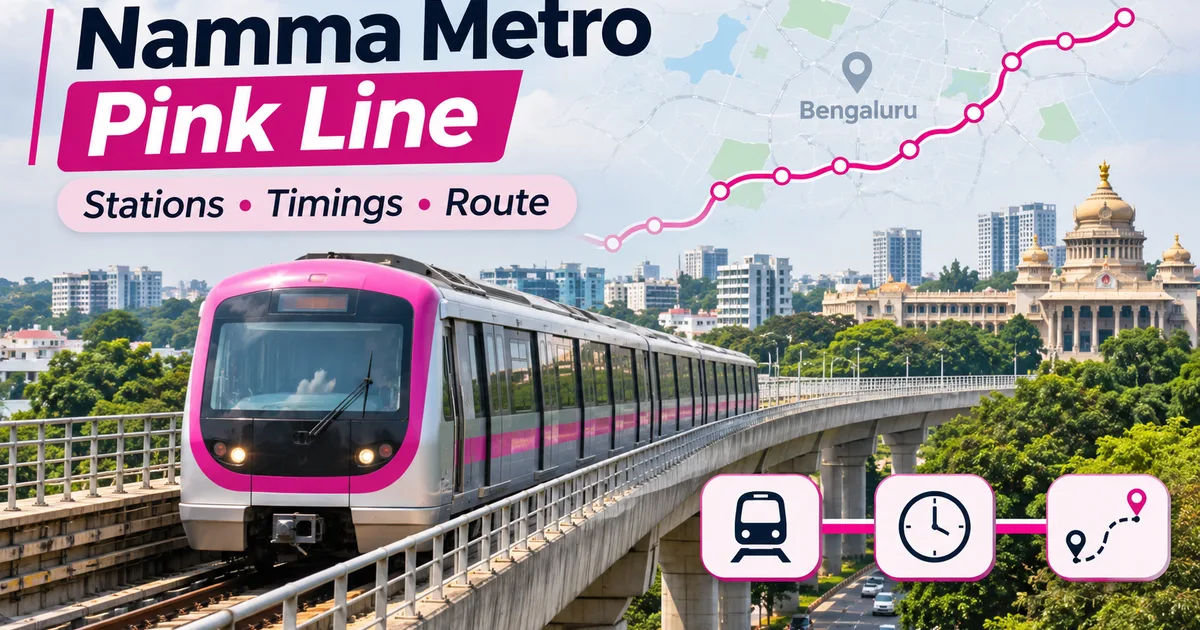
If you've ever spent forty minutes staring at a brake light near Vega City Mall on Bannerghatta Road, today is a genuinely good day. Passenger services on the Namma Metro Pink Line finally opened to the public at 6:00 AM on November 14, 2026, a day after Prime Minister Narendra Modi flagged off the corridor. Right now, only the 7.5-km elevated stretch in South Bengaluru is running. It connects Kalena Agrahara to SG Palya across six stations.
It's a short stretch.
Let's be honest about that. A 7.5-km line by itself won't fix Bengaluru traffic, and commuters on social media have already pointed out that the real prize is the underground tunnel to MG Road and Nagawara later on. Still, if you ask me, this stretch is already a relief. Because it connects straight to the Yellow Line at Jayadeva Hospital, Bannerghatta Road residents finally have a way onto the metro grid without fighting Silk Board or Dairy Circle on a scooter (which is no small thing during weekday rains). It cost around Rs 3,470 crore to build. And with this opening, Namma Metro crosses the 100-km mark to hit 103.6 km, so Bengaluru now has India's second-largest metro network.
Whether you commute daily or just want to skip weekend mall parking chaos, here's every station, timing, fare slab, and ticket booking step you need.
All six Pink Line stations and their new names
Look, before you step onto a platform or type a station name into an app, there's a small catch. Just days before the November 13 inauguration, the Union Ministry of Housing and Urban Affairs approved name changes for three of the six elevated stations after local resident committees pushed for neighbourhood names on the boards. Thing is, it was last-minute. So third-party map apps and older street signs might still show the old names for a couple of weeks (annoying, I know, especially if you're meeting someone at the gate).
Going south to north along Bannerghatta Road, these are the six stations running right now:
- Kalena Agrahara sits at the southern end of the line and is now the closest metro stop if you are heading toward Bannerghatta Biological Park and the zoo, though you will still need an auto, cab, or BMTC bus for the final stretch south.
- Hulimavu drops you right near Royal Meenakshi Mall and the Christ University Bannerghatta Road campus, which should immediately take some pressure off weekend cab demand around Arekere.
- Bilekahalli-IIMB was previously listed on project maps simply as IIMB, and it serves both the Indian Institute of Management Bangalore campus and Fortis Hospital.
- NS Palya-JP Nagar 4th Phase was earlier called JP Nagar 4th Phase, and its exits put you within walking distance of Vega City Mall and surrounding residential blocks.
- Jayadeva Hospital is the big one on this stretch because it connects directly to the Yellow Line, giving you a rail link toward Silk Board, Electronic City, Bommasandra, and RV Road.
- SG Palya, short for Suddagunte Palya, was previously called Tavarekere on construction boards, and it acts as the temporary northern terminal near Sagar Hospitals and Dairy Circle.
Honestly, I think the renaming makes sense. Ask any auto driver in South Bengaluru for Tavarekere and they'll take you kilometres away from the station near Dairy Circle. Everyone knows SG Palya and Bilekahalli, though.
Namma Metro Pink Line timings, frequency, and fares
Unlike the early months of the Yellow Line, where commuters sometimes waited twenty-five minutes for a train, BMRCL started the Pink Line with a practical schedule. Five train sets are on this corridor. Four run in regular service, and one is on standby.
If you're catching an early train or heading home late, here's BMRCL's official schedule:
- On Mondays, the first train leaves Kalena Agrahara at 4:55 AM and leaves SG Palya at 5:00 AM so early office-goers and outstation travellers can connect smoothly.
- From Tuesday to Saturday, services begin at 6:00 AM simultaneously from both terminal stations.
- On Sundays, the gates open a little later, with the first trains departing at 7:00 AM from both Kalena Agrahara and SG Palya.
- Across the week, the last train departs Kalena Agrahara at 10:50 PM and SG Palya at 10:54 PM, so try to reach the concourse by 10:40 PM to clear security comfortably.
During Monday to Friday peak hours, trains arrive every 8 minutes. During weekday off-peak hours and on Saturdays and Sundays, that gap widens to 10 minutes, which is still fast enough that you don't have to time your walk to the station down to the second. In my experience, anything under ten minutes feels pretty effortless. Fares inside the 7.5-km Pink Line stretch are Rs 10 to Rs 30 depending on distance, and if you switch to the Yellow Line at Jayadeva Hospital for Electronic City or Silk Board, or transfer further to the Green and Purple lines toward Majestic or Whitefield, standard Namma Metro distance slabs apply up to Rs 90.
But you don't pay any extra interchange penalty for changing trains, and using a QR ticket or a smart card (including an NCMC card) knocks 5 percent off the paper token rate.
Step-by-step guide to booking Pink Line QR tickets on WhatsApp
Standing in a token counter queue at 9:15 AM on a Monday is nobody's idea of a good morning. Basically, if you don't own a metro smart card yet, or you're helping a visiting parent travel across town, WhatsApp QR booking is easily the best option. No extra app needed, and no locked-up balance. For more tutorials like this, you can browse our how-to tech guides anytime.
You'll need an active Indian mobile number on WhatsApp and a UPI app like Google Pay or PhonePe (Paytm works too). Follow these steps before you reach the station:
- Save BMRCL's official WhatsApp chatbot number +91 81055 56677 in your phone contacts under a simple name like Namma Metro Ticket.
- Open WhatsApp, start a new chat with that contact, and send a simple Hi message, after which the automated bot will reply within two seconds with a language selection menu for English or Kannada.
- Tap your preferred language, then tap the Buy Ticket button from the interactive menu options that pop up inside the chat window.
- Select your starting station (for example, Bilekahalli-IIMB) and your destination station (such as Electronic City or Majestic) from the alphabetical station list, keeping an eye out for both the old and new names if the list is still updating.
- Choose the number of passengers travelling with you (you can book multiple tickets in one transaction) and tap Continue to see the discounted fare breakdown on screen.
- Tap Pay Now, which either opens an in-chat WhatsApp UPI payment prompt or redirects cleanly to your chosen UPI app where you enter your 4-digit or 6-digit UPI PIN.
- Wait three seconds after payment confirmation, and the bot will send a square QR code image right inside the chat along with your ticket validity time.
When you get to the pink-and-grey Automatic Fare Collection (AFC) gates at the station, crank your phone brightness up to at least 75 percent. Hold the QR code flat over the glass scanner window on the right side of the gate, around four inches above the glass, and the flaps will swing open. I've found the scanner can be a bit sketchy if your screen protector is cracked, so hold it steady. And keep that same WhatsApp chat open because you have to scan the exact same QR code again to exit at your destination.
Should you switch to an NCMC card or stick to smart cards?
If you ride Namma Metro every workday, even a 30-second WhatsApp booking gets old fast. You've got two card choices at the Pink Line customer care counters. One is a regular BMRCL smart card, and the other is a National Common Mobility Card (NCMC) from partner banks like SBI or HDFC (Airtel Payments Bank issues them too).
Both cards need at least Rs 50 in balance to open the entry gates, and both give you that same 5 percent fare discount. Thing is, if you ask me, older BMRCL smart cards are a bit of a mess to top up online because you still have to tap the card at a station terminal afterward. WhatsApp card recharges have been pretty patchy for users lately too, though I'm not sure exactly why that hasn't been fixed yet. An NCMC RuPay card also works on BMTC buses and other Indian metros like Delhi and Mumbai, even if you have to do a quick Aadhaar OTP or PAN check at the bank counter or app to unlock full limits. If you want to see how government digital IDs simplify this stuff, read our step-by-step Indian digital guide.
How to transfer at the Jayadeva Hospital interchange
Jayadeva Hospital is the station that makes this short elevated corridor actually useful. Without it, the Pink Line would just be an isolated shuttle up and down Bannerghatta Road. With it, you can get to Central Silk Board in minutes or go deep into Electronic City on the Yellow Line. You can also head two stops west to RV Road for the Green Line toward Majestic and Yeshwantpur, or catch the Purple Line connection to Whitefield.
Interchange stations look confusing on your first try, especially in a multi-level building like Jayadeva. Here's how the transfer works so you don't get lost or accidentally exit the paid zone:
- Step off the Pink Line train at Jayadeva Hospital and look up immediately for the colour-coded overhead signboards marked Yellow Line toward RV Road or Yellow Line toward Bommasandra.
- Follow the pedestrian walkway and escalators inside the concourse area, making sure you do not walk toward the Exit gates or tap your QR ticket at any turnstile along the way.
- Check the platform direction boards before descending to the Yellow Line tracks: take the platform marked Bommasandra if you are heading toward Silk Board, HSR Layout, or Electronic City, and take the platform marked RV Road if you want to reach Jayanagar or connect to the Green Line.
- Board your Yellow Line train and keep your phone or smart card safely in your pocket until you arrive at your final station.
- Scan your original QR code or tap your card only at your destination exit gate, where the system automatically calculates the single combined fare across both lines.
Just to give you an idea of the time saved, a trip from Hulimavu to Central Silk Board easily eats 45 minutes in evening traffic. Now it takes around 15 minutes across the Pink and Yellow lines for about Rs 40. And honestly, I think getting to Majestic via RV Road is the real win here, since it drops to a 35-to-40-minute ride instead of a gamble with Outer Ring Road bottlenecks (a massive relief if you've ever been stuck there at 7 PM). If you're planning longer outstation trips from Majestic or Yeshwantpur, you might want to check our guide on the Bengaluru intercity rail route updates.
Catching BMTC feeder buses from Pink Line stations
A metro line in Bengaluru is only as good as your last two kilometres. Nobody wants to pay Rs 20 for a metro ticket and then fight with an auto driver asking Rs 150 for a one-kilometre drop into an inner lane.
To help with that from day one, BMTC started five dedicated metro feeder bus routes today, running 28 buses across 401 daily trips. These feeders connect Jayadeva Hospital to Uttarahalli and SG Palya, and they link Hulimavu straight to Singasandra. There are also circular loops running out of NS Palya-JP Nagar 4th Phase and SG Palya stations.
Even better, BMTC and BMRCL have put up live LED arrival displays at SG Palya and Bilekahalli-IIMB stations. Look at those boards inside the concourse before you head down the exit stairs to see how many minutes away the next feeder bus is. To me, that small touch is genuinely smart. It saves you from standing on a dusty footpath wondering if you just missed the bus by two minutes.
What happens next with the underground stretch to Nagawara
Right now, going north past SG Palya still means getting back onto the road. The remaining 13.76-km stretch of the Pink Line is completely underground across 12 stations, and it cuts straight through central and northern Bengaluru before it ends at Nagawara.
Once that second phase opens, the list adds Dairy Circle, Lakkasandra, Langford Town, National Military School, MG Road, Shivajinagar, Cantonment, Pottery Town, Tannery Road, Venkateshpura, Kadugundanahalli, and Nagawara. That underground section gives commuters two big wins. You get a direct Purple Line interchange at MG Road, and a future Blue Line airport interchange at Nagawara.
Commuters changing trains at major interchange stations, such as Jayadeva Hospital (Yellow Line) and MG Road (Purple Line), will not have to pay an additional interchange charge.
When will that underground half actually open? Tunnel boring is done, and trials are underway along with Platform Screen Doors and system fit-outs. The project reports point toward March to May 2027, though the exact timeline feels a bit fuzzy to me. Given how Bengaluru metro dates have slipped in the past, I'd treat mid-2027 as an optimistic target rather than a promise, and keep an eye on latest Indian tech and infra news for confirmed CMRS safety clearance announcements.
Even if the underground tunnel is still a few months out, today's opening changes daily life along Bannerghatta Road in a real way. If you live near Hulimavu or Bilekahalli (or Kalena Agrahara down at the southern end), save that WhatsApp number and try a quick ride to Jayadeva this weekend to see how much stress it cuts out of your commute. And if you're heading into town for weekend festivals or local events, our Bengaluru event registration guide is worth bookmarking alongside your metro pass.