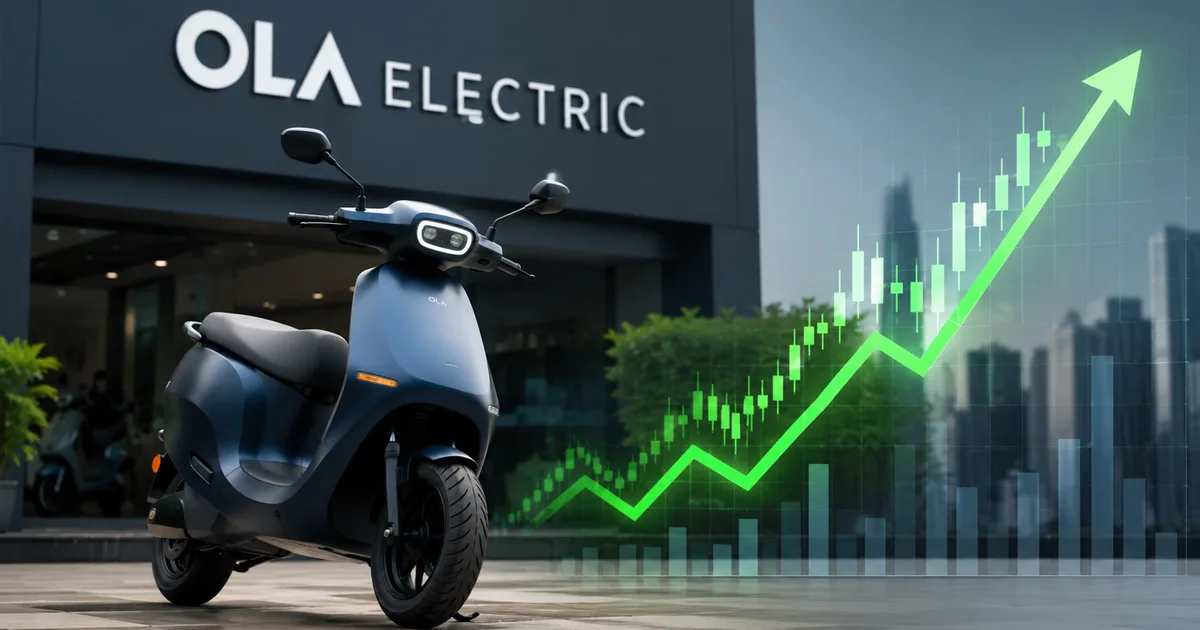
If you've been tracking the stock market today, you probably noticed something wild. The Ola Electric share price 2026 trajectory just took a massive leap, jumping over 10% in a single trading session. Some reports even have it surging past 15% despite a generally weak day on Dalal Street. Honestly, it's about time we talked about what's actually going on behind the scenes at Bhavish Aggarwal's company.
Look, I know EV stocks can be a bit of a rollercoaster for retail investors. We saw the hype during the initial public offering. Then we saw the reality check. Today's surge is tied to some very real business moves. And these moves tell us a lot about where the Indian electric vehicle market is heading over the next decade.
We need to look at what exactly drove the stock up today. I spent the morning reading through the exchange filings and latest market news. I found some specific reasons for the jump.
The Axis Energy MoU: More than just scooters
The immediate trigger for the stock's massive rally is a newly signed Memorandum of Understanding with Axis Energy. But what does that actually mean in plain English?
Ola Electric is moving beyond selling two-wheelers. They are entering the energy management business. The agreement outlines the potential deployment of up to 20 Gigawatt-hours of battery energy storage systems by 2032. That's a massive number.
India's renewable energy push has a huge problem. The sun doesn't shine at night. And the wind doesn't always blow. You need massive batteries to store that power for the grid. By partnering with Axis Energy, Ola is signaling that their Gigafactory will power the grid itself.
I find this fascinating. It shifts the entire narrative around the company. They are an automotive company trying to become a core energy infrastructure company. If they pull this off, the margins in business-to-business energy storage could dwarf what they make selling scooters to college students.
Ola Electric stock price recovery: Up 91% from March lows
The stock is up 91% from its lows in March. That's nearly a double in just a few months.
Earlier in the year, the market was punishing EV makers over concerns about the FAME subsidy reductions. When the government pulled back the subsidies, everyone panicked. Sales dipped. And investors dumped the stock.
But Indian consumers are remarkably adaptable. Yes, the upfront cost of an EV went up. Petrol prices, though, are stubbornly high. The running cost of an EV at roughly 20 to 30 paise per kilometer is still incredibly attractive for middle-class Indian families. Ola managed to keep their sales volumes respectable despite the subsidy cuts. This forced the market to re-evaluate their negative scenarios.
"The transition to electric mobility in India is no longer dependent entirely on subsidies. The total cost of ownership has reached parity with internal combustion engines for regular commuters."
That realization is what put a floor under the stock price back in March.
Commercial electric scooters: The next big frontier
Ola Electric has also reportedly secured regulatory approval for a new commercial electric scooter.
You should care about a commercial scooter because of the gig economy. Companies like Swiggy and Zomato drive a massive amount of last-mile delivery in India. Millions of delivery partners are riding around cities on old petrol scooters. They burn through their daily earnings on fuel. With the rise of UPI and digital payments, gig workers need cheaper mobility to maximize their daily earnings.
Companies like Yulu have already shown that there is massive demand for B2B electric mobility. If Ola can produce a rugged, reliable electric scooter specifically designed for delivery partners, they could lock in massive fleet orders. Fleet operators buy in bulk. This means guaranteed revenue. It also means lower customer acquisition costs compared to convincing individual buyers in showrooms.
- Lower acquisition costs through bulk sales
- Predictable revenue streams for the company
- Potential subscription models for battery swapping or charging
- Massive ESG compliance points for e-commerce giants
Honestly, I think this commercial segment might be their most profitable venture over the next three years. If you ask me, if you're an investor looking at the long term, this is a much bigger deal than a minor design tweak on the consumer scooters.
Indian EV market impact: Competitors feeling the heat
Their stock movements have ripple effects across the entire sector. When Ola moves aggressively, the rest of the Indian EV market feels the pressure.
The aggressive expansion into battery storage and commercial vehicles puts immense pressure on legacy players like TVS with their iQube. Bajaj with the Chetak is also feeling it. It also forces startups like Ather Energy to accelerate their own timelines. Ather has always positioned themselves as the premium, reliable alternative. If Ola starts dominating the B2B space and the grid storage space, they'll have significantly more capital to burn on consumer price wars.
Basically, India currently imports a massive chunk of its lithium-ion cells from China. The government has been pushing hard for localized manufacturing through the PLI scheme. Ola's gigafactory in Tamil Nadu is one of the few facilities actually attempting to make cells from scratch on Indian soil. If they succeed, it helps their margins. And it helps India's trade deficit.
The risks you can't ignore
I'm not here to tell you to blindly buy the stock. There are very real risks that every retail investor needs to understand.
- If you spend five minutes on X, you'll find plenty of angry customers complaining about long wait times for repairs. Scaling manufacturing is one thing, but scaling after-sales service across tier-2 and tier-3 cities is a completely different beast.
- Promising 20 GWh of battery storage by 2032 is a fantastic headline. Actually delivering it requires flawless execution, massive capital expenditure, and navigating complex government regulations.
- Even after the March dip, the company trades at a premium valuation compared to traditional automakers. A lot of future growth is already priced into the stock. If they miss a single quarterly target, the market will punish them ruthlessly.
The IPO journey recap: A wild ride for retail investors
When Ola Electric first went public, retail investors scrambled for allotments. They were hoping for listing gains. We saw the stock open with a decent premium, driven by the massive brand visibility.
In my experience, the public markets demand quarterly results. They want to see shrinking losses and expanding margins. They want clear paths to profitability. When the initial euphoria faded, reality set in. The company was still burning cash to capture market share. The stock price took a beating, eventually hitting those March lows we talked about earlier.
The recovery since then has been driven by hard numbers. The management has had to answer tough questions on earnings calls. They've had to show real progress on reducing the bill of materials cost for their scooters. By moving to an in-house developed battery cell strategy, they are trying to claw back the margins that traditionally go to foreign battery suppliers. Check out our investment guides if you want to understand how cell costs impact automotive margins. The numbers here are a bit fuzzy on their battery yield rates (which makes sense, actually), but they are clearly betting the house on in-house manufacturing.
Government policies: The invisible hand
You really can't discuss the Indian EV market without talking about government policy. The Ministry of Heavy Industries dictates a lot of the economics here. We saw the FAME II subsidies get slashed. This caused that massive panic. But what replaced it?
The government introduced the Electric Mobility Promotion Scheme 2026. This provided a temporary cushion. But the real game-changer is the PLI scheme for Advanced Chemistry Cells. If Ola meets the stringent localization norms required by the PLI scheme, they get direct cash incentives from the government for every kilowatt-hour of battery capacity they produce.
This is where the Axis Energy deal becomes even more important. To maximize PLI benefits, you need massive volume. Selling scooters alone might not provide enough volume to achieve the economies of scale needed to make cheap battery cells. But if you're also supplying 20 GWh for grid storage, the math works beautifully. You produce millions of cells. Your per-unit cost drops dramatically. And the government essentially hands you a cheque for doing it.
It's a high-risk, high-reward strategy. It's the kind of bold move that Indian manufacturing desperately needs if we ever want to compete with Shenzhen or Taiwan on hardware.
The charging network: A hidden advantage
There's another piece of the puzzle that often gets overlooked. Building electric scooters is hard. Building the infrastructure to keep them running is even harder. Ola has been quietly expanding its Hypercharger network across the country.
Think about the classic chicken-and-egg problem of EVs. People won't buy them if they can't charge them. And companies won't build chargers if there are no EVs on the road. By building their own proprietary network, they've solved this problem for their users. It's very similar to the playbook Tesla used in the US with their Superchargers.
If they eventually open up this charging network to other brands for a fee, that's yet another recurring revenue stream. As EV adoption grows, this infrastructure becomes a massive competitive moat. Competitors who rely on third-party public chargers simply can't offer the same integrated experience.
The export potential: Beyond Indian borders
India is a notoriously price-sensitive market. If you can build a reliable electric scooter that an Indian middle-class buyer can afford, you have built a product that can sell anywhere in the developing world.
Think about markets like Indonesia and Vietnam. These regions rely heavily on two-wheelers for daily transport, much like India. They are also dealing with rising fuel costs and pollution. Ola Electric has made no secret of its ambitions to export vehicles. If they can get their domestic operations stabilized and profitable, the export market represents a massive, untapped revenue stream.
Bajaj and TVS already make a significant chunk of their profits from exports. Ola will inevitably follow that path. The commercial electric scooter they just got approved for could be a massive hit in Southeast Asian markets where motorcycle taxis and deliveries are the backbone of urban transport.
Should retail investors jump in now?
Is the stock a clear buy after today's news?
If you're looking for a safe, dividend-paying stock that you can buy and forget for ten years, this probably isn't it. Check out our guides on traditional blue-chip stocks for that. Ola Electric is a growth stock. That's just finance jargon for extreme volatility.
But if you believe in the long-term electrification of Indian transport and energy infrastructure, they are currently the most aggressive player in the market. The Axis Energy deal proves they are thinking bigger than just two-wheelers. The commercial scooter approval proves they are looking at realistic, high-volume revenue streams.
The 91% recovery since March shows that institutional money still believes in the story. The ride from here to 2032 will likely have plenty of speed bumps. Make sure your portfolio can handle the turbulence.
Diversification is boring (annoying, I know). But it keeps you from losing sleep when the market inevitably throws a tantrum. The next few quarters will be interesting, especially with the festive season coming up. That's going to be the real test for their consumer sales numbers.