If you own a smartphone in India, you already know the drill. You're in the middle of a meeting or eating dinner and your phone rings. It's a random number. You pick up, and it's a recorded voice selling you a personal loan you never asked for, or a text claiming your electricity will be disconnected tonight. Honestly, the sheer volume of unsolicited calls and messages has gotten completely out of hand over the past few years.
But things are finally changing. The recent Bharti Airtel AI Spam Detection Network 2026 India Launch is a massive shift in how we handle this mess. I spent the last few days looking at the features and impact of this rollout. And there are some real benefits coming our way. I think it's about time someone did this.
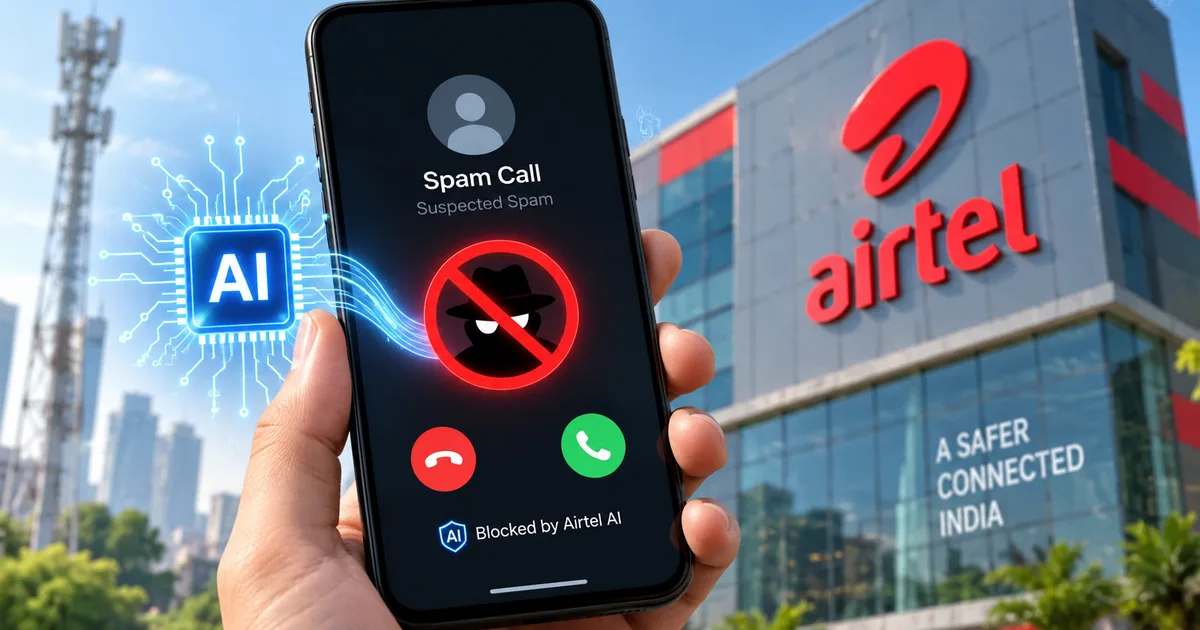
I want to break down exactly what this means for ordinary Indian consumers. This isn't another app you have to download and forget about. Airtel has basically baked artificial intelligence directly into their network layer. They're identifying and blocking these things before they even make your phone vibrate.
Let's look at the numbers. GSMA's 2025 Consumer Scam Report showed that 53% of adults in India have faced scams in their lifetime. That is a staggering statistic. Scammers are mostly hitting people on OTT messaging apps (around 46% of cases) and plain old SMS (37%). So keeping up with our Latest Tech News, we can see why a telecom operator stepping up is a big deal. For years the burden was on us to be careful. Now the network is helping out.
How Airtel's AI spam detection actually works
Look, I know tech jargon gets thrown around a lot. We hear about AI doing everything from writing emails to driving cars (which makes sense, actually). But the mechanics here are pretty straightforward. Airtel's new system doesn't rely on you manually reporting a number after the damage is done. Instead the AI looks at behavioral patterns across their massive network. It's a completely different approach.
It analyzes call frequency and usage patterns. Think about it. A normal person makes a few calls a day to different people. A spammer sets up an automated system that blasts out thousands of ten-second calls. Or they fire off 10,000 text messages an hour with sketchy links. The AI spots these abnormal patterns instantly. In my experience, these systems can catch a lot of noise.
Airtel says this system is processing over 1.5 billion SMS messages and 2.4 billion calls every single day. And it's blocking an average of 1.17 million spammers daily. Think about that for a second. That is over a million spammers blocked from annoying people across the country every 24 hours. The AI also cross-references SMS content against a centralized database of known malicious links. It alerts you if something looks fishy.
The problem with OTPs and legitimate business calls
But here's the catch. We rely on automated messages for absolutely everything now. We get bank OTPs to complete a UPI payment, Aadhaar verifications, Swiggy delivery updates, and Amazon package tracking. The last thing you want is your telecom provider blocking a banking alert because the AI mistakenly thought it was spam.
This was a major concern. If you've read our Scam Alerts & Safety section, you know that missing an alert can be frustrating. So Airtel had to balance aggressive blocking with business continuity. To address this, they rolled out their Business Name Display (BND) solution in May 2025. This ensures that verified businesses show up with their actual names on your screen. It reduces the chances of false positives. You don't miss the calls and texts that actually matter.
The push from TRAI and the regulatory landscape
We can't talk about this without mentioning the government's role. The Telecom Regulatory Authority of India (TRAI) has been pushing hard for a cleaner network. Back in March 2026, they issued a strict directive to mobile operators. They mandated that telecom companies must share data from their AI spam systems on a common blockchain-based Distributed Ledger Technology (DLT) platform. And they need to do it fast.
TRAI has directed mobile operators to share data generated by their AI-based spam detection systems within short timelines, including within two hours, to a common blockchain-based Distributed Ledger Technology (DLT) platform.
TRAI also amended the Telecom Commercial Communication Customer Preference Regulation (TCCCPR). They broadened the definition of what constitutes spam. They also tightened the rules around sender registration and demanded proactive AI monitoring. The pressure is on. In February 2026 alone, TRAI issued over 731,000 notices to unregistered telemarketers. Telecom companies can't turn a blind eye to the junk passing through their pipes anymore. We are finally seeing the results of this strict regulatory environment.
Industry coordination and the MediaNama roundtable
The industry is taking this seriously enough to sit down and hash out the details. MediaNama hosted an invite-only roundtable in New Delhi in August 2026. It focused specifically on the impact of AI in spam prevention. I'm not sure exactly why it took them this long, but it's happening.
They discussed complex issues. Like how TRAI's short-timeline signal-sharing direction can actually work when operators like Airtel, Jio, and Vi use completely different AI models. If Airtel flags a number as spam, should Jio immediately block that spam too? Even if their own AI isn't sure? They also debated how false positives should be handled. It is a complicated web of privacy and technical challenges. But the fact that these conversations are happening is a very good sign for consumers.
Airtel vs Google and the RCS messaging partnership
There is another layer to this rollout that caught my attention. Airtel didn't build this in isolation. They partnered up with Google. They extended this AI-driven protection to RCS (Rich Communication Services) messages in the Google Messages app.
If you're an Android user in India, you're probably using Google Messages as your default texting app. By collaborating, Airtel and Google are making sure that the spam filters apply to these rich text messages too. This is highly relevant for anyone looking into Airtel AI-Powered Spam Detection. Scammers are moving from traditional SMS to RCS and WhatsApp. They can send images and interactive buttons that make their scams look more convincing. Closing that gap on Android devices is a necessary step to protect users.
This collaboration also touches upon how we interact with brands. RCS allows businesses to send verified messages with a checkmark. It's much like a verified WhatsApp business account. By integrating AI spam detection here, Google and Airtel are trying to build a walled garden of trust. When you receive a message claiming to be from HDFC Bank or Indian Railways on RCS, you can be much more confident that it is actually them. The AI filters out the spoofed numbers trying to mimic these institutions.
Will this make you pay more for mobile data?
I have to be honest here. Airtel isn't doing this out of the goodness of their hearts. They are a massive corporation. Their latest FY2025-26 annual report makes their business strategy clear. They're heavily focusing on premiumization. (Annoying, I know.)
Right now, 5G data is practically given away for free to many postpaid users to drive adoption. But telecom operators in India struggle with very low ARPU (Average Revenue Per User). Airtel has around 188 million 5G subscribers. But turning that massive user base into sustainable revenue is difficult without compelling use cases.
By offering a cleaner, safer network, they're adding premium value to their core service. The idea is that customers will stick around. And eventually they will be willing to pay higher tariffs for a superior experience. They're baking AI into the network layer as a product feature to differentiate themselves in a competitive market. Also, companies like Ericsson and Nokia are praising Airtel's 5G network slicing technology. That technology helps route and manage these heavy AI workloads efficiently. The numbers here are a bit fuzzy, but the strategy is clear.
What this means for everyday Indian users
So, what changes for you and your parents? First, you should naturally start seeing a noticeable drop in the number of recorded voices trying to sell you real estate or credit cards. You should see fewer text messages with sketchy APK download links claiming you won a lottery or that your SBI account is blocked.
But don't drop your guard completely. Scammers are relentlessly creative. They'll find new ways to bypass these filters. They might cycle through unregistered numbers faster. Or they might move their operations to encrypted platforms like Telegram or WhatsApp where telecom operators can't see the message content.
If you do get a scam call or message, you still need to report it. Use the official cybercrime.gov.in portal. Or dial the 1930 helpline if you've actually lost money. The AI learns from the feedback loop, but it needs fresh data to know what new tactics the scammers are trying out. Don't rely entirely on the telecom operator to save you. Enable two-factor authentication on all your accounts. And never share your UPI PIN or OTP with anyone.
For small business owners, this is a mess. You won't have to deal with as many fake inquiries, which is great. But you need to make sure your business is properly registered under the new DLT guidelines. If you're sending out legitimate promotional texts for your local shop without the right registration, Airtel's AI will likely flag you as spam and block your numbers. You have to get your paperwork sorted. And you have to ensure you're using verified channels to reach your customers. It's an extra step, but it is necessary to clean up the ecosystem.
The future of network security in India
The Bharti Airtel AI Spam Detection Network 2026 India Launch is a massive step forward. It fundamentally shifts the burden off the consumer. For years, the only advice we got was to be careful or download a third-party caller ID app that just sells your data anyway. Now the telecom network is acting as the bouncer at the door. It tosses out the troublemakers before they reach you. If you ask me, this is a huge relief.
It's a big relief for senior citizens and less tech-savvy users who are often the most vulnerable to these digital frauds. I'm hoping to see Reliance Jio and Vodafone Idea implement similar systems soon. We need the entire telecom ecosystem locked down. Not just one operator. The technology is clearly here. The government regulations demand it. Indian consumers deserve a phone that only rings when someone they actually want to talk to is on the other end.