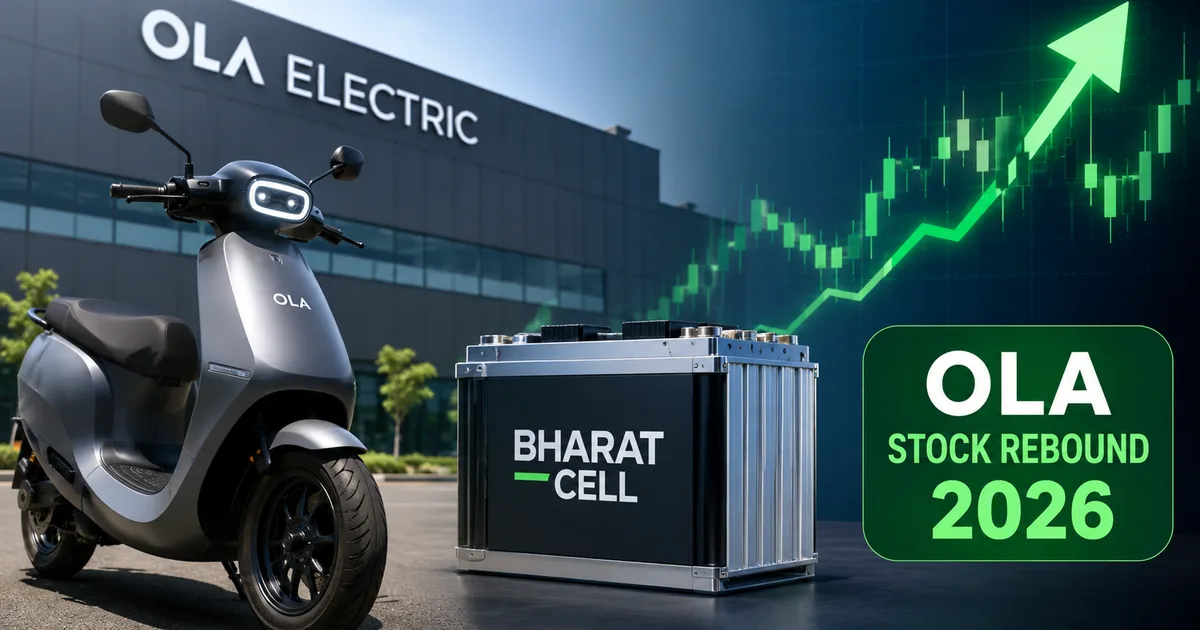
If you've been tracking the market lately, you've probably noticed the sudden chatter around the Ola Electric stock rebound 2026. Just when Dalal Street was writing off the EV maker, Bhavish Aggarwal's company pulled a couple of massive moves. They launched a ₹780 crore Qualified Institutional Placement (QIP) and began scaling up deliveries of their home-grown 4680 Bharat Cell-powered scooters. For retail investors who bought during the IPO hype or those looking to enter now, it's a confusing picture. Is this the turnaround we've been waiting for, or is it another capital-hungry gamble?
First, let's look at the actual numbers. Ola Electric set the floor price for its QIP at ₹37.74 per share. So, naturally, the stock slipped about 2% to 3% right after the announcement on June 9, 2026, since the floor price was at a discount compared to the market rate. But look at the volume. It's one of the most-traded stocks on the National Stock Exchange (NSE) now. Why? Institutional players are starting to take Bhavish Aggarwal's battery dreams seriously.
Ola Electric QIP: raising ₹780 crore to battle market share losses
Here's the deal: Ola Electric is burning cash, and they need fuel to keep the factory running. A Qualified Institutional Placement is basically just a way for listed companies to raise money quickly by selling shares to big institutional players like mutual funds and insurance companies. This time, they're targeting Qualified Institutional Buyers instead of asking retail investors for money (which makes sense, actually, given the market mood).
But why now?
If you ask me, the company's under serious pressure. Look at the Vahan sales data from May 2026. It showed that while Ola still leads the electric two-wheeler market, its rivals are catching up fast. TVS and Bajaj Auto have been aggressively launching cheaper models and expanding dealership networks. So, Ola's market share has dropped from its peak. This is true even though their overall registrations grew by 23% year-on-year. They had to launch the S1 X+ to fight back, but that model has lower margins.
To defend their turf, Ola needs money. They need to build out their manufacturing capacity and, more importantly, commercialize their battery cells. The ₹780 crore raised from this QIP is earmarked for this massive capital expenditure. If you want to understand how corporate fundraising fits into your overall portfolio, you can read our guides for Indian investors.
Here's how they plan to deploy the funds:
- Expanding the annual production capacity of the FutureFactory in Tamil Nadu.
- Funding the ongoing research and development of next-generation electric powertrains.
- Setting up the Gigafactory to mass-produce battery cells locally.
- Repaying some of the short-term debt to clean up the balance sheet.
This's a classic high-stakes game. If these big investors are willing to back Ola at ₹37.74 per share, it shows they're seeing some long-term value. But for retail investors who bought at higher prices, the dilution's a pill that's hard to swallow.
The math of Qualified Institutional Placements
In India, when a listed company needs a lot of money, they've got a few options. They can do a rights issue. That takes months and involves offering shares to existing retail shareholders. Or they can launch a Follow-on Public Offer (FPO), which is also slow and expensive because of regulatory red tape. A QIP is totally different. This one's governed by the Securities and Exchange Board of India (SEBI) guidelines. It lets the company issue shares to selected institutional buyers in just a few days. For Ola, speed's everything. They can't afford to wait six months for a public issue when competitors are eating their market share week after week. By setting the floor price at ₹37.74 per share, which was a discount to the market price at the time, they made the deal attractive enough for institutional players to jump in fast.
The 4680 Bharat Cell progress: homegrown battery hopes
Bhavish Aggarwal believes Ola's future lies in batteries rather than scooter assembly. If you ask me, he's probably right. Right now, almost every Indian EV manufacturer imports lithium-ion cells from China or South Korea. That leaves them completely vulnerable to global supply chain shocks and import duties.
Ola's response is the 4680 Bharat Cell.
This's a larger, cylindrical cell. Ola claims it's cheaper to produce and holds more energy than the standard 2170 cells you see in most electric scooters. The big news is that Ola Electric recently got the Central Motor Vehicles Rules (CMVR) approval and the International Centre for Automotive Technology certification for their S1 X+ 5.2 kWh scooter powered by these homegrown cells.
"Getting the ICAT certification for a homegrown cell is a major step. It shows that domestic cell manufacturing is commercially viable and meets Indian safety standards, which could reduce cell costs by up to 30%." - Rajesh Kumar, Senior EV Analyst at CleanTech India
The company's already started mass deliveries of these cell-powered vehicles. Bhavish Aggarwal even claimed that global giants like LG Energy Solution are worried about losing their market share in India once Ola scales up production. That might sound like typical founder bravado. But the cost implications are real. If Ola can successfully manufacture its own cells here in India, it'll qualify for maximum incentives under the government's Production Linked Incentive scheme for Advanced Chemistry Cell (ACC) battery storage.
But there's a catch. Cell manufacturing is notoriously difficult. Even Tesla struggled for years (and they have massive resources) to scale up their 4680 cell production. A minor defect in the chemical composition can ruin an entire batch. If Ola runs into manufacturing defects or safety issues, the recalls could completely destroy the brand.
If you want to see how tech policy and manufacturing standards are evolving, check out our latest tech news section.
PLI scheme benefits for cell manufacturing
The financial payoff for Ola to make this work is huge. Under the government's Production Linked Incentive (PLI) scheme for Advanced Chemistry Cell (ACC) battery storage, companies get paid based on the capacity they build and the local value they add. If Ola imports cells from South Korea, they get zero PLI benefits for that component. But if they manufacture the 4680 Bharat Cell at their Gigafactory in Krishnagiri, they'll qualify for massive subsidies from the Ministry of Heavy Industries. Honestly, these subsidies can make or break their path to profitability. The PLI payouts are designed to offset the high starting costs of setting up advanced factories in India. It's a classic carrot-and-stick deal. The carrot is the subsidy, and the stick is the heavy import duty on foreign battery cells.
Understanding the regulatory hurdles
Before a vehicle hits the road in India, it has to clear testing agencies. That's a hurdle. For Ola, getting the CMVR nod for a battery pack they designed and built from scratch is a huge win. It means the cell has passed thermal runaway tests, nail penetration tests, vibration tests, and short circuit tests under tough Indian road conditions.
But safety's only one part of the equation. Consistency is where things get tricky. I'm not sure exactly how they'll scale without hiccups, but Ola has to prove they can produce millions of these cells every week with the same quality. If they fail to get high yields at their Gigafactory, the cost per cell will actually be higher than importing them from South Korea.
What the Ola Electric share price movement means for retail investors
Let's talk about the stock. The Ola Electric share price has been on a wild roller coaster. Back in April 2026, the stock jumped over 16% in a single week, which is wild given the heavy selling on the broader Sensex and Nifty. Why did it jump? Well, the surge was driven by early whispers of the cell certification. But then the QIP announcement came at a discount and dragged the price down.
If you're holding Ola shares, you've got to realize this is a long-term infrastructure play. It's not some quick software scale-up. The gestation period for a battery gigafactory is measured in years, not quarters.
Here's what you should watch before making any buy or sell decisions:
- The yield rate of the Bharat Cell production line over the next two quarters.
- The monthly Vahan registration data to see if Ola can stop its market share decline against TVS and Bajaj.
- Any changes in the FAME subsidy program or PLI disbursement timelines from the Ministry of Heavy Industries.
- The company's quarterly operating loss margins, which need to shrink as production scales.
Honestly, the stock isn't for the faint-hearted. It's highly volatile and deeply connected to government policy decisions. If the government cuts subsidies or delays those PLI payouts, Ola's path to profitability gets pushed back by years.
To understand how other digital business models are doing under Indian rules, check out our EV market explainers.
The competitive landscape in India
Ola isn't operating in a vacuum. Legacy players are waking up. TVS has ramped up production of the iQube, and Bajaj is using its massive dealership network to sell the Chetak. Both companies have decades of manufacturing experience, robust supply chains, strong dealer relationships, and deep pockets. They don't have to deal with the kind of customer service complaints that have plagued Ola over the past year.
On top of that, new startups are entering the premium segment. At the same time, Chinese manufacturers are looking for backdoor entries through local partnerships. Ola's advantage is its vertical integration. But that requires constant capital.
I think the QIP fundraise gives Ola the runway it needs. And getting the Bharat Cell certification shows their technology works on paper, at least. But the real test is execution. If they can scale production without quality issues, they could dominate the Indian EV market. If they fail, they'll just remain a debt-heavy company fighting legacy giants who have better distribution.
For now, keep your expectations realistic. You've got to watch the factory output numbers closely.