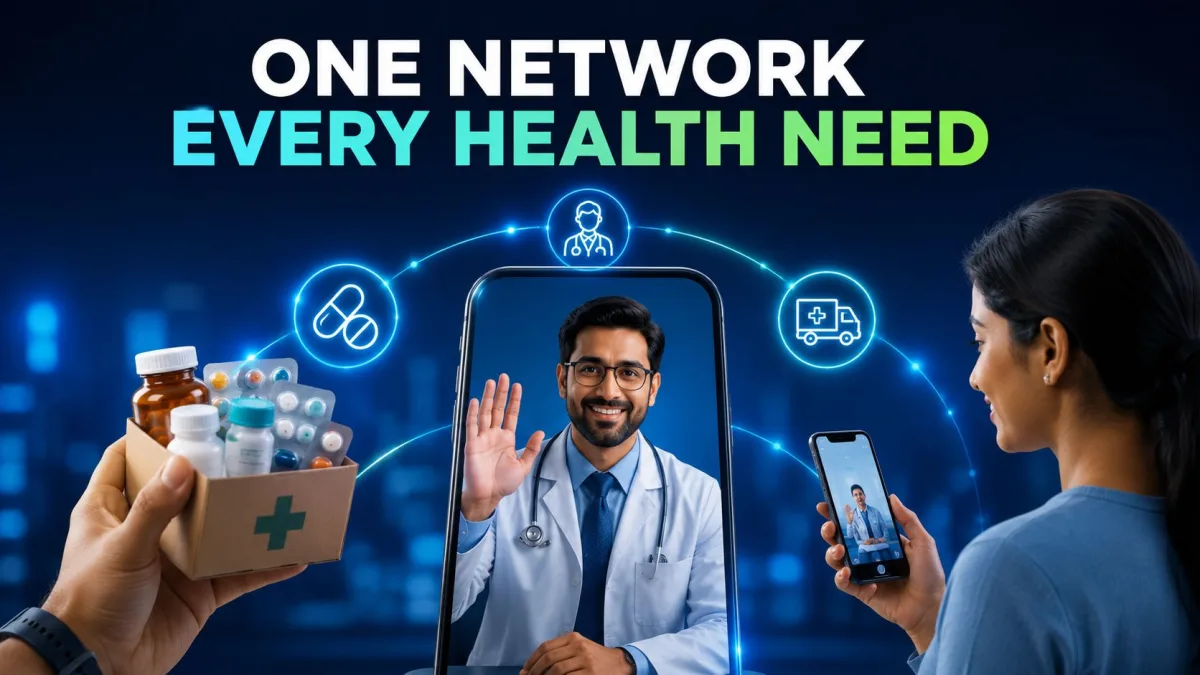
Imagine you're in Pune on a Sunday evening, your kid has a fever, and your usual doctor isn't picking up. You open your regular payments app, maybe Paytm or something similar, and right there alongside the recharge options, you see a way to book a video consultation with a paediatrician. You pay with UPI, the doctor joins in 15 minutes, and you get a digital prescription linked to your health account. No new apps to download. No new accounts to create.
That's what ONDC for healthcare is aiming to be. And in 2026, it's starting to become real.
What ONDC actually is, and why healthcare is different
If you've read our explainer on ONDC basics, you know the idea: instead of every service being locked inside one company's app, like how Practo controls the doctor listings and the booking system, ONDC is an open network where any buyer app can connect with any service provider's app.
Think of it like email. You use Gmail, your doctor's clinic uses some other mail service, and you can still talk to each other. ONDC does the same thing for digital commerce. It started with food and retail, and now it's moving into healthcare.
The government entity behind this is ONDC (Open Network for Digital Commerce), and it runs under the Ministry of Commerce. The healthcare side connects with ABDM (Ayushman Bharat Digital Mission), which is India's broader digital health infrastructure. So when people say "ONDC health," they're really talking about two government-backed systems working together. I think most people don't realise how much of the underlying work has already been done quietly.
What you can actually do through ONDC health services
The network covers a few things you'll care about as a patient or caregiver, and each one works a bit differently from what you'd get on a standalone health platform.
- Book doctor consultations (video, phone, or in-clinic)
- Order prescription and over-the-counter medicines
- Book lab tests and diagnostics
Health service providers, like clinics, teleconsultation platforms, pharmacies, and diagnostic labs, register on ONDC's health network. You, using any compatible buyer app, can browse and book from all of them in one place. That's the basic premise.
Booking doctor consultations
This is the most immediately useful part. A GP video consultation through ONDC health might run you ₹200 to ₹500, compared to ₹800 to ₹1,500 on some standalone telehealth apps. More providers competing on the same network tends to push prices down (which makes sense, actually).
After the consultation, the doctor issues a digital prescription linked to your ABHA ID (Ayushman Bharat Health Account number). That's how your health records stay with you across different apps and providers. Services like Kyno Health, which does doctor home visits in Delhi-NCR and Bengaluru within 20 minutes, are exactly the kind of providers that can plug into this network. So can larger teleconsultation platforms.
If you don't have an ABHA ID yet, it's free and takes around 5 minutes to set up using your Aadhaar. You can create it on the ABHA app or through the ABDM portal. Think of it as your health version of a UPI ID.
Ordering medicines
The medicine side works the same way. Pharmacies of all sizes can list on ONDC, from large chains to your neighbourhood medical store. You search for a medicine, see who has it nearby, compare prices, and place an order. Delivery can be hyperlocal from a nearby pharmacy or come from a larger fulfilment centre.
Right now, if you need medicines quickly, you're mostly choosing between 1mg, PharmEasy, Netmeds, or Apollo 247. All of them have their own inventory and their own pricing logic. ONDC theoretically opens the door for thousands of smaller pharmacies to compete directly, which could mean better prices and better availability of less common medicines. Whether that actually happens at scale depends on how many small pharmacies get on the network, and that adoption is still slow outside metros. Honestly, the numbers on small pharmacy onboarding are a bit fuzzy right now.
Which apps support ONDC healthcare right now
Honestly, this is where things are still early. The ecosystem hasn't reached the polish of ONDC food delivery yet.
As of May 2026, a few ONDC buyer apps have started adding health services. Paytm has been one of the early movers here, and some newer health-focused apps have built specifically on the ONDC health layer. The government has also tied this into the broader ABDM framework, so various state health apps and ABHA-connected tools can work as access points.
The experience is best in metros, places like Mumbai, Delhi, Bengaluru, Hyderabad, and Chennai. You'll find real doctor availability and medicine listings there. Smaller cities and towns are more patchy. The network needs more providers before it becomes reliably useful outside Tier 1.
For a broader look at what ONDC is enabling across different categories, the latest ONDC news section has ongoing coverage.
How to actually get started
Step one is getting your ABHA ID. Go to the ABHA app (available on Android and iOS) or visit abdm.gov.in. You'll need your Aadhaar and a mobile number linked to it. The whole thing takes under 10 minutes. You get a 14-digit ABHA number and a QR code you can show at any clinic or pharmacy registered on the ABDM network.
Once you have ABHA, download or open an ONDC buyer app that supports health services. Search for doctors or medicines in the health section, book, pay via UPI, and your records start building up in your ABHA account automatically.
If you run into issues, the step-by-step guides section covers ABHA setup and ONDC app walkthroughs in more detail.
How this compares to Practo, 1mg, and PharmEasy
Practo has been around since 2008. 1mg and PharmEasy have been around long enough to work out the logistics, and both have large user bases. They're not going anywhere.
Thing is, ONDC changes the market structure more than the user experience, at least right now. A doctor or small pharmacy in Nagpur currently has to accept Practo's or 1mg's terms to reach patients digitally. ONDC gives those providers an alternative route. For users, more provider competition should eventually mean better pricing and more choice.
The bigger difference is data portability. Your medical history in Practo stays in Practo. Your Apollo 247 records stay in Apollo's system. ONDC and ABHA together are designed so your health records follow you across platforms, with your permission. That's a real structural shift, even if it's hard to notice in day-to-day use right now.
Privacy and your health data
Any time someone says your health data will travel across apps, you should ask exactly how that works.
ABHA is on a consent-based framework. Before any app or doctor can access your records, you have to explicitly allow it. ABHA's consent rules sit under India's Digital Personal Data Protection (DPDP) Act, which came into force in 2025-26. You can check our DPDP Act explainer for what that means practically.
That said, India's health data governance is still being built. The DPDP Act covers personal data broadly, but health-specific sector regulations are still being finalised. Be thoughtful about which apps you connect to your ABHA ID (and honestly, this is one area where being a bit cautious makes sense). The consent dashboard in the ABHA app lets you see and revoke which apps have access to your records at any time.
What's still missing and what to watch
A few real gaps as of mid-2026:
- Rural and semi-urban reach is the biggest gap. A user in Meerut or Raipur isn't going to find 20 doctors on ONDC health yet.
- Specialist availability is still limited. Booking a GP is getting easier; finding a rheumatologist or hepatologist through ONDC health is another matter.
- Insurance integration hasn't arrived. Most transactions are still out-of-pocket via UPI, with direct insurer settlement still a future goal.
- UX consistency varies across buyer apps. What works smoothly on one can be clunky on another.
Watch NHA (National Health Authority) announcements. They manage ABDM and put out updates on provider onboarding and health record statistics. That's your best signal for when this has reached critical mass.
India's ABDM had registered hundreds of millions of health IDs through ABHA by 2026, but active usage and linked health records are considerably lower. The infrastructure exists; building user habits is the harder part.
So, is ONDC healthcare useful right now? If you're in a metro and reasonably comfortable with digital apps, yes. Especially for teleconsultations and medicine price checking. If you're outside a major city or need a specialist quickly, Practo or 1mg is probably more reliable right now. Apollo 247 too.
But the plumbing is being laid. And once it's there, the way India accesses healthcare digitally could look quite different.