Your electricity bill is due tomorrow. You open PhonePe, search for MSEDCL, and it just... works. No redirect to a discom website, no separate login, no queue at the collection center. You pay in ten seconds and get a receipt on your phone. That convenience exists because of BBPS, the Bharat Bill Payment System built by NPCI. And in 2026, with BBPS 2.0 fully live, the system covers far more than just electricity. It's quietly become the backbone of most recurring bill payments in India, and most people have no idea it even exists.
What BBPS actually is
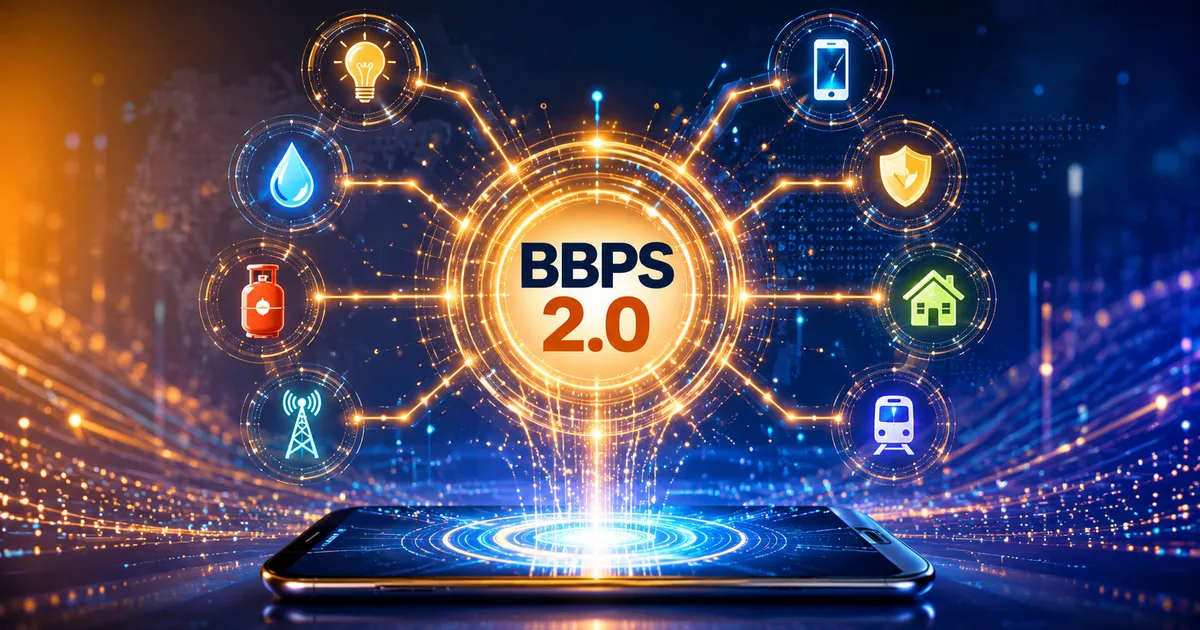
Think of BBPS as a giant switchboard. One side has hundreds of billers: electricity boards, gas companies, broadband providers, water utilities, insurance companies, schools, municipal corporations. The other side has your payment apps: PhonePe, Google Pay, Paytm, BHIM, every bank's own app, and hundreds of smaller platforms. BBPS sits in the middle, connecting them all through standardised interfaces.
Before BBPS, every biller had to build its own payment integration. Say you wanted to pay your Tata Power bill through HDFC Bank's app. Someone had to specifically build and maintain that connection. It was expensive and slow, full of gaps. BBPS replaced all of that with a single interoperable network. Any biller registered on BBPS can be paid from any app connected to BBPS. That's the whole idea, and it's a genuinely good one.
NPCI launched the first version around 2017-18. Useful, but narrow. BBPS 2.0 is the significantly expanded version that's been rolling out over the last couple of years, and by 2026 the coverage and adoption have reached a point where it's worth understanding properly.
What's new and expanded in BBPS 2.0
The original BBPS covered the basics: electricity, water, gas, DTH, mobile recharge, broadband. Useful, but not comprehensive. BBPS 2.0 opened the categories dramatically. According to a Mint report, BBPS has been actively onboarding insurance companies, schools, municipal corporations, and others since 2023-24.
Bill categories now covered
As of 2026, you can pay these through BBPS:
- Electricity, water, piped gas
- Broadband, landline, postpaid mobile
- DTH and cable TV
- Insurance premiums (life, health, vehicle)
- School and college fees
- Municipal taxes and property tax
- Housing society maintenance charges
- Loan EMIs from select lenders
- FASTag recharge
- Hospital and healthcare bills
Insurance premiums being on BBPS is honestly one of the more useful additions. Before this, paying an LIC premium or a health insurance renewal through a non-insurer app was either impossible or unreliable enough that you wouldn't trust it. Same with school fees. Most schools either wanted cash or had their own clunky portals with separate logins (annoying, I know). Now if your school has registered on BBPS, you can pay from any connected app and get a standardised receipt.
More types of apps can now connect
BBPS 2.0 also updated the technical standards so more types of payment platforms can connect as "Operating Units" on the network. Banks, non-bank fintechs, prepaid wallet apps, and business-facing platforms can all integrate now. I think this part gets overlooked in most coverage of BBPS, but it matters. When only large banks had BBPS access, billers negotiated on their own terms. More apps on the network means more pressure for billers to register and stay updated. For you, it means your preferred app is more likely to have full BBPS coverage.
How a BBPS payment actually works
Here's the flow in plain terms.
You open your payment app and go to the bill payments section. Pick a category (say, electricity), then choose your provider (say, BESCOM in Karnataka). Enter your consumer number. The app queries BBPS, which queries BESCOM's system and pulls your outstanding bill amount and due date. You confirm and pay. The payment goes through NPCI's BBPS switch, gets settled with BESCOM, and you get a receipt with a unique BBPS transaction reference number.
That reference number matters. It's generated at the network level, not just at the app level. If there's ever a dispute about whether you paid, that reference can trace the transaction through the BBPS system regardless of which app you used. Screenshot it and keep it until you see your payment reflected on the biller's side.
Settlement is real-time or near-real-time for most modern billers. A few older utility systems use batch settlement, so there's sometimes a delay before your account shows as paid. The BBPS receipt is your valid proof in those cases.
Which apps support BBPS in 2026
The major ones are:
- PhonePe (one of the most complete BBPS implementations)
- Google Pay
- Paytm
- BHIM
- Amazon Pay
- SBI YONO, HDFC PayZapp, ICICI iMobile, Axis Mobile, Kotak Mobile Banking
- Airtel Thanks
- Bajaj Finserv app
Basically, if your app has a bill payments section and is connected to UPI, it almost certainly has BBPS access. The ones that don't are usually very small regional apps that haven't prioritised integration. You can check the NPCI BBPS biller registry to confirm whether your specific electricity board, insurer, school, or housing society is registered before you try paying.
NRIs can now pay Indian bills for family back home
This one's worth knowing about. BBPS was expanded to allow cross-border bill payments, meaning someone living in the US or the UAE (or the UK) can pay bills for their parents or siblings in India through international platforms.
The Economic Times reported on this directly: NRIs can now pay bills for family back home through BBPS-connected international services. Aspora, a Sequoia-backed fintech, launched specifically to let the Indian diaspora pay Indian utility bills and insurance premiums without needing an Indian bank account or phone number. These platforms connect to BBPS as Operating Units, the same way a domestic app would, and handle the international money transfer on their end before sending the payment instruction through the BBPS network.
If you have a sibling abroad who pays your broadband bill every month, this is the cleaner way to do it now. No more informal bank transfers followed by you paying separately. For more on how India's payment infrastructure connects internationally, see our digital payments explainers.
Auto-pay and the Rs 10 lakh UPI limit
BBPS 2.0 supports auto-pay mandates. You set up a standing instruction once, and your electricity or insurance premium gets paid automatically on the due date through UPI AutoPay or your bank's mandate system, both of which hook into BBPS.
Thing is, NPCI also increased the UPI transaction limit to Rs 10 lakh for select categories. Large insurance premium payments and commercial property tax bills that previously had to go through NEFT or RTGS can now potentially go through UPI-connected BBPS. That's a real practical improvement if you're paying, say, a term insurance premium of several lakhs annually or property tax on a commercial space.
The honest limitations
It's not perfect.
Not every biller in India is registered on BBPS. Private schools and small housing societies haven't all onboarded, and neither have certain regional utilities. I'm not sure exactly what percentage of billers are fully registered right now, but NPCI has been pushing for wider adoption. It's voluntary for billers and adoption takes time. If your building's maintenance company isn't on BBPS, that's simply because they haven't registered yet.
Some billers are on BBPS but their data sync is slow. I've had situations where I paid an electricity bill through PhonePe, got the BBPS receipt, but the discom's own portal still showed the bill as unpaid for 24 hours. The BBPS receipt is valid proof of payment in those cases, but it's confusing if you're not expecting the lag.
Fees can vary by app. BBPS itself doesn't charge consumers for most bill types. But individual Operating Units can levy a convenience fee for certain categories, and they're allowed to do this. Always check before you confirm, especially for insurance renewals and large one-time bills.
There's also the occasional biller duplication issue. Some billers appear on BBPS with slightly different names or consumer number formats, and picking the wrong entry can send your payment somewhere it shouldn't. When in doubt, verify the exact consumer number format your biller uses before paying through any new app.
What to do when something goes wrong
Payment debited but biller didn't receive it. Or you got a failure message but your bank account was debited. This happens occasionally across any payment network.
First, check whether the money returns to your account within 3-5 business days. Auto-reversal for failed BBPS transactions is supposed to happen automatically. If it doesn't, raise a complaint through the app you used. Every BBPS Operating Unit is required to have a dispute resolution mechanism by NPCI's rules.
If the app isn't resolving it, you can escalate to NPCI directly using the BBPS transaction reference number from your receipt. Keep that screenshot. For broader digital payment scam concerns and how to protect yourself when paying bills online, our scam alerts section has relevant guides.
Why the infrastructure matters more than the app
India has around 200 million households paying recurring utility bills every month. Before BBPS, a substantial portion of that still happened in cash, at collection centers, or through biller websites requiring separate logins. That's friction. Friction means late payments, extra fees. And time you don't get back.
BBPS 2.0 doesn't just digitise the payment. It standardises it. Your bill history and payment confirmations flow through the same interface regardless of which app you use. That kind of interoperability is rare and genuinely useful. Business Standard noted that AI and agentic AI are expected to transform India's payments sector in the coming years. BBPS is the foundational layer that makes such intelligence possible. An AI assistant that automatically pays your bills based on your preferences, or flags unusual consumption before your due date, needs a clean and standardised bill payment API to work on. BBPS provides exactly that.
For now, the practical benefit is simpler. You get one system, working across any app and any registered biller. That's already more useful than most people realise, and you're probably already using it every time you pay a bill without knowing it.