You're at home at 11 PM with a headache, or your father's blood pressure medicine is running out, and you open three apps to figure out who has stock and who'll deliver by morning. PharmEasy, 1mg, Apollo Pharmacy. All open. All separate. All with different listings. That's exactly the problem ONDC for pharma is designed to solve.
ONDC (Open Network for Digital Commerce) is India's open commerce protocol, built on the same idea as UPI. Instead of keeping buyers and sellers locked inside single platforms, it lets anyone connect across a shared network. The pharma vertical has been live and expanding since late 2024, and by 2026 it's one of the more practically usable parts of the whole ONDC ecosystem.
What ONDC pharma actually does differently
Here's the thing about apps like PharmEasy, Netmeds, or 1mg: they're closed marketplaces. A pharmacy can only sell to you through PharmEasy if they've signed up with PharmEasy specifically. Same with every other platform. Which means your neighbourhood chemist, the one 200 metres away who stocks everything and whose owner knows your family, has zero digital presence unless they've gone through that onboarding process.
ONDC changes this. A pharmacy registers on the ONDC network once. After that, every buyer-side app on the network can show their inventory. So you could open Paytm or PhonePe, search for a medicine, and see listings from multiple pharmacies including that local chemist, ranked by price and delivery time. The pharmacy never built a separate app. They just joined the network.
Same logic applies to diagnostics. A local lab in your area that does blood tests for 30-40% less than the branded chains has no app presence right now. On ONDC, they register once and become discoverable through any compatible buyer app. This is genuinely useful for people who get monthly tests done for thyroid, diabetes, or cholesterol management. Honestly, it's one of those things where the benefit is obvious the moment you see the price difference.
Which apps support ONDC pharma ordering in 2026
Not every app supports this yet. The ones that do, or are actively building it out:
- Paytm, which has a dedicated medicines section with ONDC integration
- PhonePe, rolling out health category support through 2025-26
- Magicpin, one of the earlier ONDC adopters and active in the health vertical
- Flipkart Health+, which integrated with ONDC in 2025
- Some state-specific pilot apps in Telangana and Karnataka
The big dedicated pharma apps, 1mg, PharmEasy, Netmeds, Apollo Pharmacy, are not ONDC buyer apps. They run their own closed networks. But many pharmacies that were previously only on those platforms are also registering on ONDC now, so listings increasingly overlap.
For a broader look at how ONDC is opening up commerce across sectors, our ONDC explainers series has individual guides for travel, food, logistics, and more.
Ordering medicines: how the process works
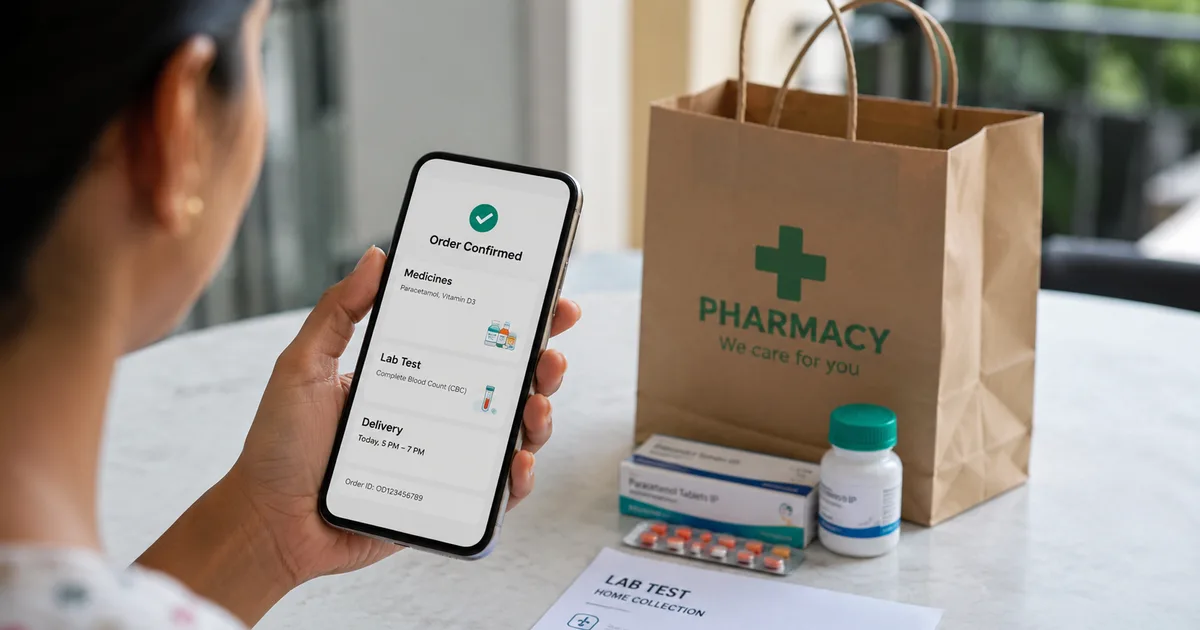
Open a compatible app and go to the health or medicines section. Search for the medicine by name, or scan the barcode if you have the packaging. The app shows listings from ONDC-registered pharmacies near your pin code, with seller name, price, and estimated delivery time side by side.
For OTC medicines, antacids, vitamins, pain relievers, most cough syrups, just add to cart and pay via UPI. Straightforward.
For prescription medicines, Schedule H drugs, antibiotics, most blood pressure and diabetes medicines, you must upload a photo of your valid prescription. The pharmacy reviews it before dispatch. This is legally required. ONDC-registered pharmacies are supposed to enforce prescription checks, and the flow does include this step, though some apps are stricter in practice than others (annoying, I know). Upload a valid prescription regardless. It's a legal requirement and a basic safety measure.
Delivery speeds depend on distance. A local pharmacy a kilometre away might deliver in under 2 hours. Uncommon medicines from further away usually arrive next day. And because you're seeing multiple sellers, prices tend to be more competitive than on single-platform apps, especially for generic equivalents of branded medicines where the active compound is identical.
Booking lab tests through ONDC
Honestly, this might be the most practically useful part of the whole pharma vertical. The diagnostics market in India has a real access and pricing problem. Dr Lal Pathlabs, Thyrocare, Metropolis, SRL Diagnostics, these chains have good apps but steep walk-in prices. Their online booking rates are better, but you're still on one platform with no way to compare across labs.
A basic lipid profile at a Thyrocare franchise typically costs Rs 299-399 with online booking. An ONDC-registered independent lab in your area might list the same test for Rs 180-220. For someone monitoring cholesterol or thyroid monthly, that difference adds up to Rs 1,000-2,000 across a year.
On ONDC, search for a test type on a compatible app: "lipid profile", "thyroid TSH", "complete blood count". Results show both chain labs and independent registered labs nearby. Home sample collection is available for most standard blood tests. You pick a time slot, a phlebotomist arrives at your home, and the report comes back digitally.
Report delivery is not fully standardised yet. Some labs push reports to DigiLocker, which then links to your ABHA health record automatically. Others send a PDF on WhatsApp or email. A few still call you to ask how you want it. The booking and payment flow works well. The last-mile report delivery is where you'll see the most variance across labs, and I'm not sure exactly why some labs still haven't sorted this out.
ABHA integration and your health record
ABHA (Ayushman Bharat Health Account) is the government's digital health ID, designed to keep prescriptions, lab reports, and consultation notes in one place. Some ONDC pharmacy and diagnostics transactions are now starting to link to ABHA automatically, depending on which buyer app you use and which lab processes your test.
If you've set up an ABHA ID, check whether your buyer app supports ABHA linking at checkout. Paytm has begun supporting this for some health transactions. It's not mandatory today, but linking is worth doing if you manage a chronic condition, see multiple doctors, or want any hospital to be able to pull your full history with a single consent tap.
Setting up ABHA takes about five minutes using your Aadhaar number. Our ABHA ID setup guide walks you through the process. And if you want to understand how your health data is handled under India's data protection laws, our privacy explainers cover the relevant rules in plain language.
The gaps worth knowing about
Cold chain medicines, insulin, certain injectables, some biologics, are not reliably available through ONDC yet. Temperature-controlled logistics is genuinely complex, and not all ONDC-registered pharmacies have that infrastructure. For insulin and similar medicines, stay with a pharmacy you trust for cold chain handling, whether on ONDC or off it.
Controlled substances and psychotropic medicines require stricter verification. The regulatory requirements are real, and not every buyer app has built the full compliance flow. Don't expect to order Schedule X medicines through ONDC smoothly right now.
Returns for medicines are tricky everywhere, and ONDC is no exception. Opened packs generally can't go back. If you receive a wrong medicine or damaged packaging, file a complaint through the app's grievance section. The ONDC redressal mechanism works, but it can be slower than dealing with a big chain pharmacy's customer care directly.
Coverage outside metro cities is still uneven. Mumbai, Delhi, Bengaluru, Hyderabad, and Pune have reasonable pharmacy and lab coverage on the network. Tier 2 cities are improving. Smaller towns, not yet. This will change as more local pharmacies join, because for them, ONDC registration costs significantly less than listing fees on closed platforms. So the incentive is real.
Why this matters beyond just convenience
The person this helps most is not someone in a metro with five delivery apps already installed. Think about a parent or grandparent who learned UPI and uses Paytm for bill payments and money transfers. On those same familiar apps, they can now order medicines and book blood tests without downloading anything new, without learning a new interface, without setting up yet another account.
Or the independent pharmacist in a tier 2 city who couldn't afford listing fees on PharmEasy. Or the local diagnostic lab doing good work at honest prices but with no way to reach online customers before ONDC.
The open network model does genuinely shift some power toward smaller sellers and toward price transparency. That matters in healthcare more than in most categories. If you ask me, that's the part worth paying attention to. For updates on which apps have added pharma support, our tech news section covers ONDC developments regularly. And if you're comparing apps for health ordering in your city, the app comparison section is a good place to start.