OpenAI GPT-5.6 Sol launch details
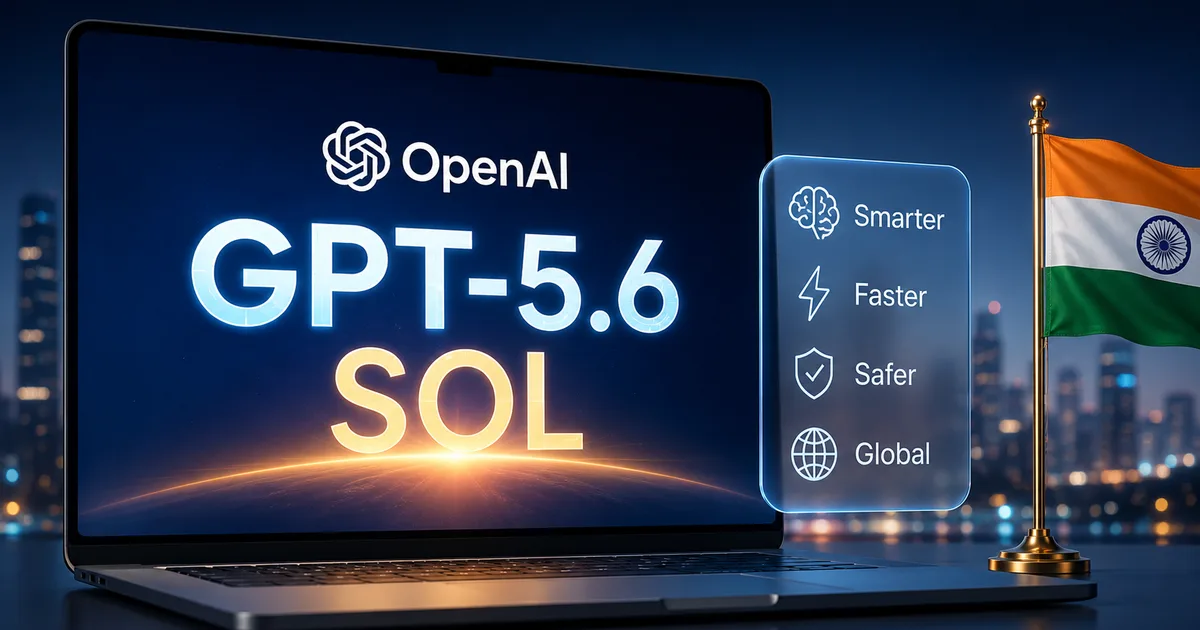
OpenAI has finally announced the limited release of its new model, GPT-5.6 Sol, along with a couple of other variants. But don't open your ChatGPT app just yet. You can't use it. The US government blocked the wide release, citing safety risks. They've only allowed OpenAI to share these new models with a small group of trusted partners. Meanwhile, the company has made a big move in India by hiring former Uber India head Prabhjeet Singh as Managing Director. This suggests they're getting ready for something substantial in our market, even if the tech is currently locked behind US government doors.
Honestly, the timing here is pretty interesting. It's coming right when the US government cleared Anthropic's Mythos 5 to return. If you ask me, there's clearly some backroom politics at play. Reports from NDTV Profit and India Today say OpenAI had to hold back due to US national security concerns (which makes sense, actually). So we in India are just stuck watching from the sidelines. It's a mess.
But, in my experience, the biggest news for us in India isn't the model itself. It's the new boss. OpenAI hired the guy who used to run Uber India, which is a massive signal. They don't just need tech people. They've got to have someone who knows how to deal with local regulations and government offices. You might remember him managing driver strikes and navigating sketchy state-level transport rules in Delhi and Mumbai. He knows the ground reality here. So this hire shows they're trying to actually set up shop in India.
Features of the GPT-5.6 Sol model
Look, GPT-5.6 isn't just a single model. It's a family. OpenAI announced three different variants: Sol, Terra, and Luna. I think they each target different tasks, even if they share the same tech underneath.
- Sol is the version everyone is talking about. It features much stronger security controls and cyber protections compared to older models.
- Terra is designed for handling large-scale data and complex reasoning tasks.
- Luna is built for speed and lightweight applications, possibly for mobile devices or fast APIs. Some early reports from Bing News actually called it Tuna, but Luna seems to be the official name used in most announcements.
But again, you can't actually use any of them yet. They're in a restricted preview right now. If you ask me, it's just a closed beta where only a few research partners and government offices get to play with the new toys.
Why is the wide release of GPT-5.6 blocked by the US government?
Look, the US government is getting incredibly paranoid about advanced AI. And honestly, they've got good reason to be. Reports from NDTV Profit say that the US blocked the public release because of sketchy cyber risks (which is pretty wild, if you ask me). They're worried. Specifically, they think a model this powerful could easily write malicious code or hack critical infrastructure.
The US government is treating advanced AI models as critical national security assets, requiring rigorous safety audits before public release.
So, the government stepped in. They're treating these models almost like weapons-grade software. This limited preview is just a way to test safety features before anyone else gets to touch it. It's a huge change from the early days of ChatGPT when OpenAI just dumped models online for everyone. Now, every big release has to go through government checks. Meanwhile, Anthropic's model was cleared to return after similar checks. This shows that dealing with regulators is just the standard path now for big AI companies.
When is the GPT-5.6 release date India?
This is the question everyone's asking. But I don't have a simple date for you. In my experience, the exact timeline is impossible to pin down because it depends on when the US government decides to lift its rules.
But we can still make some guesses. Once that US preview wraps up, OpenAI will probably roll it out to paid users in the US first. India access will follow a few weeks or maybe months later. If you're paying for ChatGPT Plus in India (which costs around 1,999 rupees a month after taxes), you'll get access once the global rollout starts.
But there's another hurdle: local regulations. India has its own Digital Personal Data Protection (DPDP Act), and the government here wants AI companies to respect local data sovereignty. This is where the new India boss comes in. He has to make sure OpenAI's systems comply with our laws before they launch anything here.
So, if you're hoping to use the model next week, don't hold your breath. It will take months. Honestly, we might not see a public beta in India until late this year.
What is the expected GPT-5.6 India price?
Here's the deal: OpenAI hasn't shared official prices for API access yet. But we can look at current rates. That should give us a pretty good idea of what's coming.
Right now, ChatGPT Plus is 20 dollars a month globally. In India, that translates to around 1,650 rupees before you add taxes. Once you add conversion fees and local taxes, you're looking at close to 2,000 rupees. It's not cheap. For a student or a small business owner, that's a massive monthly expense.
But what about API pricing? If you're a developer building apps, you'll pay by token. We expect the new model to cost a bit more than GPT-4o initially, mostly because of the extra compute needed for the new safety features. But competition will probably push those prices down. With Anthropic returning to the game, OpenAI can't afford to price themselves out.
Honestly, I hope they introduce local pricing for India. Companies like Spotify and Apple have lower rates here because they know US pricing doesn't work for the average Indian consumer. If OpenAI wants real adoption in India, they'll need to offer rupee billing through UPI. Forcing everyone to use international credit cards is just a mess.
How GPT-5.6 could impact Indian developers and startups
Right now, Indian startups are building on top of older OpenAI models. They use them for customer support and translation. So, if you ask me, a new model is a big deal.
But these restrictions mean Indian devs are stuck in limbo. US startups might get early access through partnerships, but our developers just have to wait. That's going to put our local companies at a huge disadvantage.
But there's a silver lining. The focus on cyber protections in this Sol model is exactly what Indian businesses need. Think about it. We've seen a massive rise in cyber fraud and payment scams in India. If an AI model can help secure code or spot fraud patterns in real-time, it could protect millions of users who rely on UPI for their daily transactions.
Imagine an AI assistant built into DigiLocker or Aadhaar services that can verify documents without risking leaks. That's the kind of project where safety features are actually valuable. If you want to understand how these limits affect global software development, check our AI policy explainers for more context on international tech restrictions. But until we get access, Indian devs have to stick to open-source tools or older models.
The focus on cybersecurity in the Sol model
OpenAI claims Sol has stronger safeguards than any of their older models. But what does that actually mean for us?
Basically, they've trained the model to catch and refuse requests about building exploits or finding bugs in critical software. It has a built-in safety filter that works as a firewall.
For example, if you ask it to write a script to bypass a website's login, it won't just say no. It's going to flag the attempt. That's key because hackers are constantly trying to use AI to speed up their attacks.
Organizations like CERT-In (India's national cyber security agency) regularly warn us about sketchy phishing and malware. If a model like Sol can help developers write secure code, it might stop these bugs before they go public. But this also makes the model more restrictive. Sometimes, legitimate security researchers need to test their own systems. If the AI is too sensitive, it becomes useless for ethical hackers. Finding that balance is tough. And honestly, OpenAI hasn't always got it right. We'll have to wait and see if Sol is actually useful or just overly cautious. We also track local security updates on our Indian tech news page, where we cover local policy changes and rules.
What OpenAI's India MD appointment means for policy
Having a local office and an MD like Prabhjeet Singh is a massive step. Until now, OpenAI operated in India mostly from a distance. If there was a regulatory issue, their US team'd handle it.
But India's becoming too big to ignore. The government here has been very clear that tech giants need local reps who can be held accountable. If a model generates bad content or violates the DPDP Act, they want a real office and a local face to deal with the mess.
Singh's job won't be easy. He'll have to negotiate with the Ministry of Electronics and Information Technology (MeitY) and handle policy talks about AI rules. Actually, the government is already working on draft rules for AI. And they want to make sure local data stays inside the country.
So, expect to see OpenAI engaging more with Indian policymakers. They might even set up local servers to comply with data residency rules. If you ask me, that'd be a huge win for Indian enterprise clients who are currently hesitant to send sensitive customer data to US servers. In the meantime, be careful with any links claiming to offer early access to GPT-5.6, as we've noted in our scam warning database.