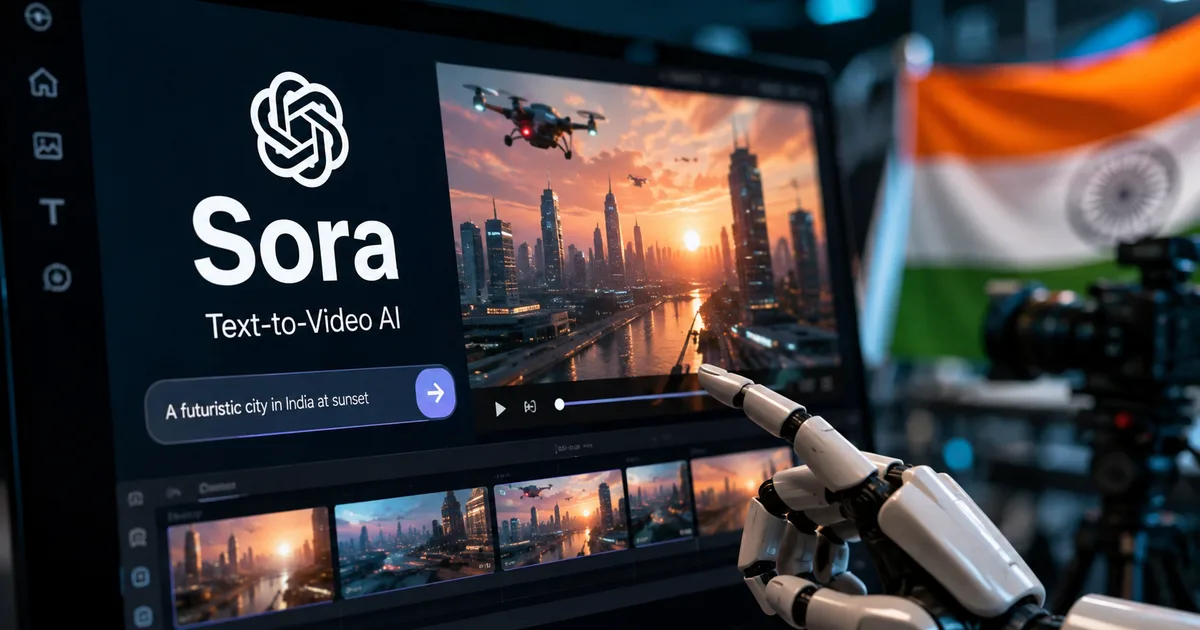
I get emails every single day from video editors in Mumbai and freelance digital marketers in Bengaluru asking about the OpenAI Sora Text-to-Video AI 2026 India Availability. Everyone saw those hyper-realistic demo videos of a woman walking down a neon-lit Tokyo street. Everyone watched the wooly mammoths walking through the snow. Everyone wanted to know how much the subscription plans would cost and when they could finally log in.
But the reality of what happened to this tool is much darker than anyone expected.
The original Sora is dead.
OpenAI quietly shut down the viral video platform less than a year after its grand launch. You read that right. The tool that was supposed to replace entire film crews and revolutionize Bollywood visual effects is gone. I spent weeks trying to get access for my own agency work, only to watch the entire project collapse in real time on Twitter.
Honestly, if you're looking for AI tools that actually work in India right now, you need to know the full story behind this mess. You also need to know what to use instead so you don't fall behind your competitors.
The truth about the 8 crore daily loss
You can't run a heavy AI video generator for free. We all knew that. Generating high-definition, 60-frames-per-second video needs massive GPU clusters working continuously. But the actual numbers are staggering to read. Look, Outlook Respawn reported that the Sora app was losing $1 million a day.
Yes, a million dollars every single day.
That translates to roughly 8.4 crore rupees flying out the window every 24 hours. No business can sustain that kind of burn rate forever, not even one backed by billions of dollars from Microsoft. When Indian creators started asking about subscription plans, many of us guessed it would cost around ₹2,000 to ₹4,000 per month. We figured it would be priced similarly to a standard ChatGPT Plus account. But based on those operating losses, OpenAI would have needed to charge thousands of dollars a month just to break even on server costs alone. They realized the math simply didn't work for a consumer-facing product.
And they lost a massive corporate partnership that could have saved them financially. The Times of India reported that the shutdown ended a $1 billion deal that Disney had signed just four months prior (insane, I know). When a company loses a billion-dollar deal from the biggest entertainment conglomerate on earth, you know things have gone entirely wrong behind the scenes. Disney apparently saw the operating costs and walked away completely. The numbers here are a bit fuzzy, but the financial hit is obvious.
Deepfakes and the Indian regulatory problem
Money was only half the problem. The other half is security and compliance, which is a massive headache in 2026. Al Jazeera confirmed that OpenAI pulled the app as concerns grew about deepfake videos.
Think about the Indian context for a second. We've seen massive issues with fake political videos during local elections. We see manipulated celebrity clips endorsing fake investment schemes every day. Financial frauds spread like wildfire on WhatsApp groups. A tool as powerful as Sora in the wrong hands is a complete disaster waiting to happen. It's really sketchy.
Basically, the Indian government has been tightening rules around AI-generated content. Current IT rules mandate clear labeling and digital watermarking for deepfakes. If OpenAI launched Sora widely in India without perfect safety guardrails, they would have faced immediate legal trouble from the Ministry of Electronics and Information Technology. The risk of getting banned or heavily fined in a market of 1.4 billion people is simply too high.
I think the executives in California panicked. They built something too powerful for their own safety teams to manage. And they realized they couldn't control it. Check our scam alerts section to see just how bad the deepfake fraud situation is locally. We write about new AI voice and video scams almost every single week.
The confusing launch of Sora 2
Just when everyone thought the Sora dream was completely over, OpenAI confused the entire tech industry by launching Sora 2. But this isn't the professional filmmaking tool we were promised earlier this year.
According to Livemint, OpenAI launched the Sora 2 model alongside a new Instagram-like app specifically for creating and sharing AI videos. The Economic Times called it a direct rival to TikTok and YouTube Shorts.
This completely changes what the tool actually is. Instead of a desktop application for filmmakers and advertising agencies, it is a mobile toy for social media influencers. They shifted the target audience overnight. If you wanted to use Sora to render long corporate explainers or detailed stock footage for your freelance clients, you're entirely out of luck.
And even this new mobile version is a mess. The Indian Express noted that OpenAI imposed strict new daily limits for Sora and Nano Banana AI tools due to a massive demand surge. Users report being cut off after generating just five seconds of video. You simply can't build a reliable freelance video editing business when your main software locks you out before your lunch break.
What about the API and subscriptions in India?
Software developers in Bengaluru and Pune have been waiting for API access for months. They wanted to integrate video generation into their own Indian apps and educational platforms.
I have very bad news on that front. Recent reports indicate the product is completely closed. The API is officially deprecated.
You can't buy a subscription right now. You can't plug your UPI details or your HDFC credit card into an OpenAI billing page and start generating clips. The entire commercial rollout is completely halted. If you ask me, this is incredibly frustrating for Indian small businesses. Many startups planned their entire 2026 content marketing strategies around this specific technology. Some founders even stopped hiring freelance video editors because they thought they could just automate the work. Now they're stuck without a working product and scrambling to catch up with their competitors.
What happens to your data and privacy?
Before you jump into any of these video platforms, we need to talk about data privacy. This is a massive issue for Indian businesses right now.
Thing is, when you upload your face or your company's proprietary product images to generate a video, where does that data go? With OpenAI, the rules are incredibly murky. They train their models on user inputs unless you explicitly opt out through hidden settings menus. This means if you uploaded a mockup of an unreleased product to Sora, there is a real chance that data could be absorbed into their training set (annoying, I know).
For Indian agencies working under strict Non-Disclosure Agreements (NDAs) with large corporate clients, this is a nightmare scenario. You can't risk leaking client data to an American AI server. If you use free tiers of these tools, assume your data is being harvested.
If you plan to use AI video for serious commercial work, you must pay for enterprise subscription plans. Those plans usually have strict data privacy guarantees. They cost significantly more rupees, but they protect you from lawsuits. Never use free consumer apps to process sensitive client information.
Google swoops in with Veo
Tech companies never miss a chance to kick a rival when they're down. Immediately following the Sora shutdown news, Google took a massive public shot at OpenAI.
India Today reported that Google announced that "video is here to stay" and promptly dropped the prices for their own Veo video generation model. This is highly aggressive marketing. Google knows OpenAI dropped the ball. And they're actively trying to get all those frustrated video creators who have budgets ready to spend right now.
For Indian users, Google Veo might actually be the much better option. Google has a much stronger payment infrastructure in India. They accept standard Indian debit cards and UPI for their cloud services. They also understand local data privacy regulations better than most foreign tech companies, having operated here for over two decades.
Best alternatives for Indian creators in 2026
So what should you actually do right now? Stop waiting for an OpenAI fix.
I talk to dozens of successful video editors across the country. The smart ones aren't sitting around complaining about server limits on Reddit. They're moving on. If you need text-to-video capabilities today for your YouTube channel or your freelance clients, you have to look at the alternatives that actually accept Indian payments and deliver reliable results.
These are the three main reasons you can't access Sora in India today:
- The server costs reached 8.4 crore rupees daily.
- The deepfake regulations in India created massive legal risks.
- The Disney partnership collapsed, removing their primary funding source.
Since you can't use Sora, these are the tools you can actually use right now:
| AI Video Tool | Estimated Monthly Cost (INR) | Pros | Cons |
|---|---|---|---|
| Google Veo | ₹1,600 | Excellent prompt understanding, accepts UPI easily, high resolution outputs | Waitlists still exist for certain advanced features |
| Runway Gen-3 Alpha | ₹1,250 - ₹3,000 | Available right now, great motion brush controls, highly stable servers | Requires an international credit card for smooth monthly billing |
| Kling AI | ₹800 - ₹1,500 | Very affordable for students, generates long clips, highly realistic | Chinese platform, sometimes has server lag during peak Indian hours |
| Pika Labs | Free Tier / ₹850 | Good free tier for beginners, great for anime and 3D styles | Struggles heavily with photorealistic human faces and hands |
If you decide to try any of these, check out our expert guides for tips on writing better video prompts for these specific platforms. The prompting style differs wildly between them.
The reality of AI video generation
Don't build your entire business model on a single piece of software that loses a million dollars a day. It will disappear on you without warning. And it will take your workflow down with it.
The hype cycle around artificial intelligence is vicious right now. Companies promise the moon. They release a viral trailer that looks like a Hollywood movie. And then they quietly scale back when the reality of computing costs hits them in the face. Sora is simply the biggest and most public example of this trend so far.
I'm not sure exactly when, but I expect we'll see a completely stable, affordable video generator eventually. But it will almost certainly come from a company with massive, established cloud infrastructure like Google or Microsoft. It probably won't come from a standalone AI research lab burning through venture capital just to keep the servers cool.
"The AI video market in 2026 is defined by empty promises. Indian creators need tools they can actually buy and rely on, not viral tech demos that shut down after six months."
Until OpenAI figures out their business model and their server costs, Sora is a fascinating failure. Save your rupees for software that actually exists. Keep focusing on your actual editing skills. The machines aren't taking over the film industry today.