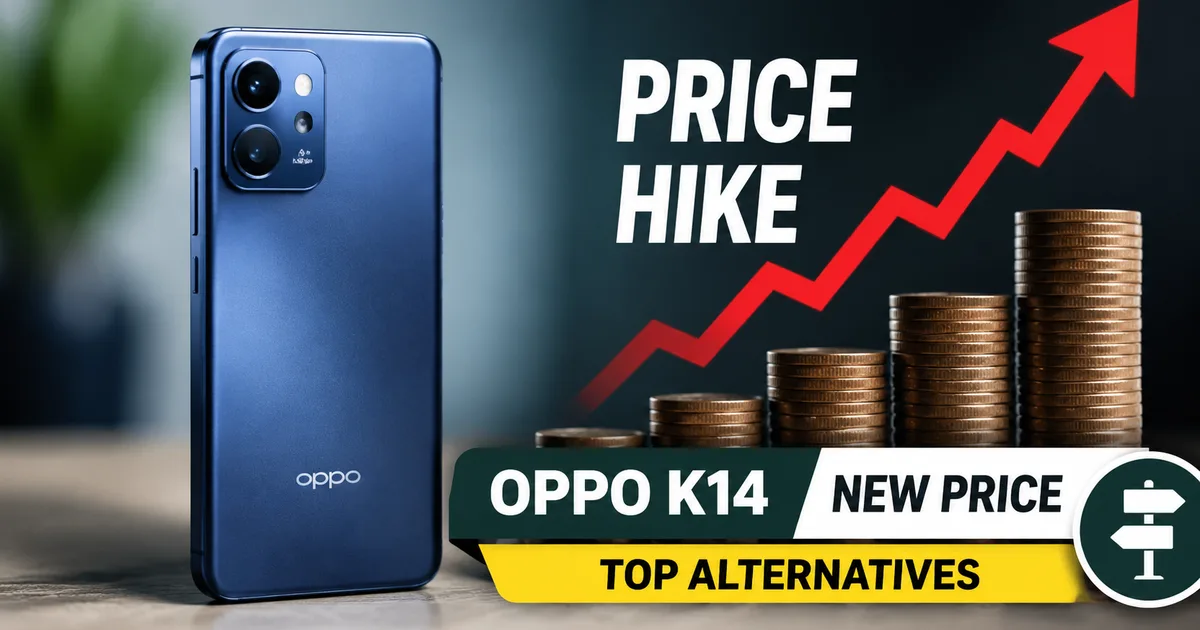
I woke up this morning to some genuinely frustrating news for anyone looking to buy a new mid-range smartphone. The **Oppo K14 price hike in India** is now officially in effect, and honestly, it's a tough pill to swallow. We're talking about a sudden increase of up to **INR 4,000** on devices that were already facing stiff competition. This affects the standard K14 and the K14x. The budget-focused A6s is hit, too.
You save up for months. You decide on a budget. You finally pick a phone. And then, without any warning, the brand quietly changes the price tag on Flipkart. It's an incredibly annoying experience for the average buyer who relies on careful financial planning (which makes sense, actually). Buying a phone in India is rarely an impulse decision. It usually involves comparing specs for weeks. You watch review videos. You wait for the right moment.
I looked into the updated pricing. The changes are a mess. The hike started reflecting across retail channels on **July 20, 2026**. If you walk into a local store today, you're paying noticeably more than what these phones cost just last week. This isn't a minor adjustment of a few hundred rupees. A massive 4,000-rupee jump completely alters the value proposition of these devices.
Understanding the new Oppo pricing strategy
The numbers themselves tell a clear story. The exact markup depends on which RAM and storage variant you want to buy. The base models saw a hike of around INR 1,000. But if you want higher storage, you're paying INR 4,000 extra. This aggressive pricing strategy feels particularly punishing for power users. They need the extra space for photos and large apps.
Why did they do this? I couldn't find a clear official answer on this from Oppo. The numbers here are a bit fuzzy. But looking at the broader smartphone market right now, component costs are rising. The rupee's fluctuation against the dollar plays a part in electronics pricing. And sometimes, brands just realize a specific model is selling well enough that they can squeeze a bit more margin out of it.
But passing that cost directly to the consumer in the middle of a product lifecycle is a sketchy move. Especially in India, where a difference of a thousand rupees can make or break a buying decision, in my experience. People rely on UPI apps like PhonePe and Google Pay for everyday transactions. A smooth smartphone experience is a basic necessity. It isn't a luxury. Paying more for the exact same hardware feels wrong.
The smartphone market in India is incredibly price-sensitive. A sudden hike of this magnitude pushes these devices into entirely different price brackets, forcing buyers to reconsider their options completely. It disrupts the delicate balance of price-to-performance that consumers expect.
I've seen this happen before. Brands launch a phone at a highly aggressive price. It gets great reviews. People recommend it to their friends. And then, quietly, the price creeps up. It's a frustrating bait-and-switch tactic. You can read more about these broader consumer electronics market trends in our latest news section.
What this means for your daily budget
Let's break this down practically. If you had a strict budget of INR 20,000, the K14 might have been on your shortlist. Now, with the new rates, you might have to stretch that budget. Or you settle for a lower storage variant. Neither option is great for long-term usage.
- The standard K14 is now pushing into the mid-premium territory where expectations are much higher.
- The K14x, which was a solid value proposition for gamers and heavy users, is now directly competing with much more powerful devices.
- Even the A6s, designed for budget-conscious buyers, is getting slightly out of reach for students and first-time buyers who need a reliable device for online classes.
- Replacement parts and out-of-warranty repairs might also see a corresponding increase in cost.
If you're planning to finance this, the equated monthly installments will be higher. The down payment will be higher. Every little bit adds up. This is especially true when everyday household expenses are already stretching thin for many middle-class families in India. An extra 4,000 rupees could be half a month's grocery bill for some (annoying, I know).
Are these Oppo K14 alternatives worth buying?
This is where I have to be brutally honest. I liked the K14 when it launched. It had a good 120Hz display and respectable battery life. But value is relative. A phone that is a great deal at INR 18,000 might be a terrible buy at INR 22,000. The competition at the higher price point is much stronger.
At these new prices, the competition is brutal. You're suddenly looking at phones with better processors and cleaner software experiences. The K14 series is good. But it isn't "pay an extra 4,000 rupees" good. It doesn't offer anything revolutionary that justifies the sudden premium.
If you ask me, if you absolutely love Oppo's ColorOS and their specific approach to portrait photography, you might still justify the cost. They do have a very specific tuning for skin tones that many Indian users prefer. But for the average consumer who just wants the best possible hardware for their hard-earned money, I find it very hard to recommend these specific models at their new rates.
We often discuss how to navigate these tricky buying decisions in our buying guides.
Right now, my main advice is to pause and look around. You have options. You should use them.
The best smartphone alternatives you can buy today
Since the prices have gone up, I spent some time looking at what else you can get in this new price bracket. Honestly, the alternatives are compelling. They often provide a better overall experience.
There is the latest offering from **Nothing**. Their phone brings a highly unique transparent design and an incredibly clean Android experience. It doesn't have the bloatware or persistent ads you often find on other devices in this segment. If you value smooth performance and software that doesn't constantly bombard you with notifications, it's a very strong contender.
Then you have Motorola. They've been quietly releasing some of the most well-balanced smartphones in India over the past year. You get a near-stock Android experience and excellent OLED displays. They often provide better value for money in the sub-25,000 category compared to the newly priced Oppo models. Their Edge series, in particular, offers fantastic curved displays at aggressive prices.
Even Samsung has some aggressive options in their M and A series right now. They offer the reliability of a massive brand and a robust service network across India. Their Knox security is also a big plus for users worried about banking apps. And if you're buying during a Flipkart or Amazon sale, you can usually stack some decent bank offers to bring the price down further.
How to save money if you still want the K14
Look, I get it. Sometimes you just want a specific phone because you're used to the brand. If you're dead set on getting the K14, you shouldn't pay full price. There are ways to soften the blow and get closer to the original launch price.
- Wait for the next major e-commerce sale. Amazon Prime Day and Flipkart's big sales always have something around the corner. Prices often drop significantly during these events.
- Check offline retail stores. Sometimes local shops have older stock they are willing to sell at the pre-hike prices to clear inventory before the new stock arrives.
- Look for credit and debit card discounts. HDFC, SBI, and ICICI frequently run instant discount offers that can effectively cancel out the recent price hike.
- Consider exchanging your old phone on Cashify or directly on Flipkart. The trade-in values can be surprisingly good, especially if your current device is in decent condition with no screen damage.
Don't just blindly hit the "buy now" button. You have to be smart about your money. Make sure you check out our detailed explainers on how to maximize your savings during online sales. Avoid sketchy third-party sellers.
The broader impact on the Indian market
This price hike isn't just about a few phones from one brand. It signals a shift in the market. Brands are feeling the squeeze from supply chain issues and currency fluctuations. They're passing it on to us. We've seen similar silent price increases across the industry over the last few years. It's a worrying pattern.
Thing is, it makes it harder for tech reviewers to give accurate recommendations. A review written a month ago praising a phone's value proposition is now completely outdated. It makes it harder for consumers to plan what they buy. They know the price could jump overnight.
I worry that this trend will continue. The days of incredibly aggressive pricing in the Indian smartphone market might be slowly fading. I'm not sure exactly why it's happening so fast. We're moving towards a landscape where you have to pay a premium for features that used to be standard in the mid-range segment. Even basic 5G connectivity is an excuse to bump up prices.
This specifically impacts rural and semi-urban buyers. When a phone's price increases by a few thousand rupees, it often means delaying it entirely. It affects access to digital services and online banking. A smartphone isn't just a gadget in India. It's an essential tool for everyday life. You need a reliable device to scan that QR code at the local tea stall. You need it to check your Aadhaar details on DigiLocker. You need it to book a train ticket on the IRCTC app. When the barrier to entry goes up, it affects everything from small business transactions to personal communication.
Final thoughts on the situation
So, where does this leave us? The Oppo K14, K14x, and A6s are still decent phones. But they aren't the great deals they were at launch. The price hike has changed their position in the market. It made them much harder to recommend.
My recommendation is simple. If you need a phone right now, look at the alternatives. Motorola and Samsung are offering better overall packages in this specific price range today. If you must have the Oppo, you need to hunt for bank discounts and offline deals to avoid paying the inflated price.
Don't let a brand dictate your budget. Be an informed buyer. Read reviews and compare prices across different platforms. Understand exactly what you're paying for. The Indian smartphone market is huge. You always have choices.
I think you just have to be willing to look for them. Don't settle for a bad deal.
I'll keep a close eye on this space. We'll see if other brands follow suit with their own mid-range offerings.