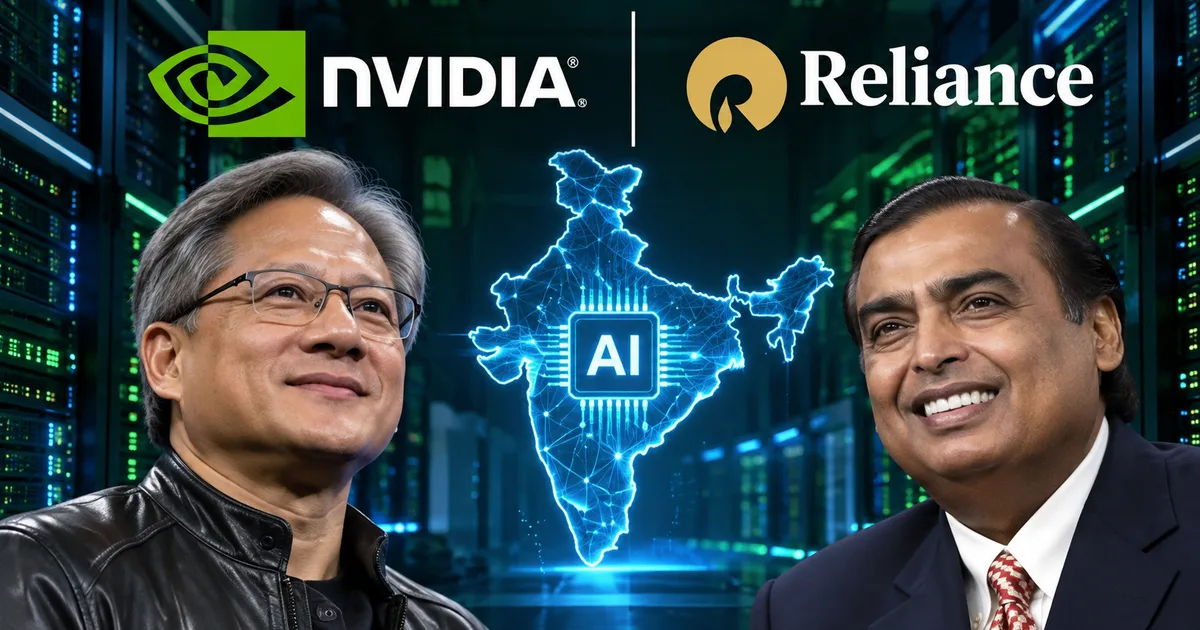
When Jensen Huang walked onto the stage in Mumbai and shook hands with Mukesh Ambani, tech teams across Bengaluru and Hyderabad sat up and watched. The headline dominating the conversation is the massive NVIDIA and Reliance AI infrastructure deal, a multi-stage plan to build gigawatt-scale computing capacity right here in India. Ambani pitched data and population as India's biggest natural assets, arguing that our country needs to produce its own intelligence rather than exporting data and buying back finished software from Silicon Valley. It sounds impressive on an auditorium screen. But you probably want to know what a giant server farm in Jamnagar actually means for your monthly phone bills and local startups.
Most big tech announcements in India end up as software partnerships or reseller arrangements (which makes sense, actually, given past history).
This one isn't that. It's focused directly on heavy physical hardware and raw electrical power. If you ask me, that shift from cloud talk to heavy machinery is the real story here.
What the 1GW data center in Gujarat actually involves
To put this in plain numbers, one gigawatt equals 1,000 megawatts. That's a lot of juice. It's enough electricity to run hundreds of thousands of urban homes, or roughly the entire output of a thermal power station. AI clusters eat power constantly. That's why American and European cloud companies keep running out of grid capacity. So Reliance is putting this infrastructure in Jamnagar, Gujarat, right next to its giant oil refining and renewable energy complex.
None of this happens overnight. Akash Ambani shared an initial target of 120 megawatts by the end of this year, which is just the first step before scaling up toward the full 1-gigawatt capacity. NVIDIA supplies the computing architecture, like its Blackwell hardware. Reliance handles the physical data halls and the liquid cooling setups. If you follow our tech explainer guides, you know air conditioners won't work here. You need specialized liquid heat exchangers to cool thousands of power-hungry chips in Gujarat's summer heat.
Thing is, NVIDIA doesn't hand out discounts to anyone. High-end AI accelerators cost between $30,000 and $40,000 each in global trade, which works out to around ₹25 lakh to ₹35 lakh per chip at current rates. Getting chips from Jensen Huang is the real achievement. Western cloud giants wait months for deliveries. If you ask me, securing priority allocation from NVIDIA is the hardest part of the puzzle (which makes sense, given the global shortage).
Why Jamnagar and the green power puzzle matter
Plugging high-density server racks into ordinary state electricity grids in India would be a total mess. State distribution companies already battle peak summer demand. Adding an energy-hungry cluster to that mix would trigger blackouts or spike local tariffs. Reliance plans to power the Jamnagar site mostly with captive green energy, tapping into its own solar and green hydrogen projects nearby.
That energy setup fixes two big problems. First, it doesn't overload Gujarat's public grid. Second, it keeps the cost per kilowatt-hour steady for the next twenty years. We saw this same logic when looking at the Jamnagar AI data center project, where cheap land and direct private power gave the location an edge over packed metros like Navi Mumbai or Chennai.
Electricity is up to 60 percent of a data center's lifetime operating costs (the numbers here are a bit fuzzy depending on local tariffs, but it's always the biggest bill). When power eats that much cash, owning the generators changes everything.
"India should manufacture its own AI. You have the data, you have the talent, and you have the scale. It makes complete sense to build the intelligence here." - Jensen Huang, NVIDIA CEO
Huang has repeated that exact point during his visits to New Delhi and Mumbai. He gets it. India has hundreds of thousands of developers building software for foreign clients, yet almost none of them can get their hands on high-end compute at home. In my experience, watching talented teams get throttled by hardware shortages is painfully common.
How sovereign AI in India affects local developers
If you build software in India today, you probably pay Amazon Web Services or Microsoft Azure in US dollars. Your company card gets charged in foreign currency. Then you pay bank forex fees (brutal on margins, honestly). On top of that, your data sits in server racks across Virginia or Singapore. It's a costly setup that drags down local engineering teams.
Building sovereign AI is really about fixing those balance sheets and cutting latency down to milliseconds. When compute runs locally, Indian companies pay in rupees without stressing over dollar swings. And there's legal pressure too. Strict data residency rules under the Digital Personal Data Protection Act mean banks and healthcare providers can't just ship user files overseas to train foreign models. They need domestic clusters that pass Indian privacy audits and CERT-In rules.
Indian startups run into compute rationing all the time. I spoke with a founder in Pune last month who was trying to fine-tune a speech recognition model for Marathi regional dialects. His team was spending nearly ₹4 lakh a month on rented cloud instances in the US. Half the time, their jobs got killed because bigger corporate spenders reserved the cluster. That's brutal. In my experience, that kind of resource squeeze kills promising Indian projects before they even launch. Having massive capacity in Gujarat gives Indian builders a real chance to book compute locally at domestic rates.
The domestic ecosystem benefits in several specific ways:
- Indian colleges and research labs can secure compute grants without burning their annual budgets on foreign exchange fees.
- Regional startups can train custom models for logistics, agriculture, and micro-lending without routing sensitive user financial records through overseas nodes.
- Enterprise software vendors can offer guaranteed data localization to public sector clients and nationalized banks.
- Engineers gain hands-on operational practice building massive distributed training pipelines on NVIDIA hardware without leaving Indian soil.
What ordinary internet users will actually notice
You won't log into a portal and click a button labeled Jamnagar GPU. That's not how this works. Instead, the changes will show up quietly inside apps you open every single day.
Take Jio's software suite. Reliance already announced JioBrain, which is an internal platform meant to plug smart tools across its telecom network and retail apps. Right now, automated customer service on most Indian apps is irritating. You type a question in Hinglish, and the bot gives you a generic link to a recharge plan you never asked for (annoying, I know). That happens because running large language models in real time for 450 million subscribers costs a fortune on foreign cloud servers.
When compute costs drop, telecom operators can roll out responsive voice assistants that actually understand regional dialects. Imagine talking to your phone in Bhojpuri or Telugu to check a government subsidy status or book a train ticket, without waiting five seconds for an overseas server to answer you. Basically, you need low-latency domestic hardware to make that feel instant.
Look at daily UPI payments. The NPCI handles billions of transactions every month. Fraud detection models have to review transactions in milliseconds before clearing a transfer. Running machine learning verification directly inside Indian data centers helps banks spot sketchy transactions without stalling your morning tea stall payment.
Government programs have just as much to gain. Digital platforms like DigiLocker and PM-Kisan verification portals process millions of documents daily. If you ask me, local compute is what will finally let public agencies automate document checks in regional languages while keeping citizen records safely inside our own borders.
The real bottlenecks Reliance has to fix
Big announcements always create buzz. But building hardware at this scale comes with messy operational headaches that could easily derail timelines.
First, hardware supply is tight everywhere. Even with Jensen Huang standing next to Mukesh Ambani on stage, NVIDIA has massive delivery commitments to Microsoft and Meta. We explored this dynamic when covering India's AI chip import policy, where customs clearance paperwork and export paperwork can add weeks to delivery schedules. I'm not sure exactly how quickly customs officers will clear this volume of hardware, but Reliance still has to prove it can import and rack these systems as fast as it claims.
Second, power infrastructure takes serious time to build. Getting 120 megawatts online is a manageable short-term goal for an industrial titan like Reliance. Scaling to 1,000 megawatts is a whole different beast. You need massive substations and dedicated water lines for cooling loops. Liquid cooling at gigawatt density is brutal engineering (and terrifying if you manage facilities). If a cooling loop leaks or heat exchangers get clogged with mineral deposits, millions of dollars in silicon can fry in seconds.
Third, hardware without skilled engineering is just an expensive room heater. India has plenty of developers who know how to query APIs from OpenAI or Anthropic. But we have a severe shortage of distributed systems engineers who know how to run multi-node training across tens of thousands of interconnected GPUs. In my experience, finding talent that understands GPU clustering at this scale is wildly difficult. If Reliance wants local teams to build real models on this compute, it has to fund deep training programs and release open SDKs.
Here are the concrete milestones to watch over the next 18 months:
- The completion and commissioning of the first 120-megawatt data hall in Jamnagar before year end.
- The official pricing sheet for JioBrain and cloud compute rentals for third-party Indian startups.
- Announcements of partnerships with Indian university labs to grant subsidized GPU hours to student researchers.
- Actual enterprise deployments of localized voice and text models across Jio's consumer platforms.
Will this trigger another Jio price war in compute?
Back in 2016, Reliance entered the telecom market by giving away free 4G data, totally wrecking the pricing model used by Airtel and Vodafone. People were coughing up ₹250 for a single gigabyte of 3G data back then. Jio crushed data costs down to practically zero. And it forced the whole country online.
Mukesh Ambani wants to run that exact same play on computing power. He has already said AI compute in India has to be the cheapest in the world. If Reliance prices its GPU cloud at a massive discount compared to Western cloud platforms, then Amazon and Microsoft will have to slash their Indian data center rates too. That's a massive win for young founders. Right now, college kids look at cloud cost calculators and walk away before writing a single line of training code.
Whether Reliance can actually pull off a 1-gigawatt buildout on schedule is still up in the air. Pouring concrete is messy (far messier than shipping code, anyway). It's way slower than pushing an app update. Still, NVIDIA committing its flagship chips to Gujarat proves that global tech firms take Indian compute seriously. I think the next two years will show if local developers can turn this silicon into tools that matter. You can keep an eye on our latest Indian tech news feed as construction updates and compute pricing details become public.