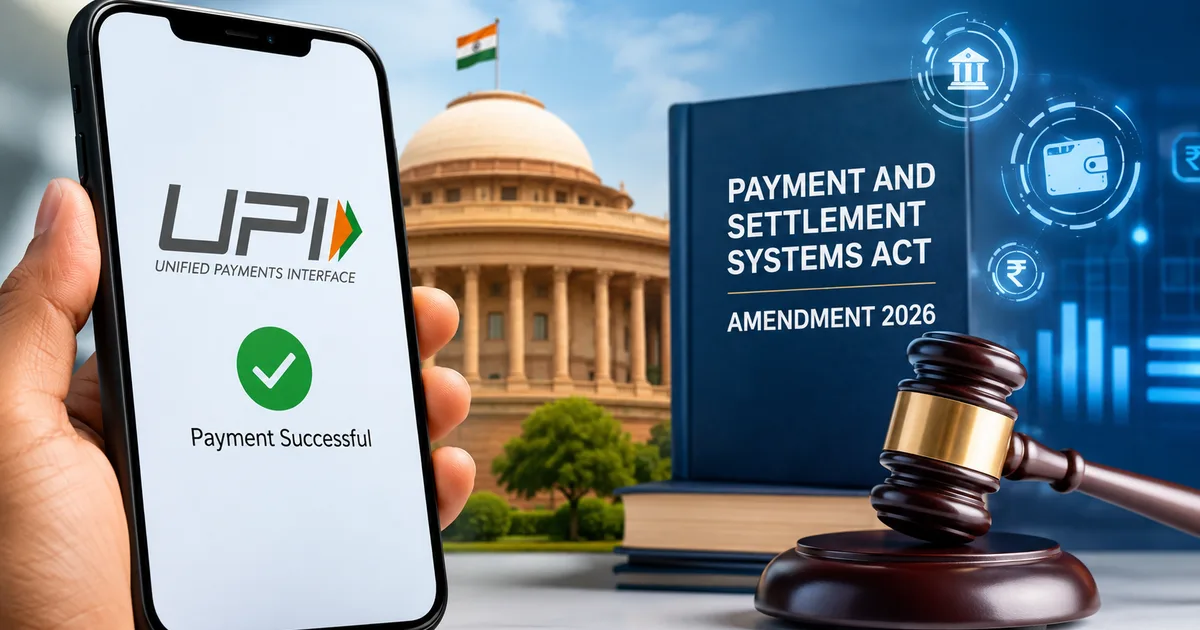
You scan a QR code for a cutting chai, enter your PIN, and walk away. That smooth, zero-fee transaction is basically the heartbeat of modern India. But things are about to change. The Lok Sabha just cleared the Payment and Settlement Systems Act Amendment 2026. Honestly, this is one of the biggest shifts in how digital money works in our country.
I know legal amendments sound boring. Stick with me though. This specific change directly affects that scanner at your local kirana store and the apps on your phone. It alters the economics of the digital payment revolution that defined India over the last decade.
What the Taxation and Other Laws Amendment Bill actually does
Here's the deal. On a noisy Thursday, amid protest from the Opposition, the government passed the Taxation and Other Laws (Amendment) Bill. They did it without much debate. This bill does a few things about income tax and foreign investment. But the part we care about is how it changes the Payment and Settlement Systems Act of 2007.
Basically, it removes a specific legal block. For the last few years, Section 10A of the Payment and Settlement Systems Act strictly prevented banks and payment service providers from charging any fees on UPI transactions. They couldn't impose what the industry calls a Merchant Discount Rate, or MDR. (Which makes sense, actually, given the adoption goals).
That block is now gone. The central government now has the power to decide which digital payments are free of merchant charges and which ones aren't. In plain English, the government can now allow banks to charge fees for processing UPI payments. The law no longer forces them to provide the service for free.
This is a massive legislative change. It overturns a policy that has been in place since 2019, when the government decided that merchants shouldn't incur costs for accepting digital payments through UPI or RuPay cards. By removing this restriction, the government is signaling that the digital payment ecosystem has matured enough that it might need to start paying for itself. I think this was inevitable.
Why was UPI completely free until now?
To understand why this is a big deal, you have to look at how we got here. When the National Payments Corporation of India (NPCI) launched UPI, the government wanted absolutely everyone to adopt digital payments. They wanted to move away from cash-heavy transactions for better transparency and pure convenience.
To make that happen, they mandated a zero MDR policy for UPI and RuPay debit cards. This meant neither you nor the shopkeeper paid a single paisa in processing fees. If you sent ₹100, exactly ₹100 left your bank account. And exactly ₹100 arrived in the merchant's account. The government even offered small subsidies to banks to compensate them, but banks always argued it wasn't nearly enough.
It worked flawlessly. India now does billions of UPI transactions a month. We take it for granted that we can pay a vegetable vendor ₹20 without a second thought. You don't worry about hidden charges when splitting a dinner bill with friends. From small roadside stalls to massive shopping malls, the QR code became ubiquitous because accepting a payment cost the merchant nothing.
But the banks and tech companies actually running the servers were bleeding money. Processing a payment costs real money. Server space and security infrastructure require massive investments. For years, banks have complained that they bear the cost of this public infrastructure while companies like Google Pay and PhonePe acquire millions of users without contributing to the underlying bank costs.
There was also immense pressure from international players. Visa and Mastercard have long argued that a zero-fee mandate creates an uneven playing field. If local networks like RuPay and UPI are forced to be free by law, foreign networks that rely on merchant fees simply can't compete in the same space. The US government had even raised this issue in trade discussions. They pushed for fair market conditions for American payment giants operating in India.
How the Merchant Discount Rate MDR affects you
This is the question everyone is asking. Will you have to pay a fee every time you scan a QR code? The short answer is probably not directly. The long answer is a bit more complicated. It depends entirely on how merchants react to the new rules.
The fee being discussed is the Merchant Discount Rate. When you swipe a credit card at a large retail store, the store pays a small percentage of the sale to the bank processing the transaction. Usually, this is around 1% to 2%. You, the customer, don't see that fee on your receipt. The merchant absorbs it as a cost of doing business. They often bake it into the retail price of the goods.
So, if banks start charging MDR on UPI, the merchant pays it. Your local chaiwala or the big electronics store would pay a fraction of a percent to their bank for accepting your UPI payment. Honestly, that adds up fast for them.
The problem is that merchants are smart, and margins for small businesses in India are incredibly thin. If a small shopkeeper has to pay a 1% fee on every UPI payment, they might just ask you to pay in cash. Or they might increase the price of their goods to cover the cost. Imagine buying a ₹10,000 phone and the shop owner asking for an extra ₹100 if you want to pay via UPI. We already see this happen with credit cards at smaller electronic stores. It's a mess.
I honestly think a tiered system is the only way this works without destroying the adoption we've seen in tier-2 and tier-3 cities across India. Maybe transactions under ₹500 stay free. Or maybe small informal merchants are exempt, while large registered supermarkets have to pay. The government knows that killing the UPI habit would be a political disaster. They'll tread very carefully here.
We might see a situation where peer-to-peer transfers between friends remain completely free, while merchant transactions incur a small cost. Even then, the definition of a merchant matters. Is your local tailor a merchant? Yes. Should they pay the same fee as a massive online retailer? Probably not. The numbers here are a bit fuzzy.
The real impact on Indian Fintechs
This amendment is a massive deal for the fintech industry in India. Think about PhonePe, Google Pay, Amazon Pay, and Paytm. They process billions of transactions daily. But they make basically zero direct revenue from those core person-to-person or person-to-merchant payments.
They've had to build entire business models around cross-selling. They offer you insurance, mutual funds, personal loans, and credit cards just to survive. If the government allows MDR on UPI, these companies finally have a path to direct profitability from their core service. (Which is wild to think about).
It also changes the dynamics between banks and payment apps. Right now, banks bear a huge load of the technical failures and server costs. When a transaction fails, it's usually the bank's servers failing under the load. A fee structure could allow for revenue sharing. The bank gets a cut and the payment app gets a cut to maintain the core system.
"Public infrastructure attracts capital if users are ready to pay fair and transparent usage charges. In the case of NPCI's UPI too, the user-pays principle should apply."
I read that opinion in LiveMint recently and it makes total sense. You can't run a critical national system on zero revenue forever. At some point, the infrastructure needs funding to upgrade security and handle the sheer volume of daily trades.
Fintechs have been lobbying for this change for years. A small, reasonable fee will allow them to invest more heavily in dispute resolution systems. Right now, if your UPI payment gets stuck, getting a refund can take days. With actual revenue tied to the transaction, companies would have a financial incentive to build better customer support. In my experience, support is currently terrible.
We're already seeing small changes in the app ecosystem. Some apps charge a platform fee for paying utility bills or mobile recharges. But charging for a direct peer-to-merchant transfer is a totally different game. It could finally make Indian payment apps highly profitable businesses instead of cash-burning customer acquisition tools.
What to expect from banks in the coming months
The bill has passed the Lok Sabha. Now we wait for the exact rules from the Finance Ministry and the Reserve Bank of India. The amendment gives them the authority to allow charges. It doesn't automatically apply a flat fee to everything.
We might see a slow rollout. The RBI could approach this in a few different ways:
- They could introduce fees only for credit-card-on-UPI transactions first.
- They might apply a flat fee for large value business transfers above ₹50,000.
- They could create special merchant tiers where small street vendors remain exempt while large supermarkets pay standard rates.
- They might allow apps to charge a direct convenience fee to the customer for certain premium services.
Look, I recommend keeping an eye on announcements from your specific bank. HDFC, SBI, ICICI, and Axis Bank will likely be the first to announce any changes to their merchant terms. They'll probably introduce new merchant categories. A street vendor might get a zero-fee QR code, while a registered private limited company gets a standard MDR QR code.
Until the RBI releases the final guidelines and the exact merchant categories, your daily payments will continue exactly as they are. Don't let shopkeepers try to charge you a fee right now based on this news. The law allows for fees to be introduced. But they haven't been implemented yet.
One thing is certain. The days of a completely free digital payments ecosystem are ending. The government is moving UPI from a subsidized public good into a self-sustaining financial product. It's a sign that the system has grown up.
For more details on how financial rules are changing, you can check out our explainers section or read up on recent policy news to see how this affects your small business. If you're worried about online frauds taking advantage of this news, make sure to read our latest scam alerts to stay safe.