You're standing at a tapri in Pune. The chai is Rs 15. You scan the QR code. You wait for the internet to connect on your phone. You carefully type your six-digit PIN. You wait for the bank servers to talk to each other. Sometimes the connection times out. And when it finally goes through, that tiny Rs 15 payment clogs up your bank statement forever.
This is exactly why the Paytm UPI Lite Auto Top-Up 2026 feature matters. It fixes the most annoying part of digital payments in India.
Look, we all rely on UPI now. It changed how we buy things completely. According to the National Payments Corporation of India (NPCI), Indians made over 23.2 billion UPI transactions in May 2026 alone. The total transaction value was Rs 29.9 lakh crore. That's a massive amount of money moving through phones. But this success created a new headache for anyone trying to track their budget or file income tax returns. Your bank passbook is an unreadable mess of tiny transactions.
I tried downloading my bank statement last week. It was fifty pages long. Nearly all of it was Rs 20 payments for auto rickshaws and Rs 50 payments for vegetables. Plus those Rs 15 payments for tea. Finding my salary credit in that data was difficult. Honestly, it was a nightmare.
UPI Lite was introduced to solve this exact issue. It creates a small on-device wallet on your phone for these small payments. You load money into it once. Then you spend from it without ever entering a PIN. The transactions are processed locally. They stay completely off your main bank statement. Your main account only shows the single bulk transfer you made to load the wallet.
But there was a major catch. You had to manually reload this wallet every time the balance ran dry. If you forgot to top it up, you were back to standing at the auto stand. You'd open your app and type your PIN for a Rs 40 fare. (Annoying, I know).
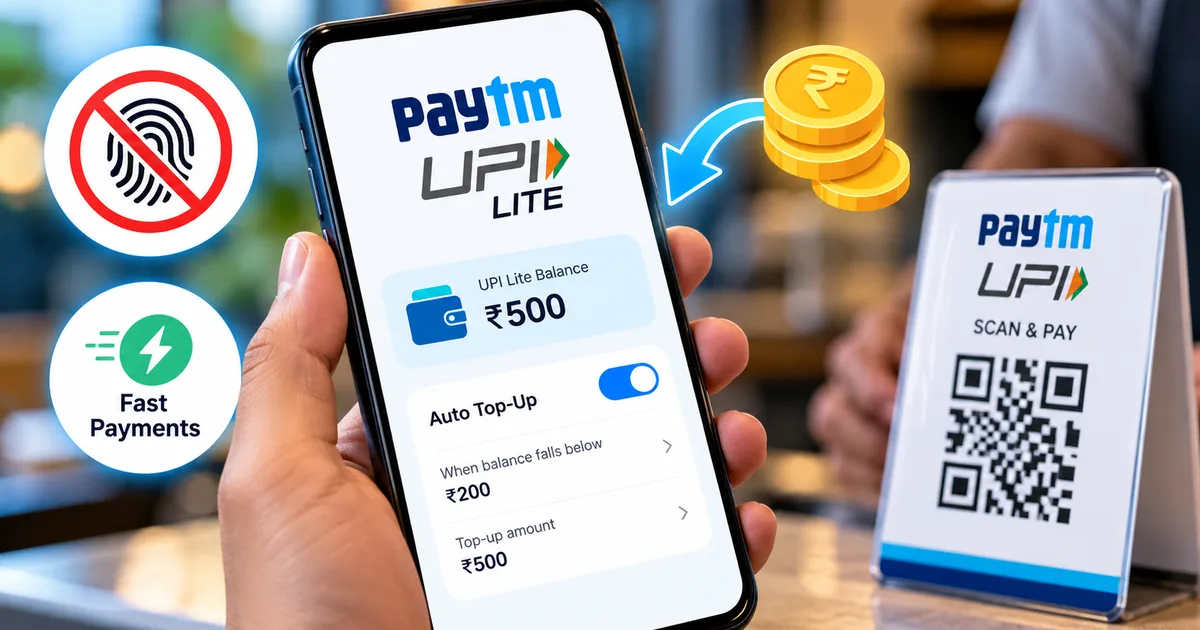
So Paytm finally solved the second half of the equation. They rolled out an automatic top-up feature for their UPI Lite users. This means your on-device wallet now refills itself directly from your linked bank account the moment your balance gets too low. You authorize this connection just once. After that, you tap and pay for daily expenses.
How the Paytm UPI LITE auto top-up feature works
The mechanics of how this system works are straightforward. The One97 Communications Limited owned app announced this update specifically to handle high-frequency small-value transactions. I'm not sure exactly why it took them this long, but it's here now.
When your UPI Lite balance drops below a specific minimum limit that you decide, the app automatically triggers a request to pull money from your main bank account. You don't have to open the app. You don't have to type your PIN to add funds. It happens silently in the background.
There are strict rules in place to stop this system from draining your bank account. You can only make individual payments up to Rs 500 per transaction using this PIN-less method. Also, the total amount you can spend in a single day is capped at Rs 2000. So even if you lose your unlocked phone and someone tries to buy things, the maximum damage they can cause is Rs 2000. (Which, for the record, I think is actually a good thing).
Currently, this automatic top-up capability is live for users who've linked their Yes Bank and Axis Bank accounts. A Paytm spokesperson confirmed they plan to expand this to all users and partner banks soon. So if your primary account is with SBI or HDFC, you might have to wait a few more weeks. Users with ICICI will be waiting too.
Guide to enable PIN-less offline payments on Paytm
Setting this system up takes only a minute. I tested the activation process on a friend's phone yesterday since my own bank isn't supported yet. Here is exactly what you need to do.
- Open your Paytm app and make sure it's updated to the newest version on the Google Play Store or Apple App Store. Old versions won't have the menu options you need.
- Look for the 'UPI Lite' option on the home screen. It's usually right under the main blue scanner button. Tap on it.
- If you haven't used UPI Lite before today, you'll first need to link your bank account to create the wallet. Remember, right now only Yes Bank and Axis Bank support the auto-reload function.
- Once your wallet is active, look for the settings gear icon or the 'Manage' button. Inside that menu, you'll see a toggle switch for 'Auto Top-up'. Turn that switch on.
- The app will ask you to configure two amounts. First, you set the threshold amount. If your balance falls below this number, the refill triggers. Second, you set the top-up amount. This dictates how much money the app pulls from your bank during a refill.
- Finally, you'll be prompted to enter your standard UPI PIN one last time to authorize the mandate.
From this point forward, your wallet manages its own balance. The process is very similar to how you can set up delegated payments for family members. You handle the setup once. Then the software manages the daily stuff.
The real benefit of offline payments
This is genuinely useful for normal people, not just tech enthusiasts. The most obvious benefit is sheer speed.
Typing a PIN takes about five seconds. Waiting for the bank server to respond takes another five to ten seconds. That time adds up fast when there are fifteen annoyed people waiting behind you at a busy Mumbai local train ticket counter. By skipping the PIN and bypassing the slow banking system, your payment goes through almost instantly. The transaction is verified locally on your device.
But there's a secondary benefit. Network reliability. We all know how mobile data behaves inside a crowded vegetable market or deep inside an underground metro station. The bars just disappear. Because UPI Lite transactions happen via the on-device wallet, they don't need a perfect internet connection to your bank's servers. If you want completely internet-free payments, you should read our explainer on offline payments via NFC.
Then we come back to the bank statement issue. This is the biggest relief for working professionals, in my experience.
"The introduction of automatic top-up in Paytm UPI Lite makes everyday payments faster and more seamless, covering everything from daily chai and food to auto, metro, and bus rides. It helps keep the main bank statement clutter-free, ensuring small, frequent transactions don't overwhelm it," a Paytm spokesperson stated recently.
They also built a feature to download a separate UPI statement directly within the app. So if you actually need to track how much cash you spent on auto rickshaws this month, you can check that specific app data. Your HDFC or SBI bank statement stays clean.
Where Paytm stands in the digital payment market
The broader business context here explains why this feature launched now. Paytm had a rough start to 2024. The Reserve Bank of India (RBI) blocked the company from registering any new UPI users. They also stopped all deposits into their standard wallets and FASTags because of compliance issues. It was a massive blow to their business model.
During those chaotic months, competitors captured a lot of ground. Recent data shows that PhonePe currently has a 46.2% market share in India. Google Pay is in second place holding a 32.7% share. The numbers here are a bit fuzzy, but the trend is clear.
But the market is shifting again. The National Payments Corporation of India (NPCI) recently let One97 Communications resume onboarding new UPI users. This auto top-up feature feels like their first big push to win back users. Many people migrated to PhonePe or Google Pay during the RBI restrictions, after all.
Honestly, they need aggressive features like this one. The Indian payment market is crowded. If a company wants you to open their app instead of a competitor's app, they have to offer something that actually removes friction from your daily life. Check our latest tech news section for more updates on how the payment market is changing this year.
Keeping your money safe with digital wallets
I hear a lot of older users express worry about PIN-less transactions. My own uncle flat out refuses to use any financial app that doesn't demand a password for every single action. I get it. The idea of money leaving your phone without permission feels sketchy.
But the actual risk is contained by the system design. The Rs 2000 daily limit ensures that a thief can't empty your life savings. Even if they steal your phone while it's unlocked. And since the money is drawn from your main account in small chunks, your primary balance is safe from large attacks.
If you happen to travel internationally, Paytm also recently started allowing UPI payments in select foreign destinations like the UAE, Singapore, France, Mauritius, Bhutan, and Nepal. You can pay for a coffee in Dubai exactly how you pay for it in a cafe in Mumbai. Indian payment systems are expanding globally fast.
Just be careful about the usual digital scams. Never click on random WhatsApp links claiming your wallet is blocked. The official government portal cybercrime.gov.in and the national 1930 helpline are your best resources if something goes wrong. Fraudsters often send fake SMS messages asking you to complete KYC to unblock your UPI Lite account. Remember that no bank will ever ask you to download a third-party app to verify your identity. (Which makes sense, actually).
Basically, the auto top-up feature is a genuinely smart addition. It takes a system that was mostly convenient and removes the final annoyance. You just tap your phone. You hear that familiar soundbox confirmation. Then you walk away.