Picture this: you're at a crowded metro station in Bengaluru, rushing to top up your card. The internet cuts out. Your phone shows one bar. The QR scanner at the counter works fine, but your PhonePe app just keeps spinning. We've all been there. This is exactly the problem that UPI Lite X is built to fix, and honestly, it's one of the more useful additions NPCI has made to the UPI stack in years.
So what is UPI Lite X, and how does it work when there's no internet at all?
The basic idea: payments without a network
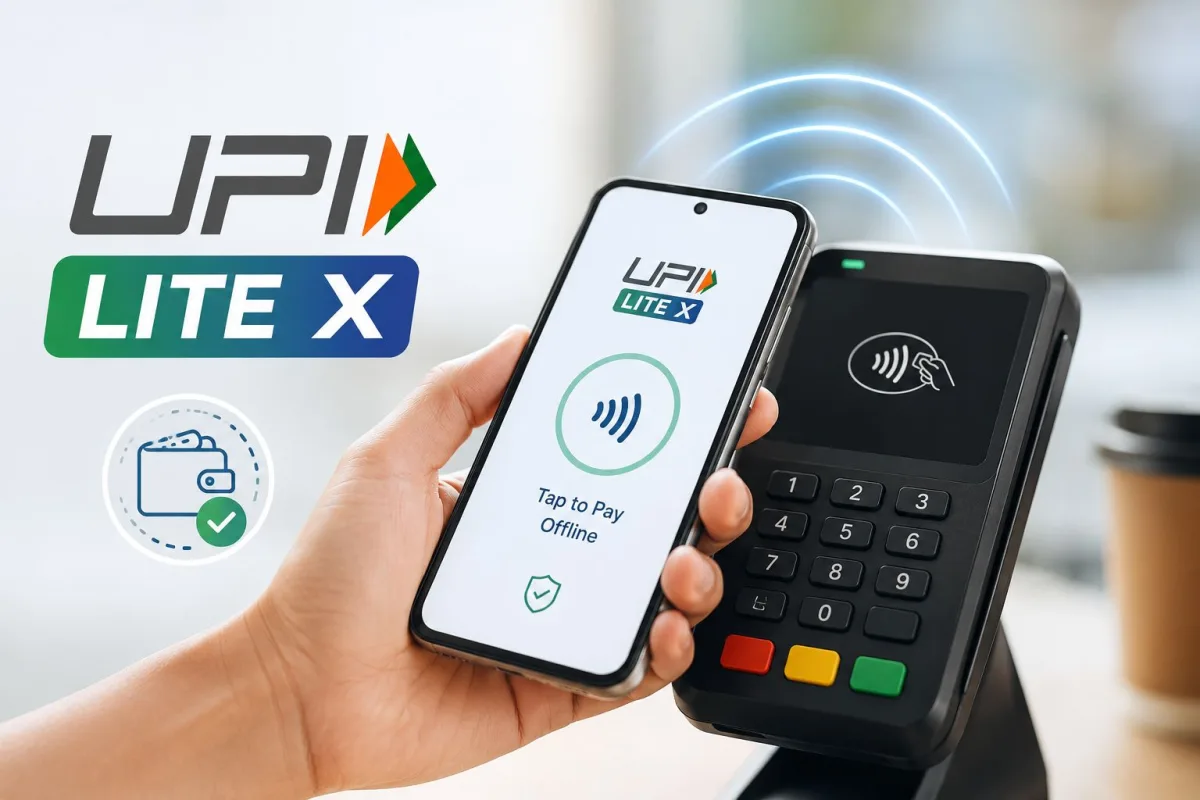
UPI Lite X is an offline payment feature launched by the National Payments Corporation of India (NPCI). It lets you send money from your phone to another device without needing an active internet connection on either end. The technology behind it is NFC, short for Near Field Communication.
NFC is the same tech that lets you tap your debit card on a POS machine at a supermarket or convenience store. Your phone has it too, assuming it's a mid-range or better device from the last 3-4 years. Bring two NFC-enabled devices within about 4 centimetres of each other, and they can exchange small amounts of data directly. UPI Lite X uses this to move payment information between phones, no internet required.
NPCI pushed this feature specifically to cover India's connectivity gaps. Think tens of thousands of villages and semi-urban areas where 4G is unreliable, highways with dead zones, metro stations with underground sections, crowded markets where a hundred people hitting the same cell tower slows everything to a crawl. With 500 million+ UPI users now, the offline piece matters more than it ever did.
How UPI Lite X differs from regular UPI and UPI Lite
There are now four main UPI modes, and they genuinely confuse people. Worth sorting out clearly.
Regular UPI is what you use daily on PhonePe, Google Pay, Paytm, BHIM. Every transaction needs internet, hits a bank server, and settles in real time. Limit is up to Rs 1 lakh per transaction for most banks.
UPI Lite, launched in 2022, is an on-device wallet for small purchases up to Rs 500. You load up to Rs 2000 into it. It's faster than regular UPI because it skips some server checks, but it still needs internet to initiate. Think of it like keeping a small amount of cash in a separate pocket so you don't have to unlock your full account for every small buy.
UPI Lite X is the truly offline version. No internet at all. Device-to-device via NFC. Same Rs 500 per transaction limit, Rs 2000 maximum wallet balance. Settlement happens later, when your phone reconnects online and syncs with the bank.
UPI 123PAY is something else entirely, designed for feature phones without internet. It runs on IVR calls, missed calls, or sound-based OTPs. Limit there is Rs 5000 per transaction. Different use case, different users entirely.
What happens during an offline NFC payment
Here's the actual flow, step by step.
First, you preload a balance from your bank account into the UPI Lite X wallet on your phone. This sits locally on the device, encrypted and secured. Then when you want to pay offline:
- Open your UPI app and go to the UPI Lite X or offline payment option.
- Enter the amount you want to pay.
- Bring your phone close to the receiver's phone, within 2-4 cm.
- The NFC chip transmits the payment data to their device.
- Both phones confirm. Done.
No OTP. No server check. No bank ping. The receiver's phone stores the transaction data locally, and when they reconnect to the internet, the balance updates in their account. This is called deferred settlement, and it's how offline digital payment systems work globally.
(I know "deferred settlement" sounds slightly dodgy. It's not. Each transaction generates a unique encrypted token that's cryptographically signed by your bank. You can't reuse it, duplicate it, or forge it.)
Which phones and apps actually support UPI Lite X
Your phone needs an NFC chip. That's the hard requirement. To check: go to Settings and search for "NFC." If it's there, you're set. If not, UPI Lite X won't work on that device, full stop.
Most Android phones above Rs 10,000-12,000 from Samsung, OnePlus, Xiaomi, and Realme have had NFC for a few years now. Budget phones under Rs 8,000 often don't. iPhones have NFC hardware too, but iOS UPI app support is patchier (annoying, I know). Worth checking your app's current version notes if you're on an iPhone.
On the app side, BHIM was among the first to add UPI Lite X support. PhonePe and Google Pay have been rolling it out through 2025-2026. The full list of certified apps is on the NPCI website and has been expanding steadily. Check your app's update notes to confirm whether your version supports it yet.
Transaction limits and what Rs 500 actually covers
Rs 500 per transaction, Rs 2000 total wallet balance. Those numbers are set by NPCI and they reflect the intended use case.
Is Rs 500 enough? For a sabzi vendor in a no-network area, yes. For an autorickshaw ride, yes. For chai and a samosa at a highway dhaba, obviously. For paying rent or sending money to family, no, and that's intentional. The limits exist because without real-time internet checks, fraud detection is limited. Keeping the exposure small is the tradeoff for having offline capability at all. Honestly, I think that's a reasonable call given where India's network infrastructure still stands.
UPI Lite X, UPI Lite, and UPI 123PAY together form NPCI's strategy for pushing digital payments into areas with poor connectivity, including the many semi-urban and rural locations across India where 4G coverage is still inconsistent.
For context, UPI crossed 18 billion transactions in December 2024 alone, per NPCI data. The offline segment is the last major gap in that story.
Is UPI Lite X safe to use?
The technical answer is yes, with some nuance.
The NFC range is about 4 cm. Intercepting an NFC signal from even 10 cm away is practically impossible with consumer hardware. The payment tokens are bank-generated, encrypted, and single-use. Replay attacks don't work because every token is tied to a specific transaction and expires immediately after use.
The real risk is physical theft. If someone grabs your unlocked phone with Rs 2000 loaded in the wallet, they can drain it before you block the device. The fix is straightforward: use your phone's screen lock, enable your UPI app's PIN, and don't preload the full Rs 2000 unless you actually need it for that trip or day.
If something does go wrong, the standard UPI grievance process applies. Raise a complaint through your UPI app. For a detailed walkthrough on staying safe with UPI, our UPI safety guide covers the key steps.
NFC QR codes: the merchant side of offline payments
Alongside UPI Lite X, NPCI also introduced NFC-enabled QR codes for merchants. These are physical NFC tags placed at payment counters. Instead of scanning a QR code with your camera, you tap your phone on the tag. The merchant's payment details are embedded in it.
Sounds like a small change. In practice it's faster in poor lighting, works when phone cameras are dusty or slow, and suits high-volume counters like canteens, transit booths, and fast food counters. So if UPI Lite X handles person-to-person offline payments, NFC QR tags cover the consumer-to-merchant side.
NPCI also launched contactless voice payments around the same time, letting you start a UPI transaction using voice commands without touching the screen. That's a separate feature, useful for accessibility and for anyone whose hands are busy. We cover more of these in our UPI explainers section.
How to actually set it up
Turn NFC on in your phone's Settings if it isn't already. Update your UPI app to the latest version. Open the app and find the UPI Lite or UPI Lite X section, usually under a "more" or "settings" tab depending on the app. Activate it and load some balance, minimum Rs 100, maximum Rs 2000.
The first time you tap phones with someone, the app walks you through the process. The actual transaction takes about two seconds once everything's active. Faster than a normal QR scan when the network is cooperating, and obviously much faster when it isn't.
One thing worth being clear about: UPI Lite X has nothing to do with the RBI's Digital Rupee pilot or e-RUPI vouchers. Those are separate systems. UPI Lite X runs on the existing UPI infrastructure, linked to your regular bank account. No new apps, no separate registration, nothing beyond updating your current UPI app and turning NFC on.
For more on how India's digital payment stack fits together, the explainers section has breakdowns of UPI 123PAY, Account Aggregator, and more. And if you want to understand what fraud looks like on UPI and how to stay ahead of it, our UPI scam guide is a good place to start.