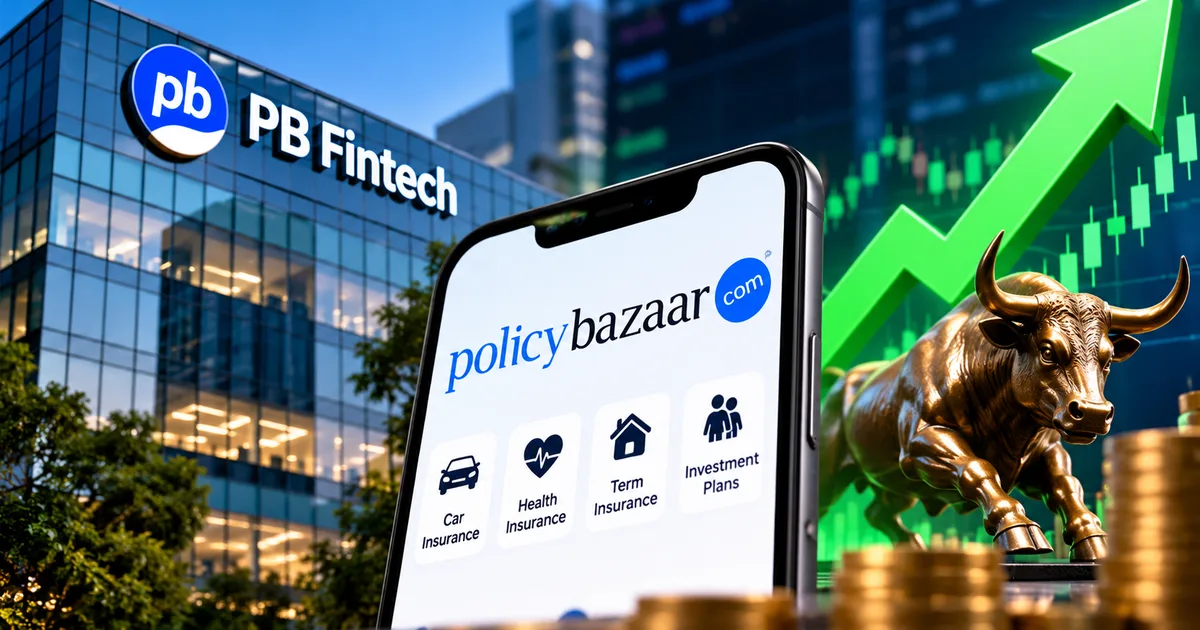
So, if you've been tracking the Indian stock market this week, you've probably noticed the massive PB Fintech share price surge in October 2026. Honestly, it's hard to miss. My phone has been buzzing non-stop with notifications from my Demat account app, and I know I'm not the only one.
The parent company of Policybazaar and Paisabazaar just dropped their Q2 results. And the numbers are pretty wild. We're talking about a 165% year-on-year jump in profits. They hit a very solid ₹135 crore. That's a serious chunk of change (which makes sense, actually, given the recent digital push). Especially when you consider how sketchy and volatile the tech startup space in India has been lately.
But the stock market is weird. Just last week, PB Fintech crashed nearly 36% after the Insurance Regulatory and Development Authority of India (IRDAI) proposed new distribution rules. People panicked. Lots of retail investors dumped their shares in a hurry. They thought the growth story was over. Then, bam. The Q2 results drop. Profits go up, and the stock rallies right back up, jumping around 4% almost immediately. I think investors just got spooked initially.
I've been getting lots of questions about this from people who read our Tech Explainers section. What exactly is going on with Policybazaar? Is this a dead cat bounce, or a real recovery you can trust? Let's look at exactly what happened, what the numbers actually mean, and why analysts are suddenly so interested in this stock again.
The Q2 2026 results: breaking down the numbers
Here's the deal. When a company like PB Fintech reports a 165% profit jump, you have to look under the hood. You can't just read the headline, log into Zerodha, and buy. You have to understand where that money is coming from.
PB Fintech's net profit shot up to ₹135 crore for the second quarter. This growth is mostly from their core insurance business. More Indians than ever are buying insurance online. And they use Policybazaar to compare quotes. It's really that simple. We are finally seeing that long-promised shift from offline agents to digital platforms.
Top-line revenue climbed too. Their business model is getting a commission for every policy sold through their platform. It's working.
Trading volumes for PB Fintech shares saw a massive spurt this week. We're talking about a serious spike in shares changing hands. This is heavy institutional buying. You just don't see that volume unless the big players are making a move. Mutual funds and foreign institutional investors are clearly interested.
In fact, PB Fintech is one of four F&O (Futures and Options) stocks with a sharp rise in futures open interest. I know it sounds complicated. It isn't. It just means traders are placing active bets on where the stock will go next (keeping contracts open instead of closing them). This derivative market activity often comes before major price movements in the underlying stock.
Why the sudden panic last week? The IRDAI effect
To understand the current surge, you have to look at the massive crash right before it. It is a classic market overreaction followed by a rapid correction.
The IRDAI recently proposed new rules about how insurance policies are distributed in India. The specifics get bogged down in legal jargon. But the short version is it made investors nervous about Policybazaar's future profit margins. If the rules change how brokers get paid by insurance companies, it hits PB Fintech's bottom line. In my experience, regulatory news always causes this kind of panic.
The reaction was brutal. The stock tanked 36% almost instantly. PB Fintech wasn't the only one affected. Turtlemint took a 20% hit. It was a mess for a few days. Lots of retail investors who bought at the peak were left holding the bag.
The RBI and IRDAI hold immense power. A single circular can wipe out thousands of crores in market capitalization overnight. It is a stark reminder of regulatory risks.
Then the Q2 results came out. The narrative completely flipped. The market saw that the underlying business is still printing money today. The panic selling stopped. Bargain hunters stepped in and drove the price back up.
What about Paisabazaar and new opportunities?
Policybazaar gets all the headlines. But we can't forget about Paisabazaar, the credit side of the business. Paisabazaar has been steadily building its own user base. They help Indians compare credit cards and check their CIBIL scores for free. This creates a massive funnel of users. Someone might come for a free credit check and end up buying health insurance.
The link between the two platforms is a big part of the bull case for the stock. If they can cross-sell a credit card user into a term life insurance policy, their customer acquisition cost drops dramatically. Lowering that cost is huge for profitability.
Also, PB Fintech management said they spotted new opportunities in the insurance space itself. They are actively looking at new product lines. They want to integrate more with insurance providers. Institutional investors want to see this kind of approach after a brutal market correction.
The broader tech stock context in India
We should also zoom out and look at the broader context of tech stocks in India right now. 2026 has been a wild ride. We've seen massive IPOs and sudden corrections. Companies that went public a few years ago are finally being judged on actual profits. Not just user growth.
PB Fintech is proving they can transition from a startup burning cash to a company that generates real profit. That's a very difficult transition. Many Indian tech unicorns have failed at it. I'm not sure exactly why so many struggle, but it happens. PB Fintech posting a ₹135 crore profit is a massive signal. Their business model works at scale.
This is why you see a strong reaction in the derivatives market. When a company proves the skeptics wrong with hard numbers, short sellers get squeezed. Long-term believers double down. That's what is playing out in the F&O data right now.
What the analysts are saying about PB Fintech
I always take analyst ratings with a pinch of salt. They get things wrong all the time. But right now, the consensus on PB Fintech is surprisingly positive.
Bernstein put out a note saying they expect PB Fintech's earnings to recover fully. They did flag some "near-term pain." That's analyst speak for saying the stock might be choppy for a bit. The long-term fundamental outlook is solid. They're basically telling clients to look past the regulatory noise and focus on cash flow.
Broader market sentiment is playing a role too. Bank of America (BofA) is constructive on the Indian market. They predict the Nifty 50 could hit 26,200 by December. They're suggesting investors switch to large-caps. PB Fintech isn't a traditional legacy large-cap like Reliance or TCS. But in the tech space, it is a heavyweight. When foreign money flows into Indian equities, these tech stocks catch a bid.
- Net profit skyrocketed an impressive 165% year-on-year to reach ₹135 crore.
- Shares rallied up to 4% immediately following the Q2 results, recovering some lost ground.
- Unusually high trading volumes strongly indicate renewed institutional interest in the stock.
- Futures open interest saw a sharp, sudden rise, signaling very active derivative trading.
Honestly, this entire situation reminds me a lot of the Suzlon Energy Stock Surge October 2026: Market Impact we saw recently. A company gets beaten down by negative news. Then it reports good fundamental numbers. The market scrambles to reprice the stock higher.
The long-term play for Indian retail investors
Look, the Indian market is evolving incredibly fast. We are seeing rapid maturation across the board. If you want to understand how global tech trends affect our local markets, check out our piece on the AMD Share Price Surge September 2026: Market Impact Explained.
For PB Fintech, the long-term thesis remains the same. India is a severely under-insured country. The penetration of health and life insurance is low compared to the US or Europe. As the Indian middle class grows, people get more comfortable buying financial products online. Companies like Policybazaar are perfectly positioned to capture that growth.
They have built a massive moat. Try thinking of another website you'd go to first for term life insurance. You probably can't (annoying for competitors, I know). That brand recall is incredibly valuable. It's expensive for a new competitor to replicate.
"The underlying growth in the Indian insurance sector remains robust, and digital aggregators are capturing an increasingly large share of the pie."
But you can't ignore the regulatory risks. The numbers here are a bit fuzzy long-term. The IRDAI is highly active right now. They will change the rules if they think it protects consumers. An investment in PB Fintech is a bet that management can adapt to these changes.
The bottom line on the surge
So, what should you do with this information? I'm not a financial advisor. You shouldn't buy a stock just because it had a good week.
If you're already holding PB Fintech, the Q2 results should give you some comfort. The business is strong. If you want to enter the stock now, you have to be okay with serious volatility. The stock just crashed 36% and then rallied 4% in a single week. That's not for the faint of heart.
Keep an eye on trading volumes over the next few weeks. If institutional buying continues, we might see the stock establish a higher base. If volume dries up, it could retest those lows.
Please don't blindly follow stock tips on random Telegram groups. Do your own research. Read the earnings reports yourself. Understand what you are actually buying. For more grounded insights, keep an eye on our Latest Tech News section.