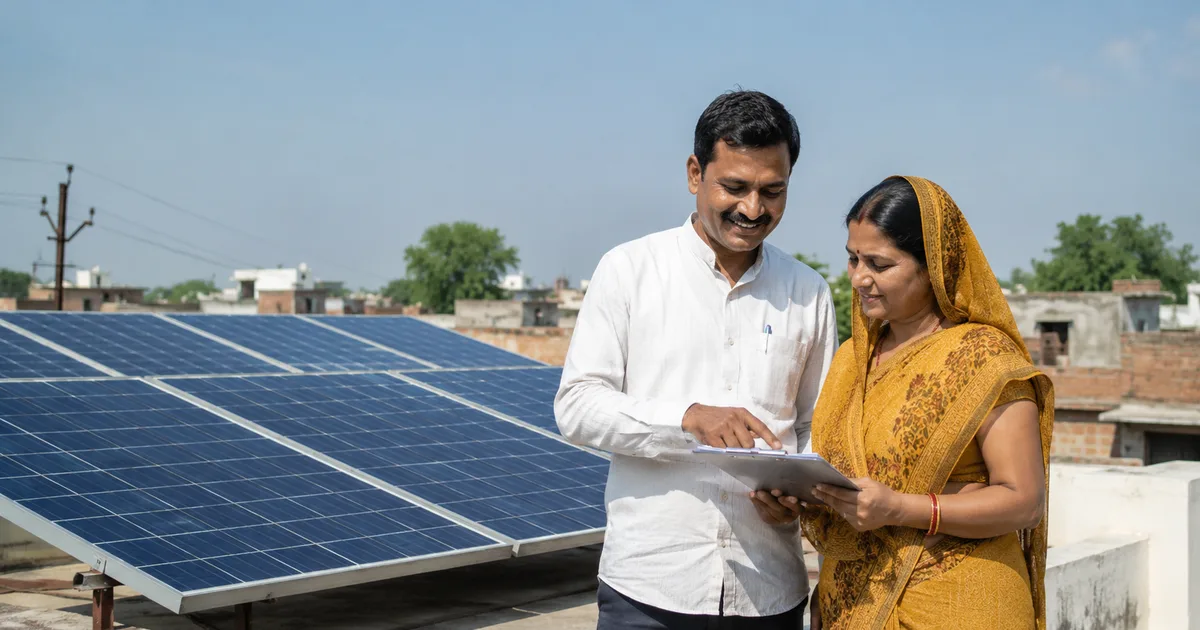
The electricity bill arrives. You look at it. ₹2,400 this month, maybe ₹2,800 next month when summer hits hard. You've thought about solar panels before, but the upfront cost always felt like too much. That's exactly the problem PM Surya Ghar Muft Bijli Yojana is trying to solve.
The central government launched it in February 2024. The scheme gives Indian households subsidies of up to ₹78,000 and the potential to generate up to 300 units of free electricity per month. By May 2026, over 26 lakh homes across India have enrolled, with a total installed capacity of 9.56 GW. That's not a small pilot anymore. And the Union Budget 2026-27 put ₹22,000 crore specifically toward this scheme, which tells you the government is serious about scaling it up.
What the scheme actually does
The basic idea: the government pays a chunk of your solar panel installation cost through a subsidy, and once the panels are up, your electricity bills drop enough that the remaining cost pays for itself over time.
The "300 units free" part needs some unpacking, though. You're not getting 300 units handed to you. What actually happens is your rooftop solar system generates electricity, and whatever it generates offsets what you'd normally pull from the grid. If you generate more than you use, the excess goes back to the grid and your DISCOM (distribution company) credits you for it. So the net effect, for a household with a properly sized system, is that your monthly bill can hit zero.
A 1 kW system typically generates around 90-130 units per month depending on your location and how much sun your roof gets. A 3 kW system covers 300 units or more without any trouble. I think the subsidy structure is designed quite deliberately to make that 3 kW size financially accessible for most homeowners.
How much subsidy do you actually get under PM Surya Ghar?
This is where a lot of people get confused. The central government subsidy works on a sliding scale by system size:
- 1 kW system: ₹30,000 subsidy
- 2 kW system: ₹60,000 subsidy
- 3 kW system: ₹78,000 subsidy (this is the residential maximum)
- Above 3 kW: subsidy stays capped at ₹78,000
A typical 3 kW rooftop installation in India costs ₹1.5 lakh to ₹2 lakh depending on the panel brand and your state. With ₹78,000 knocked off, you're looking at ₹70,000 to ₹1.2 lakh out of pocket. That's still real money. But several banks, including SBI, offer collateral-free loans under this scheme at subsidised interest rates, so you don't need the full amount ready before you start.
Some states also stack extra subsidies on top of the central amount. Rajasthan and Gujarat have state-level top-ups worth checking out (a few other states do too, though the figures change). Your state government's energy or DISCOM portal will have whatever is current.
Who can apply and who should think twice
The scheme is for residential households. You need a residential electricity connection in your name and, ideally, you own the home. If you're a tenant, it gets complicated fast because the subsidy and net metering agreement go to whoever holds the electricity connection, which is usually the landlord. (Annoying, I know.)
Key eligibility requirements:
- Indian resident with a residential electricity consumer number
- Rooftop must be structurally sound and unshaded for most of the day
- Your DISCOM must be enrolled under the scheme (most are now)
- One subsidy per household connection
- Aadhaar authentication is now mandatory (MNRE made this compulsory for subsidy disbursal in 2025-26)
That Aadhaar requirement is worth paying attention to. Your Aadhaar needs to be linked to your bank account for the subsidy to transfer via Direct Benefit Transfer. If you're not sure whether yours is linked, check at your bank branch or through the UIDAI website before you start the application. Honestly, this is one of the most common reasons subsidy disbursal gets delayed for people who'd otherwise qualify without any issues.
How to apply online in 2026, step by step
The official portal is pmsuryaghar.gov.in. The process has improved a lot since the scheme launched, and it's not as complicated as nine steps on paper makes it sound.
- Register at pmsuryaghar.gov.in with your mobile number and select your state
- Enter your electricity consumer number and DISCOM name
- Fill in the application form and submit it
- Your DISCOM does a feasibility check and approves your application (can take days to a few weeks)
- Select a registered vendor from the approved list on the portal
- Get the system installed (takes one to two days for a standard 3 kW system)
- Apply for net metering (your DISCOM then installs a bidirectional meter to measure what you export back to the grid)
- After the net meter is installed, submit your bank account details and installation photos on the portal
- Subsidy is credited directly to your bank account via DBT
One thing people consistently don't realise: the subsidy comes after installation. You pay first, then get reimbursed. Budget for this or arrange financing before you sign anything with a vendor. Finding out mid-process that you need to front ₹1.5 lakh isn't a pleasant surprise.
The real-world picture: where the scheme is working and where it isn't
The 26 lakh number is real. Uttar Pradesh currently ranks second nationally in rooftop solar installations under this scheme, according to UPNEDA (Uttar Pradesh New and Renewable Energy Development Agency), with the state government actively pushing enrollment. These aren't numbers you get from a scheme sitting quietly on a government portal.
Maharashtra is more complicated. In early 2026, there were allegations that MSEDCL was putting informal capacity restrictions on new PM Surya Ghar installations. MSEDCL denied this publicly and the situation seems to have stabilised. But it's a reminder that your experience can vary a lot depending on which DISCOM you're dealing with.
Karnataka is its own case entirely. The state's Gruha Jyothi scheme already gives households up to 200 units of free electricity per month without any upfront investment on the resident's part. According to KRESMA (Karnataka Renewable Energy Service Master Association), this has noticeably cut into the financial incentive for Karnataka residents to bother with rooftop solar under PM Surya Ghar. If you're in Karnataka, run your own numbers on whether the scheme makes financial sense for your consumption level before applying.
And then there's the equity problem nobody talks about enough. A 2025 review by the Centre for Financial Accountability found that the scheme has largely not reached lower-income households. Basically, you have to pay first and claim later. For a family earning ₹18,000-25,000 a month, even ₹70,000 post-subsidy is a stretch, and not everyone can access or wants a bank loan. That doesn't mean the scheme is bad. But be honest about who it currently serves. The 26 lakh number is weighted heavily toward middle-class homeowners who already have some capital or credit access.
Before you start the application: practical checks
Check your monthly electricity consumption from your last 12 bills and average it. Under 100 units a month? A 1 kW system is enough. 150-200 units? Go for 2 kW. 250 units or more? A 3 kW system is what you need to get close to zero billing.
Check your roof too. If it's heavily shaded by trees or neighbouring buildings for most of the day, the system won't generate enough to justify the investment regardless of the subsidy. Get a free site assessment from a registered vendor before committing to anything.
Only use vendors registered on pmsuryaghar.gov.in. There are plenty of private installers who'll promise you subsidies but aren't registered with the scheme, which means you won't get the government money. This is also where scams come in. If anyone contacts you via WhatsApp or asks for a "registration fee" to access PM Surya Ghar benefits, that's a scam. Our scams section has detailed breakdowns of how these fake government scheme scams work and how to spot them early.
For more on how Aadhaar-linked DBT payments work and how net metering is structured, our step-by-step guides cover both in plain language. And for the latest state-wise enrollment numbers and policy updates on this scheme, check our news section.
The ₹78,000 subsidy is real. The payback period on a 3 kW system is typically 4-6 years after the subsidy, though the numbers can shift depending on your state's electricity tariff and your roof's sun exposure. After that, you're generating free electricity for the remaining 20-plus years the panels will last. Your bill drops to zero or near-zero. For homeowners who qualify and have the capital or credit access, this is one of the more solid central government schemes worth acting on right now.